(Solution) Leoron 5HR03 Reward for Performance and Contribution
Solution
Table of Contents
1.1 Principles of rewards and importance. 2
1.2 Contribution of extrinsic and intrinsic rewards. 3
Supporting Eco-Insulate Performance. 4
2.1 Grade and pay structures differences. 5
2.2 Contingent rewards impact 6
2.3 Different types of benefits. 8
2.4 Merits of recognition schemes. 9
3.1 Business context of reward environment 10
Overview of PESTLE Factors. 10
3.2 Benchmarking data gathering and measuring. 12
3.3 Approaches to job evaluation. 13
Formal Strategy of Job Evaluation. 13
Informal Strategy for Job Evaluation. 14
3.4 Legislative requirements impacting rewards practice. 14
Impact to the Eco-Insulate Reward Practice. 15
Report Answers
1.1 Principles of rewards and importance
In modern organisations, the principles of reward include;
Fairness– In CIPD (2021) definition, this principle evidence a phenomenon where issued rewards are informed by their input and capacity. In Eco-Insulate case, they do not issue well-planned reward strategy informing need to work on avoiding feel of unfairly treating others and inequal rewards. The case organisation initiating fairness in rewards would enhance trust-based relations hence high-level commitment and engagement.
Transparency– By being transparent means outright on how rewards are issued enhancing confident teams with a positive input to being confident and open-based culture. According to CIPD (2024), mistrust issues are often challenging owing to Eco-Insulate preference to the senior employees. For reviewing their recruitment process, it is essential ensuring explicitly detailing rewards issuance.
Equity– This is a principle which detail need for fair compensation of employees guided by how skilled, experienced and having an input. According to CIPD (2020), the existing systems in Eco-Insulate precipitate inequalities particularly for senior employee’s reward schemes.
Organisation Culture
For appropriately shaping Eco-Insulate organisation culture, rewards provision needs to be fair, transparent and embracing equity. The lack of embrace of identified incentives lead to a negative workplace culture with disengaged and demoralised employees.
By rewards being transparent, Hounsell (2024) identify this as eliminating feeling of misunderstanding as entire contents are elaborate to the employees with a feel their input to their organisation is recognised and appreciated.
For equity, this enhance relevant feeling that the rewards scope beyond only just. This is with the advancement of the rewards guided by what the employees contribute to the organisation and not favouritism.
Conversely, failure-thereof of integrating noted principles to rewards lead to being dissatisfied hence disengaged with a culture of lack of willingness to take part in discretionary workplace behaviour eliminated. The capacity for integrating appropriately principles rewards enhance positivity and collaboration workplace aligning employee’s motivation with organisation goals eventually enhancing satisfaction scope.
Performance Management
By rewards embracing transparencies and fairness this has positively influenced on enhancing motivated with highly engaged teams. This is with performance management enhanced.
For Eco-Insulate organisation, the inexistence of fair and transparent rewards has been contributing to the issues of performance in their sector. There could be a turnaround by ensuring fair and transparent rewards are issued. Through a holistic equity, employees are assured that they are paid on basis of their input hence mitigating resenting and disengaged staff. According to Mirza (2024), lack of clear definition of the rewards and inequal application, disengagement results lowering performance and lack will for embracing feedback issued.
1.2 Contribution of extrinsic and intrinsic rewards
Extrinsic Rewards
This can be identified to be the tangible gains granted to staff for performance motivation and appropriateness of their behavioural tendencies (CIPD, 2019). Examples are rewards are pay, bonus, promotion, pension and fully rewards time off-work paid entirety.
The employees contribution is established through extrinsic rewards particularly workplace security and recognised essential for staff motivation for achieving/exceeding their productivity goals.
In Eco-Insulate, considering the production department, bonuses introduction could be motivating to staff for improving their performance with zero compromise of quality levels. Further, offering appropriate benefits packages to the employees such as healthcare cover and leave from workplace enhance satisfaction with turnover mitigated. According to AIHR (2024), an appropriately structured rewards enhance how they are motivated, dissatisfied and turnover mitigated. Besides, the financial rewards independently lack capacity of sustainable engagement but only short-term hence necessity for integrating intrinsic aspects.
Intrinsic Rewards
This identify the internal factors of employees motivation sourced from being internally satisfied and individualised fulfilling. The examples are identified in Cottin (2020) to entail recognition approaches, autonomy in workplace and individual development. All these categories are core as they increase engagement levels through offering sense of belongingness and having achieved.
With employees granted with a feeling of high-level and professional development, opportunities for effective contribution is enhanced appropriately. A case instance is Eco-Insulate initiating well-structured recognition strategy for their staff including “top performing staff; “Employee of the year” for appreciating those who perform exemplary.
Also, Eco-Insulate could boost morale of staff, enhance their creativity and reduce turnover issues by initiating non-monetary rewards. Examples of this according to Indeed (2022) is appropriateness of job designs, mentoring sessions and career development all boosting how committed they are.
Supporting Eco-Insulate Performance
Taking into account of Eco-Insulate expectation of performing sustainably, the employees must readily be advanced with extrinsic and intrinsic ways of rewarding. As highlighted by CIPD (2025), the rationale of this is that the extrinsic rewards including attractive rewards and performance-driven bonus pay directly influence how motivated and turnover mitigated upon addressing their issues.
Put differently, intrinsic rewards entail issues of recognising and career development for substantial engagement in assigned functions.
Taking into account of Eco-Insulate, there has been cases of negativity in their organisation culture with retention hindered. For enhancing workplace commitment, intrinsic rewards are essential.
Further, by issuance of formally recognised workforce or development opportunities advanced, this enhance loyal employees and discretionary behaviours practice. With extrinsic rewards guiding attraction of highly qualified organisation talents, intrinsic rewards enhance motivation of workforce, innovativeness and commitment in their practice. Hence, performance is boosted with engagement of employees well organised particularly aligned with staff demands.
2.1 Grade and pay structures differences
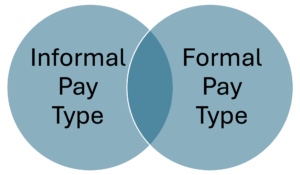
Formal Pay Type
Broad-Banded Reward Structure– This is detailed as using various reward grades to less, broad band hence flexible for rewards increment. In Eco-Insulate context, this would be relevant for supporting various functions, allowing internally pursued career development and eliminating need for frequent regarding.
Broad bands facilitate management with an opportunity for rewarding best performing employees with limited prioritisation on rigidity in classifying functions. According to Tapi (2024), the structure similarly assists to achieve talents development by employees being granted with an opportunity of transitioning in different bands with no need for being promoted.
Nevertheless, elaborate guidelines are essential for managing reward differences in a broader band in a manner mitigating inconsistent and potential unfair favouring certain levels.
Another negative is that it lead to dissatisfaction owing to reward compression challenges apart from a situation rewards changes regulations is strict.
Informal Pay Type
Spot-Rate Pay Structure– This entail fixing the rewards towards particular job functions/levels. It does not encourage pay progress or increase gradually by adjustments. In Eco-Insulate context, the strategy is relevant for guiding production department employees to align rewards with other departments including packaging, manufacturing and operations.
For strengths, the structure is direct, transparency and easily administered hence lowering payroll complexities. Informed by their functions in workplace, employees are commensurately rewarded with how they perform. This is with their predictability high hence easily controlling incurred costings and operation efficiencies.
For negatives, inadequacy of flexibility in nature and failing in promoting sustainability on how they are committed or progressing therefore turnover managed.
Differences
Comparing broad banded structure with spot rates pay structures, they are distinct. This is with broad band in Eco-Insulate freely developed in regard to skills and shifting in varying rewards bands, highly engaged and retained. According to Weeks (2024), spot rates rewards is easier managing and controls in regard to costs factors.
Another difference is that spot rates are uniform with demotivation evident as they lack acknowledgement of input of different people. The broad bands rewards governance core to avoid inconsistencies while spot rates management is easy and how administered.
Finally, an immense admin complexity with broad-band structure characterised by line management functions leading to bands fairness. According to Binder (2024), spot rates could easily be predicted despite lacking incentivisation. The broad band structure is highly successful to enhance sustainable engagement by Eco-Insulate organisation with spot rates relevant for employees joining the organisation or those functions demanding simplified rewards.
2.2 Contingent rewards impact
Contingent Rewards– Adopting Lingberg (2022) definition, this is performance
Please click the following icon to access this assessment in full