(Solution) CIPD Level 5 5C002 New Evidence-Based Practice
Solution
Table of Contents
1.1 Concept of evidence-based practice; decision-making in absence management and equal pay. 2
1.2 Ansoff and McKinsey’s 7s Models. 3
1.3 Critical thinking tools of questioning and checking validity. 4
Pay data to inform Own Ideas. 4
Pay Data to Inform Other’s Idea. 5
1.3 Action learning approaches and problem-outcome framework. 5
1.4 Theory of deontology and equality. 7
3.1 Organisation use cash flow as financial measure and service level agreements. 8
3.2 Measure impact and value of people practice. 9
Report Part Two: Data Analysis and Review.. 10
2.1 Analytical data using appropriate analysis tools and methods. 10
Recruitment Costs for Each Year 10
Turnover for each department every year. 10
Departments having the higest trend. 11
Turnover per year as a percentage. 11
2.2 Key findings for stakeholders from people practice activities and initiatives. 11
Report: Part One
1.1 Concept of evidence-based practice; decision-making in absence management and equal pay
Evidence-Based Practice– Abbreviated as EBP, this entail making decisions guided by most appropriate existing evidence, research integrated, data of organisations, professional expertise and stakeholder’s input. This definition by Stuart (2023) identify use of EBP as enhancing objectivity, eliminate biasness and appropriate outcomes attained.
Rational Model– This is an example of an EBP which entail appropriate structure and logic sequencing, issues identification, data collection, alternatives evaluated and best decisions selected. The outcome of this is eliminating uncertainties and underpinning strategic practice.
Critical Thinking– This similarly represent a major EBP approach where analysis of data is done in an objective manner, questions posed against assumptions. According to Young (2024), this is while ensuring evaluation of evidence prior concluding.
In summary, the identified EBP approaches assists in improving people practice professionals making of decisions, support initiatives hence fairness and effectiveness in people practices in alignment with organisation goals.
Absence Management– The effectiveness of absence management is evident in an event making of decisions is guided by data hence lowering rates of absenteeism and improving performance of employees.
For example, using the rational model, people professionals analyse records of attendees, highlight absenteeism trends and analyse impact of input including flexible working plan and total rewards on these patterns. According to Vulpen (2025), the outcome of this is people practice professionals establishing an evidence-based policy managing absenteeism levels contrary to only working on assumption, embracing absenteeism data and benchmark process contrary to industrial standards/levels in place.
Also, the use of evidence-based decision making enhance critical thinking. This is since an opportunity to question if the absenteesm rates are enormous owing to cultural trends in organisations, dissatisfied in their roles or external environment issues.
By prioritising on varying contexts of employees feedback, reports on medication and legal demands, people practice professionals are in a position of fairly and transparently formulating varying policies. According to Chojnacki (2023), this lead to offering an assurance that their input guide achievement of an entity needs and wellbeing enhance employee’s engagement, reduce absenteeism costs incurred.
Equal Pay– By using the approaches, the process is informed by data to analyse and make decisions strategically in identifying and resolving pay inequalities.
using rationale model, it is possible for people practice professionals in embracing systematically approaches to evaluate reward structures. This is by implementing salaries auditing, evaluating job roles and industrial benchmarking.
The strategy facilitates decisions on rewards defined with objectivity criterion and eliminating risks associated with unconsciousness in being biased and discriminated. This is supported with use of critical thinking through noting whether the reward gaps are as a result of systematic inequalities, how jobs are designed or productivity differences. Hence, Symonds and Pham-Ada (2024) identify the process as leading to people practice professionals identifying and developing fair rewards informed by evaluation of promotion opportunity, rewards progress criterion and gender-guided operations and distinction of ethics.
Integrating all the identified areas enhance ability of an organisation to adhere on equal pay policies/legislation and initiate equity in working, enhanced trust amongst employees and retention levels.
1.2 Ansoff and McKinsey’s 7s Models
Ansoff Matrix– This is defined in Peterdy (2023) as strategic tool for assisting an entity in appreciating available growth chances. This is in categories of market penetration, products development, market development and diversification.
The application of the model assists in systematically working on assessment and likely value initiated with provision of new services. The relevance of the matrix is to diagnose organisation issues such as noting if internal capabilities are in alignment with selected approach.
An example is where an organisation venture to new market, regulation issues are encountered or lack of popularity for the brand. Further, according to Indeed (2024), for opportunities, matrix assists to establish opportunities for innovativeness and expanding.
By embrace of customer-based data and the R&D approaches, services are clearly differentiated in an entity prioritising on product development.
The use of Ansoff Matrix assists organisations in coming up with evidence-based decision making in areas of expanding aligned with marketplace factors, competitiveness and capabilities. This end up assisting a strategic plan and mitigating risks linked with newer services.
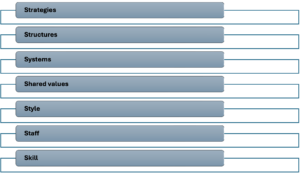
McKinsey’s 7s Model– This is a tool providing a broad image of an analysis in an entity through an evaluation of factors of;
- Strategies
- Structures
- Systems
- Shared values
- Style
- Staff
- Skill
Structures
Systems
Shared values
Style
Staff
Skill
This definition in Jurevicius et al. (2023) imply the model as relevant to diagnose how an organisation is internally aligned in their departments.
To diagnose organisation challenges, using the model guide to identify whether the service provision is compliant with vision and market position. This is relevant as inefficient implementation can lead to misaligned strategies and structures.
Additionally, the relevance of the model is evaluating systems. According to CFI (2023), this is meant for ensuring the service alignment with technologies and workflows.
A set of major challenges/limitations entail change resistance, skills mismatch and cultural challenges. For instance, an internal push could be noticeable in the services introduction when employees lack essential skills or appropriateness of leadership strategy in organisation non-adaptive.
An active mitigation of the resistance is informed on ability of ensuring shared values are fostering innovativeness and adaptability. Regarding opportunities, a match of the different elements promotes how services are embraced hence easier in operations and competitiveness in sector. People practice professionals’ roles including employees upskill and initiating a good culture guide transitioning at ease.
1.3 Critical thinking tools of questioning and checking validity
Pay data to inform Own Ideas
By using critical thinking in review of reward data in an entity for supporting my own ideas, this guide how they question, analyse sources validity and evidences. This is for enabling validity, fairness and accuracy and grounded on conclusions.
In my own ideas, using validity assists in ensuring accurate information through cross-checking the internal pay report contrary to external benchmark. According to Howlett and Coburn (2019), this is by leveraging on pay data from government, compensations survey with evaluation pursued in establishing completeness, reliability and freedom from biasness for the data.
For example, when I encounter pay auditing, I noted approximately 20% gender pay gap in existence. I tool substantial time in critically evaluate if this is since the various levels of experience and qualified or basically informed by unjust distinction.
The pay gaps analysis is through a review of job analysis procedure, performance appraisals and policies for promotion and analysis of objectivity/systematic biasness of the final results.
A verification of the data sources similarly is validating to the up-to-date nature of the data, representing all players and collection by use of appropriate approaches. According to CIPD (2016), by elimination of any form of making decisions is based on facts. I can hence initiate a well-reasoned approach and identifying equity scope of the pay structures.
Pay Data to Inform Other’s Idea
In process of review of pay data in an organisation to inform other people ideas, I would begin with noting the critical thinking tools which are appropriate. This is by actively working on posing questions, evaluating how sources are valid and evidences for ensuring the decisions they make is anchored on right and zero-biased data.
The ability to question gives me an opportunity of challenging any inconsistency and work on verifying compared rewards with priority being experiences in workplace and performance. According to Doyle (2024), working on the validity use cross-checking for many data sources. These include the external industrial benchmarking and internally existing progress on pay report for evaluating their accuracies.
For instance, when senior employees have issues on pay gaps in the various teams, I can work on verifying their worries on whether objective aspects including needs in the market of specific skills or likely inequality in rewards.
For mitigating any form of misinterpreted data and enabling decision making informed by data, the process is followed. Further, prioritising on Equality Act 2010, this assists in compliance with fair reward policy. According to Gosner (2024), this is since it guides an appropriately defined and evidence-based analysis process.
Hence, I end up being well placed in explaining rewards structure targeting top ranked leaders hence enhance transparent systems and implement essential reward adjustment.
1.3 Action learning approaches and problem-outcome framework
Action Learning
I would use the action learning model in enhancing active decision making in my organisation. This is by initiating well structured team-based problem solving strategies which integrate learning with prompt solving of problems.
According to Indeed (2022), the rationale of using action learning is to engage a team of employees collaboratively in problems analysis. Also, it guides a reflection on potential outcomes and pursue actions for solving these issues. This is with a progressive learning from experiences.
For example, when there has been reports of increased turnover in an entity, using the action learning would identify root cause. This is by giving references and noting likely trends in exit interviews insights/data and attempt to identify specific retention initiatives. A refinement of entire solutions would be possible by reflecting how they question, issue feedbacks and interact in solving the problems which are encountered.
Additionally, by embracing the approach, decisions are anchored on evidences, integrate many point of views and alignment with an organisation objectives. An integration of continuous-based learning process as part of making decisions lead to action learning improving how problems are solved successfully, encouraging innovativeness and ensuring sustainable organisation success.
According to Saha (2023), these approaches lead to decision making not anchored on theory but practice, verification evident hence reducing potential risks. This is with a high likelihood evident to sustain their implications.
Problem-Outcome Framework
In an entity context, I can use this framework in the form of a well structured strategy to make decision. This is by appreciating all issues/challenges, define expected/desired results and formulate evidence-based outcomes.
To start, I would specify the evident problem clearly with entire stakeholders given an opportunity of understanding scope and problem impact. According to Karami (2023), when performance has declined, the beginning would be diagnosing where the problem is coming from by sourcing data quantitatively and qualitatively. These include performance trends, feedback from staff and inefficient workflows.
After an elaborate definition of the problem, what follows is setting attainable and measurable results. Finally, using this framework, it entails assessment and selection of most fitting intervention which can attain objectivity. The examples of objective practice is changes in teams function flow, initiating training initiatives and incorporate new technologies.
A continuous-based monitoring and assess of decisions are pursued in the entire process in a manner the decisions have consistency with organisation objectives. This strategy facilitate well-structured making od decisions, data-based and outcome oriented. According to Cantero (2022), this has a positive implication of reducing risks of prioritising on prompt decision.
1.4 Theory of deontology and equality
Deontology Theory
The basic assumption of this theory is that duties, rules/regulations and morality in……
Please click the following icon to access this assessment in full
Related to:https://rankedprofessionals.com/downloads/solution-cipd-5c002-cipd_5co02_25_01/