(Solution) New CIPD Level 7 7HR03 Strategic Reward Management
Solution
Question 1 (1.4) (Words Count: 1,096 Words)
Saudi Aramco Reward Strategy
Saudi Aramco is an organisation the learner has knowledge about operating in the Saudi Arabia (KSA) oil and gas sector. In their operations in oil and gas sector both onshore and offshore, they offer competitive pay, performance-based rewards and total rewards (Aramco, 2024). The rationale of this reward strategy is informed by Noorazem et al. (2021) which note it as inclusive of fixed rewards with different bonuses for guaranteeing alignment of organisation objectives with offered rewards. Apart from this, Saudi Aramco employees are provided with allowances, travelling benefits and capacity development.
Further, in line with Manjenje and Muhanga (2023), Saudi Aramco non-tangible/non-financial rewards entail recognition, remote/flexible working plan and health and wellbeing of staff. The intention of the strategy is improving motivation levels, commitment and engagement in their roles. The authors identify these rewards as having direct correlation with reward approach used by an entity. Specifically, through the total rewards employees feels considered in all facets therefore improved performance. According to Werner and Balkin (2021), the employees assume a feel of appreciation and recognition by their management.
Evaluation of Effectiveness
Positives
A set of Key Performance Indicators (KPI’s) evidence effectiveness of Saudi Aramco reward strategy. These include;
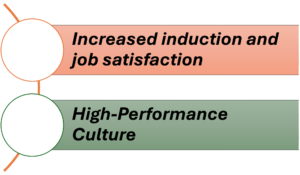
Increased induction and job satisfaction– In Gunawan et al. (2024) research, there is a direct correlation of the identified Saudi Aramco reward strategy with turnover reduction and increased satisfaction in their functions. In Oil and Gas industry where the organisation operates with upto 60% of qualified talents gap, total rewards enhance their retention. According to Uzair and Mehmood (2021) issuance of financial rewards to the employees including bonus pay is associated with increased motivation particularly in technical job roles in onshore and offshore operations. With technical employees operating in different subsidiaries owned by Saudi Aramco, travel bonuses are essential for retention of their employees as they are found accessing best perks often lacking in other sectors. Further, according to Gunawan et al. (2024), the issued rewards lower the absenteeism rates, engagement increased and entire performance levels.
High-Performance Culture– By offering employees with total rewards, Virgiawan et al. (2021) identify this to contribute to development of a high-performance culture. This is characterised with employees putting optimum efforts to achieve their organisation objectives. In Saudi Aramco, Aramco (2024) report evidence their more than 70,000 employees have contributed to more than $300 billion in terms of revenues. These statistics are directly linked with the employee’s recognition through rewards. Further, according to Annas et al. (2024), high-performance culture is also manifested by increased sense of belonging. This is since the identified rewards ensure Saudi Aramco employees maintains their loyalty to the organisation. The employees hence have the will of staying in the organisation for a longer timeline.
Also, by providing remote/flexible working strategies to employees, Saudi Aramco organisation increase overall job satisfaction (Miller, 2023). This is the case in Saudi Aramco where Aramco (2024) report identify as having 60% of Generation Y and Z and Millennials as part of their workforce.
Negatives
For Saudi Aramco reward strategy, it is characterised by a set of drawbacks/limitations. These are barriers for successful adoption and implementation.
Failure to prioritise on increased costs of living– As evidenced in Akanda et al. (2021), the Saudi Aramco reward strategy is insensitive. A report published in Argaam (2025) identify KSA economy inflation as having increased in 2024 upto 1.7%. This is with the Cost-of-Living Index being 111.30 points in 2024 as opposed to 109.45 in 2023. The reward strategy does not prioritise on these factors hence leading to dissatisfaction and potential turnover.
Unhealthy Pressure amongst workforce– According to Jensen et al. (2022), issuance of performance-based rewards has a positive correlation with the employees’ pressure to go beyond their capability. This is the case in Saudi Aramco since their reward strategy is defined with rigidity on what attracts rewards. The outcome of this is what Issa et al. (2024) identify as surge in stresses, burnout cases and reduced satisfaction in workplace. All these negatively impact on performance and retention capacity.
Lacking Flexibility– The Saudi Aramco rewards are noted to lack the essential flexibility for effectiveness in achieving the organisation objectives. According to Victor and Hoole (2021), this is a phenomenon where there is no fairness and equality in issuance of rewards. The lack of opportunity for customised rewards has a negative implication in achieving individual goals hence inappropriate nature of the reward strategy. Additionally, according to Fan and Henager (2022), lacking structured financial wellbeing initiative such as care for children and housing lead to vulnerability economically which lower satisfaction and commitment levels.
Recommendations for increasing Attraction and Retention
Recommendation 1: Flexibility in reward Strategy
For Saudi Aramco increased attractiveness for likely employers, flexible rewards would need to be initiated as part of their strategy. The rationale of this strategy is individualising the rewards financially and lifestyle factors. For instance, in line with Poór et al. (2022) recommendation, a cafeteria style benefit plan would be implemented. This entails base pay, travel package and pension contribution managed. The rationale of the customisation is improving satisfaction by aligned rewards with employees’ goals.
Further, regular adjustment is essential to align with changing macro and micro-economic factors. Saudi Aramco could ensure their reward strategies are competitive in oil and gas industry in KSA and Middle East, hence mitigating any attrition. According to Lusardi and Messy (2023), through financial wellbeing including pay increase and low interest loans, these assists in mitigation of financial stressors amidst economy slow-down. A highly inclusive recognition strategy appreciating input in entire departments assists to boost engagement in non-financial rewards. According to Poór et al. (2022), for Saudi Aramco, the flexible rewards facilitate maximising retention for staff as they feel recognised and support advanced monetary and non-monetary.
Recommendation: Strengthening Career Growth and Work-Life balance
This is an essential improvement as it would attract highly qualified employees from internal mobility initiatives, coaching/mentoring sessions and leadership and management development. As evidenced in Fan and Henager (2022), initiation of well-structured talent strategy for future staff is a significant investment for increased loyalty and commitment therefore reduced turnover.
For Saudi Aramco, customised L&D strategies, blended L&D programs, certification in industry enhance retention scope. Also, Victor and Hoole (2021) identify flexible rewards and leave benefits ought to be recommended for enhanced work-life balance. This is for technical departments where they are remote and rotation shift preference by the employees. Through an effective work-life balance and capacity development, Lusardi and Messy (2023) identify improved loyalty and engagement. This imply attracting highly qualified employees and at the same time ensuring employer brand is developed in the organisation successfully.
Question 2 (2.4)….
Please click the following icon to access this project in full
Related to: https://rankedprofessionals.com/downloads/solution-cipd-level-7-7hr03-reward-strategy-of-an-organisation/