(Solution) New CIPD Level 7 7C001 Work and Working Lives in a Changing Business Environment
Solution
Question 1- 1,025 Words
The Trend Towards Greater Globalisation of International Business Activity
Globalisation arise from developments in technology, trade liberalisations and economic capital flows that have a great impact on international business activity (Harahap et al., 2023). The global trade has witnessed substantial expansion in recent times which has led to the growing economic dependencies between countries. This interconnectedness enables multinational corporations to integrate production and market expansion initiatives which leads to both efficiency improvements and growth opportunities, according to Beisenbayeva et al (2024). This is supported by CIPD (2024) identifying the multinational organisations as transitioning towards an increased integration. This is in regard to organising themselves internationally, motivation through the presented potential of exploiting cross-national differences in business practices. The success in global integration transition past organisation development practitioners.
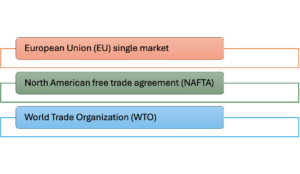
Technological advancements particularly in communication and transportation serves as one of the core factors driving globalisation (Singh et al., 2024). Song et al. (2017) demonstrate how internet and digitalisation technologies enable firms to start international businesses easily which has enabled simpler supply chain integration and remote work capabilities. The logistical advantage created by containerisation and air freight has made international procurement and worldwide distribution of finished products more affordable for firms (Wei, 2018). Trade liberalisation, together with economic policy frameworks have served as accelerators for global developments. Perraton (2019) explains how agreements such as the European Union (EU) single market, North American free trade agreement (NAFTA), and the World Trade Organization (WTO) support cross border trade and investments, reducing tariffs and regulatory barriers.
Developing economies including Asian regions have observed a rise in foreign direct investment (FDI) as they participate more actively in global supply chains (Oramah & Dzene, 2019). For succeeding and embracing sustainable change process, upskilling and empowering the globalisation players who could be lacking in the traditional change programs is a challenge.
Moreover, the labour market dynamics have also furthered globalisation (Akcigit et al., 2018). This has resulted in off shoring of manufacturing and services jobs to developing economies because companies require affordable production locations (Meagher, 2018). This has stimulated the economic development in these regions and enabled consumers based in developed economies to have access to goods and services at lower cost. According to Stypińska & Nikander (2018), one of the other main reasons for international business expansion has been financial globalisation. According to the authors, deregulated financial markets provide capital mobility where investors has access to international opportunities and economic growth is spurred. Additionally, according to Ketteni & Kottaridi (2019), advances in the development of global financial institutions and integrated capital markets result in businesses having access to funding across border and hence economic linkages. However, globalisation has difficulties. In his research, Olssen (2020) explains several debates that have arisen as a result of the long-term sustainability concerns that stem from income inequality, environmental degradation, and national security. The vulnerabilities that were exposed in global supply chains during the COVID 19 pandemic have left many companies and governments to question their reliance on overseas production (Yaya et al., 2020). Nevertheless, overall economic prosperity has largely been driven by globalisation, increasing technological exchange and international collaboration.
Whether There Will be Reduced Globalisation in the Future
While globalisation has greatly impacted the international business activity, there is growing evidence that it has reached its peak and there could be a decline in global integration in the future. According to Hassan & Bezbaruah (2020), geopolitical tensions, economic nationalism and supply chain vulnerabilities indicate a potential shift from deglobalisation to regionalisation in several areas. The rise of economic nationalism and protectionism is one of the major reasons that may account for the reduction of globalisation. In an effort to protect domestic industries, governments across the world have imposed tariffs and trade restrictions (Sheldon et al., 2018). This trend is demonstrated in the U.S.-China trade war, as both countries impose policies to limit dependencies on each other. In addition, Brexit marked a shift away from regional integration, a move that has increased scepticism of supranational governance structures. After intense disruptions brought by the COVID 19 pandemic and geopolitical conflicts, supply chain has become a focal point for businesses (Czech & Krakowiak-Drzewiecka, 2019). However, many companies are choosing to reshore or nearshore production, in a bid to reduce the risks of relying too heavily on distant suppliers. As De Burca (2018) explains, this is seen especially in industries like pharmaceutical, semiconductors, and food production where national security concerns force governments to encourage local production.
Globalisation patterns are also affected by technological advancements. Cross border business is now facilitated by digital connectivity, then there is automation and AI that is lessening reliance on low-cost offshore labour (Matyushok et al., 2021). As businesses make strategic investments in advanced manufacturing technologies, they are increasingly becoming less reliant on global supply chains and are looking more to local production. Another factor which helps to decline the globalisation is geopolitical tensions. Ukraine’s ongoing war and strained U.S.-China relations, as well as broader geopolitical instability, are prompting other countries to reexamine their trading relationships, according to Awosusi et al. (2022). The domestic approach to regionalisation trend is further reinforced because governments are more ready to prioritise national security over economic interdependence (Tahir et al., 2020). In response to carbon taxation and environmental regulations, businesses are also minimising long distance transportation and making investments in sustainable production (De Burca, 2018).
However, globalisation will not disappear completely. Baloch et al. (2020) confirm that a more strategic and selective approach to international business activity is expected, rather than complete elimination. These authors believe that, in this case, regional trade agreements, digital trade and sector specific global cooperation will still occur, but more so under strict regulatory scrutiny and more strategic reshoring. Overall, the economic growth has been driven by globalisation, although its course has changed. Geopolitical uncertainty, protectionism, and supply chain restructuring imply that it may have peaked, and businesses and governments strive for a balance between global integration and domestic resiliency. This is ranging from presentation of unified image to customers or interdependencies in specific goods production (CIPD, 2024). The process is inclusive of organisation responsibility to stakeholders, criteria that govern performance and fairness in resources distribution.
Question 5- 1,013 Words
Effects of Technological Developments on Recruitment and Selection in Organisations
Technological developments have fundamentally transformed recruitment and selection into more efficient, data-driven and scalable processes (Ore & Sposato, 2021). Artificial intelligence (AI) and machine learning algorithms are used to screen resumes, match candidates with job descriptions, and predict job performance from historical hiring data. According to Hamza et al. (2021), these tools allow recruiters to quickly handle huge volumes of applications, shortening time-to-hire and improving the accuracy of decisions taken. Additionally, applicant tracking systems (ATS) handle interview scheduling, candidate communications as well as pre-employment assessments to streamline workflows and optimise overall efficiency. Also, digital recruitment platforms, like LinkedIn, Indeed and Glassdoor have expanded recruiters’ exposure to a global talent pool, hence improving the recruiter’s capability to proactively source for talent and engage with passive job seekers (Gilch & Sieweke, 2020).
However, although these benefits exist, technological developments also come with challenges. Woods et al. (2019) argue that if algorithms are trained on unrepresentative datasets, AI-driven hiring systems could perpetuate bias and lead to discriminatory hiring outcomes. Moreover, as more automated means are being used, recruitment tends to become dehumanised, which can lead to disengagement. Furthermore, some of the applicants from non-technical backgrounds or with disabilities may find it difficult to cope with AI-driven assessments or video interview platforms (Hmoud & Várallyai, 2022). Another significant issue is cybersecurity, because recruitment platforms operating in the digital sphere can store huge volumes of sensitive applicant data which is susceptible to breaches. These risks need to be addressed by organisations through implementation of ethical AI, improved cybersecurity, and strategies for maintaining human involvement in the hiring process (Hamza et al., 2021).
Overall, while technology increases efficiency, recruitment and selection effectiveness depends on how technology is integrated into the organisation’s strategic objectives. To provide seamless candidate experience while maximising the hiring outcomes, employers must find the perfect balance between automation and personalisation. According to Hamza et al. (2021), automation is most appropriate to reach out to a broad talent pool in a quick and efficient manner. This is with the building of meaningful connections and understanding of candidates potential achieved best through an effective personalisation strategy.
Reasons for Technological Developments in Recruitment and Selection
Evolving workforce expectations, global competition for talent and efficiency needs of the firm are factors that increase the direct adoption of technology in recruitment. Due to the substantial skill shortages, many organisations opt to leverage AI driven sourcing tools to rapidly identify and attract highly skilled professionals (Hunkenschroer & Luetge, 2022). Based on my previous experience in a multinational firm, I have witnessed the immense impact of an applicant tracking system (ATS) to reduce manual screening processes, making the recruiters spend more time on more valuable strategic hiring decisions. The AI powered chatbots were also crucial in engaging the applicants by answering queries instantly and making the overall candidate experience better and also reducing the administrative burdens on the HR professionals. Technological adoption in recruitment has also accelerated due to changing workforce demographics as well as remote work trends (van Esch et al., 2019). Because millennials and Generation Z candidates expect digital-first interactions, companies have created mobile friendly application processes, video interview platforms, and gamified assessments. Research shows that firms that use AI during assessment report better candidate engagement because technology-based hiring is personalised and interactive (Dawson & Agbozo, 2024). With the increasing adoption of hybrid and remote work models, the need for virtual recruitment tools has grown further, allowing businesses to reach out to global talent without the constraints of physical boundaries.
The growing emphasis on diversity and inclusion in hiring is another key driver of technological advancements in recruitment and selection processes. Many organisations are leveraging the use of AI powered recruitment platform to eliminate unconscious bias in recruitment and to standardise recruitment selection criteria (Kess Momoh et al., 2024). In an effort to make hiring fairer, AI solutions of hiring evaluate candidates not on subjective factors but based on skills and competency. Together, these technologies help integrate companies as they have more flexible talent bases that are broadly diverse and hire fairly, creating an inclusive workplace. Despite these developments, organisations need to adopt advanced approaches on developing AI models and ethical frameworks so as to prevent the development of unintended bias and ensure transparency in the decision-making process (Gould et al., 2020).
Benefits of Technological Developments in Recruitment and Selection for Employers
Technology in recruitment is a useful tool for employers for many reasons such as cost……
Please click the following icon to access this project in full