(Solution) New Brief 7HR02- Resourcing and Talent Management to Sustain Success
Solution
Question 1 (AC1.1)- 1,074 Words
External Factor- Labour Market Skills Shortages
In this question, Aldar Properties a MENA region organisation with operations in Saudi Arabia (KSA). Their operation vision is working within realms of sustainability, modernised designs and green-infrastructure development, sourcing for qualified talents in these areas are instrumental. With the organisation encountering competitiveness in modernised projects implementation, they ought to prioritise on recruiting best talents and local and international competitions for talents (Aldar Properties, 2025). The international competitiveness for sourcing highly qualified talents in the digital project’s implementation, sustainability and digitisation, there is a limited talents and professionals.
Further, according to Ozen (2021), the international talents attraction challenges is largely impacted by issues linked with visa application procedure, challenge to relocate and issues to adapt with culture of host country. Similarly, with Aldar being a UAE native country, they are affected by future, multi-lingual and multi-culture employee’s commitment levels for the organisation being complex affect talent demands. This inform the need to be aligned with immigration policies, being an employer brand and competitive pay structures.
The identified external factor (labour market skills shortages), the candidates intense expectation shifts impact the process. Highly qualified talents opt for organisations giving them flexibility in working (Oliveira & Forte, 2021). Also, with sustainability core mandate in line with Vision 2030 of sustainability (Dargin, 2021), they call for ESG compliance and transparency in advancing their careers which ought to be core in Aldar Properties value-based offerings. Nevertheless, with Aldar Properties investing in different mega-projects and investments such as Jeddah Region in KSA smart cities, the organisation is prompted to prioritise on aggressiveness and dynamism in international recruitment strategies. For handling the challenge, Aldar Properties pursue international awareness strategies and collaboration with higher education institutions and industrial leadership despite of skills shortage persisting.
Apart from a phenomenon identified factors are attained with substantial responses, their projects would be significantly hindered. In line with this, Atin et al. (2024) note the need for specialised and predictive-based “labour-market intelligence model” for detecting challenges with talents at an early phase and initiate strategies for their implementation through initiating sustainable international sourcing strategies and local talents investment.
Internal Factor- Organisational Growth and Structural Complexities
Aldar Properties is going under a continuous and rapid transformation directly impact resourcing and talent management strategy. From initiation, Aldar Properties has expanded from conceptualisation to fully-fledged investment in different sectors including real estate, international-tourism, digitised innovation technologies and energy sector. The significant development lead to consistent need to restructure, initiating new programs and need for transformed roles demanding immense adaptability, and continuously changing workforce needs (Goraya et al.,2024).
Further, there prevail internal pressures for occupying significantly technical-based job functions within short timelines, and different locations of Aldar Properties operations (Riyadh, Jeddah, Al Nakheel Mall and others). This negatively affect the organisation ability of maintaining internal talents and HR planning strategies. Majorly, the workforce planning fail in maintaining organisation needs changes hence the recruitment strategy is reactive as opposed to being strategic. According to Kalt (2022), this impact efficiencies leading to misaligned talent development and skills underutilised.
Similarly, internal-based culture is anchored on innovativeness and prompt implementation of talent demand possessing entrepreneurial view and immensely resilient. However, as identified in Ozen (2021), lacking appropriately established internal career direction/succession planning initiative threaten loosing qualified talents and undermine sustainable capability development. With lack of appropriate alignment with Aldar Properties vision, staff could encounter disengagement from strategic development. Further, culture-based integration and internal onboarding practices need improvement with Aldar Properties progressing with international recruitments. According to Oliveira and Forte (2021), the issues are complex owing to difference in what they expect, communication approaches and leadership strategies leading to delayed teams’ performance and active collaboration.
Hence, there is a necessity for proactively altering Aldar Properties internal strategies for achieving proactiveness in resourcing prioritising on vertical development and horizontal integration of their functions. These could be managed by prioritising on strategic workforce planning with organisations leadership involved in forecast of demand and internalised (Atin et al., 2024). Also, internal mobility would be achieved through integration of learning and development (L&D) systems for capacity development of their human resources for assume newer job roles hence reduced over-reliance with external-based recruitment process.
Recommendations
Labour Market Skills Shortages- Aldar Properties ought to alter their recruitment and selection strategy for its proactiveness in developing talents pipeline contract to having reactive international resourcing. As evidenced in Causa et al. (2025), this entail initiating long-term relations with international higher learning institutions and technical institutes. These relations are intended to initiate personalised graduate and internship initiatives matching different Aldar Properties sectors including sustainability, digitisation and Green Energy operations.
By collaborating with these institutions, they would co-author curriculums content and be exposed early in different projects and work shadowing. As such, Aldar Properties would be promised of access to ready talents prior they complete with their graduation process. This is at the same time improving digitisation for being an employer brand internationally, emphasis on sustainable plan, innovativeness and professional development strategies. According to Thrainer (2024), improving relocation support and initiating flexibility and hybrid working plan based on possibility could guide to attract international-based professionals not favoured by location and cultural issues. An active investment in international talents mapping and predictive-based workforce planning strategies would facilitate Aldar Properties in responsiveness in shifting dynamics of their labour markets in different locations.
Organisational Growth and Structural Complexities- Aldar Properties ought to improve talent development approach through integrating formal workforce planning strategy. This is appropriately integrated with organisation development focus and cross-functional demands. An internal talent plan would be pursued for assisting matching talents required with their different future projects, temporary tasks or stretched functions informed by skills demand and interest areas.
According to Causa et al. (2025), the process identified promote internal-based mobility and reduced recruitment timelines and increased employee’s commitment levels. Also, though an embrace of formalised succession planning and development initiatives for critical job functions, this would assure them of continuous operations upon the organisation expansion.
Further, Aldar Properties could similarly consider pursuing role-oriented onboarding initiatives, leadership development initiatives and culture integration capacity development. This would be customised to the organisation for facilitating newly recruited employees in adapting promptly in different business levels/units in Aldar Properties (Thrainer, 2024).
Finally, developing business partnership in accessing workforce analytics would be essential for being visible in talents management and improving operations. This is between the people practice professionals and operations intended to restructure or launch new opportunities in their business environment.
Question 2 (AC2.4)- 1,091 Words
Improving Effectiveness of Aldar Properties Employee Induction Program
Implementing a Stepwise, Specific-Function Induction Initiative/Program- Aldar Properties ought to pursue implementation of stepwise, specific-function induction strategy. The rationale of this is that today, Aldar Properties induction program content is today standard and front-based overwhelming new recruits and reduced turnover of core data. The steps which would be put into account include;
- Pre-boarding
- Initial orientation
- Long-term role-based collaboration
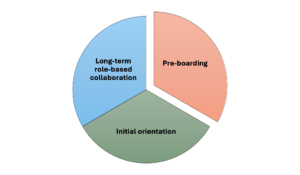
The importance of these stages is allowing staff source data based on their appropriateness. For instance, the new technical staff would encounter complexities in their operations and technologies in second- or third-weeks post-settlement to their organisation.
The content of induction would be customied to different departments in Aldar Properties and job families offering customised experiences, improved engagement scope and lowering the time-to-performance (Reinhard et al., 2024). The stepwise induction process guide to handle the challenges in Aldar Properties while enhancing an easy merger to various areas and division. This aligns with appropriate strategies large-scale based and organisation projects in their business sector requiring rapid integration of their talents to their core job roles requiring direct guide and support strategies (Masenya, 2022).
The main strengths of the strategy include a surge in knowledge-based retention and onboarding challenges. As identified in Wilkhoo (2024), the staff would increase their likelihood of retaining major culture and compliance data in pre-onboarding stage. Later, they would prioritise on team-based roles and techniques in progressive weeks. By having role-specific content-based data, this lead to engineering departments, sustainable-based expertise and accounts teams gaining in custom-based onboarding initiatives, improved performance and reduced time used to start offering optimum service quality (Masenya, 2022).
The drawbacks include immense administration input and immense costs incurred to develop immense onboarding strategies in various departments. The people practice professionals would require a close link with the line management and aligned information, set timeline and delivery structures. According to Patel and Mohanty (2023), an enhanced consistent quality in various departments would be challenging to achieve in the onboarding process. A different limitation is to ensure their line managers capacity development and engagement in delivering their roles for role-specific induction successfully.
Introducing Culture-based integration and mentorship Initiatives– With Aldar Properties working with diversity and international employees, culture-based induction and mentorship initiatives are core leading to sustainable retention and teamwork. Aldar Properties engaging staff from a higher of 100 countries, they would be struggling n understanding their functions and aligning with the organisation relevant culture, leadership demands and interdepartmental relations. It is in this regard that Wilkhoo (2024) recommended need to initiate a well-planned mentorship initiative, match new staff with their experiences for providing progressive peer-based facilitation in their 3 months (90 days of work).
Further, through implementation of cultural immersion workshops integrating values, interactions and work strategies for Aldar Properties multi-culture environment. The identified initiatives would lower social-based isolations, initiate cross-functional network and enhance staff engagement levels. A priority on emotional and culture onboarding is identified in Sani et al. (2023) as relevant in operation functions with Aldar Properties being in a position of enhancing a prompt integration and high-level job satisfaction levels at the end contributing to opportunities increased for commitment in organisation.
The strengths of this include sustainable relations initiated, two-way communication feedback generated and increased commitment. As identified in Liyanage et al. (2025), the mentorship
Please click the following icon to access this project in full