(Solution) CIPD New Brief 5HR01 Public Sector Organisation Merger
Solution
Answer to Questions
1.1 Employees involvement and participation
Definitions
Employees involvement is a practice facilitated by management intended for encouraging employees to present ideas and get feedback This is with eventual decision being for the leaders. In the Merging Public sector for instance, this would enhance employee’s engagement and morale despite of less implication on power for making decisions (CIPD, 2025a).
Employee participation conversely is identified as a process where employees are provided with an elaborate function for making decisions. This is while granting a chance for active participation in decision making formally. In the public sector merging, Taylor and Woodhams (2016) identify the examples including committees, workplace groups and consultative meetings/engagements.
Employee Involvement Example– An appropriate example here is the Staff Suggestion Scheme. This is an initiative where the management grant a chance for employees’ submission of their ideas on improvement areas of their operations and later pursuing a review and implementation based on possibilities.
The process would assist staff impacted by previous changes in merged public sector voicing constructive feedback safely and in a valid platform. The outcome of this is increasing trust levels as employees’ possess a belief their opinions and knowledge are prioritised. According to Young (2024), this is even in an event the leaders are making ultimate decision. The employees possessing a feeling that leadership process is relevant and readily listening would initiate positive workplace relations. Further, involvement strategies in the merging public sector guide in lowering anxious teams in the time of organisation change though facilitating the employees with an opportunity for taking their input with morale supported and continuous practice.
Employees Participation Example– The example for this is the Joint Consultative Committee (JCC). These are made up of staff reps and also the managerial teams. The function of this body is to participate in regular meetings for discussing issues in workplace such as change in policy, employee’s classification change and welfare of staff strategies.
JCC has the capacity of offering employees as part of organisation Merger formally to make decision pertaining to workplace and operation areas. Through making sure issues are put into account at an early phase, transparency, inclusion would assist in strengthening trust-levels and improved teamwork hence lowering likelihood of disputes emergence. According to Price (2023), inclusion of staff in making decisions evidence management being committed to aspects of embracing fair-based relations and sharing roles. This is specifically instrumental in merging process since uncertainties and employee’s apprehension are enormous contributing to positive-based workplace relations with feeling of empowerment and mutual-based respect.
1.2 Union and non-union forms employee’s representation
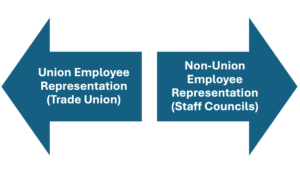
Union Employee Representation (Trade Union)
This represents an independent entity working on behalf of the staff in regard to rewards, workplace environment and policies development. In UK context, trade unions are identified in ACAS (2024) to operate within statutory rights which govern rights for negotiation with employers on-behalf of membership, collective bargaining to represent employees as part of disciplinary/grievances.
For context of the organisation going through the merger, unions for example Unison play an important function of enhancing employees voice and to protect them in workplace. Post Merger, the trade unions would be engaged in assisting evaluating issues raised by staff, conflicts management while promoting fair-based relations when organisations pass through changes.
Non-Union Employee Representation (Staff Councils)
This is made up of employee representatives and management working together with the latter being categorised to be representation of employees in a non-union arrangement. The sole purpose of this is advising about work challenges, encouraging communication and discussing areas of workplace condition, health and safety (H&SE) and also change in organisations.
In some instances, it does not have formally presented bargaining rights popular with employees and leadership. For case of merging organisation/public, implementing the councils of employees offer guidance to ensure their interests are prioritised specifically in times of reduced enrolment to membership and failure of integrating their considerations in collective agreement.
Similarities and Differences
The two (trade unions and staff councils) are an appropriate form of employee representation interested with enhancing voice of employees and fair-based workplace relations. They are effective in granting an opportunity for employees raising concerns and cumulatively enhanced inclusivity in core decisions made.
Similarly, CIPD (2020b) identify both of them as assisting in managing emerging disputes and also promoting active communication amongst the staff and managerial teams.
For differences, how they are structured and powered inform this. For example, the trade unions operate with guidance of collective bargain aided by statutory-based rights with industrial action participation. The staff councils exercise voluntary-based consultations rights without legal rights for negotiations to reach a mutual agreement. Also, the unions operate externally with the membership funding their operations as opposed to the staff councils internally operating with employers supporting their operations.
Also, the staff councils prioritise on managing workplace challenges including employee’s wellbeing and updating organisation operations as opposed to trade unions which are majorly working towards rewards and contracts terms and conditions. Finally, according to CIPD (2025c), with the two-granting support to staff morale, the unions could firmly take part in the negotiations with employee’s councils offering collaborative engagement in case of organisation in public sector involved in merger.
1.3 Relationship of employee voice and organisation performance
Employee voice and performance- Adopting CIPD (2023) definition, this includes a chance granted to staff for raising their input, feedback provision and suggesting points of knowledge on work aspects.
Conversely, organisation performance represents a phenomenon where the organisations gain in their operations, finances/profitability and meeting strategic objectives. The relationship of both factors is anchored on fact that organisations enhancing the employees voice could lead to successful drawing of immense knowledge, operations information and innovativeness. According to CIPD (2024), this significantly contribute to improve decisions making and offering services.
For case of
In the public sector organisation merging, morale would be enhanced, uncertainties mitigated, and sense of inclusion promoted. This is in an event the employees are offered with opportunities for accessing formall and informal opportunities for sharing concerns and making suggestions in process of change.
In CIPD (2022), an active inclusion of employees offers an opportunity for noting the potential risks at an early phase, operation issues managed, and wellbeing of employees enhanced. This also enhanced an on-time and evidence-supported decisions by management teams. This contributed to organisation results and satisfied in their work.
Evaluation of Relationship
A set of advantages/strengths are in place in the relationship of employee voice and organisation performance. The inclusion of employees actively in making of decisions facilitate spotting/identification of inefficiency, initiating strategies for fixing the issues and obtaining an appropriate services provision. These are core in times of organisation change including organisation merging. Further, according to CIPD (2021), misunderstandings are lowered with an opportunity granted for resolving the conflicts and initiating appropriate workplace culture. Besides, likely negatives are evident. The poor management of the employee voice or ignorance of the provided feedback could lead to increased frustrations, distrust and disengagement. Further, enormous consultations could lead to slowing down of process used to make decisions specifically in context of the public sector organisation going through merger. This is owing to existence of bureaucratic tendencies in the process.
Brief Judgement
From the explanation provided, there exist substantial positive relations of employee voice and organisation performance when appropriately managed. Active listening to staff and appreciating their input represent a significant approach for enhancing workplace environment characterised with open-based relations, mutual-based trust and teamwork. This is specifically relevant in times of change such as the organisation involved in the merger process. The rationale of this is that organisations could note operation issues or concerns raised by employees at an early phase prior escalating. In People Insight (2025), this is noted as supporting development of a resilient organisation. The employee voice nevertheless requires appropriate management with elaborate interaction and prompt action for mitigating disengaged teams.
1.4 Better working lives
In ACAS (2020a), better working lives represent a situation of initiating appropriate and meaningful workplace experience for staff past normal rewards issued and jobs security. It represents a process where an environment facilitating employees with feelings of high-level value, support advanced and nurturing them in thriving in their profession and individually. For the new public sector organisation merging, giving priority to better working lives assists in enhancing morale, trust relations and structurally engagement (CIPD, 2018).
Designing Better Working Lives
Pay and Benefits– The provision of
Please click the following icon to access this project in full
Related to: https://rankedprofessionals.com/downloads/solution-cipd-ics-learn-5hr01-cipd_5hr01_25_01/