(Solution) 5CO02 Charlotte and Camellia case Assessment ID / CIPD_5CO02_26_01
Solution
Table of Contents
Q1: AC 1.1 Evidence-Based Practice at Camellia. 2
Q2: AC 1.2 Analysing Issues, Challenges, and Opportunities at Camellia. 3
Analysis Tool: Porters Five Forces. 3
Analysis Method: Interviews. 4
Q3: AC 1.3 Applying Critical Thinking to Support Rational Debate at Camellia. 5
Critical Thinking and its Principles. 5
Q4: AC 1.4 Decision-Making Processes. 6
De Bono’s Six Thinking Hats. 7
Q5: Ethical Perspectives to Inform Decision-Making at Camellia. 7
Q6: AC 3.1 Appraisal of Financial and Non‑Financial Performance Measures at Camellia. 9
Financial Measure: Cash Flow.. 9
Non-financial performance measure: stakeholder benefits and feedback. 9
Q7: AC 3.2 Adding Value through People Practices at Camellia. 10
The way people Practice add value. 10
Techniques to quantify the impacts. 11
Task two – quantitative and qualitative analysis review.. 11
Q9: AC 2.2 Diagramatical Representations of table 1. 13
Q10: Review the feedback in Table 2. 15
Task 1: Report
Q1: AC 1.1 Evidence-Based Practice at Camellia
Evidence Based Practice (EBP) Knowledge.
Evidence-based practice (EBP) is a decision-making strategy that incorporates the most appropriate evidence based on various sources, such as scientific studies, organisational information, professional experience, and the views of the stakeholders (CIPD, 2023).
In contrast to tradition, hierarchy or intuition, EBP encourages critical analysis to enhance the quality and validity of people management decisions. Its advantages are better diagnosis of the problem, less bias, higher organisational performance and more justification of the change initiatives. Nonetheless, difficulties are scarce availability of trustworthy statistics, inability to analyze, time, and inertia of the leaders who trust the old ways of doing things. These issues are especially topical in Camellia, which might be fraught with the inability to collect data and innovate due to paper-based systems and the old leadership style. However, the implementation of EBP may make the People Practice role much more effective.
Example 1: Modernisation of Learning and Development (L&D).
The existing learning and development activities at Camellia seem to be outdated and might not facilitate the skills needed to facilitate the intended expansion. The workforce capability data, the performance outcomes, and employee feedback might be analysed with the help of EBP and the outside research related to the effective methods of training, including blended and experiential learning. This would allow Sue to know the skills gaps and provide specific training that is in line with the business goals. It has been found that the more effective training programmes are, the more evidence-based, strategically aligned, and assessed in terms of impact, the higher the performance and the requirement to break even is achieved (Salas et al., 2012). This evidence would provide the argument to the case of modernising L&D systems to the top officials.
Example 2: Employee Wellbeing and Absence Management.
The second one is absence management. In case Camellia experiences such high levels of absence, EBP may consist of studying internal absence statistics, job descriptions, and conditions under which people work, as well as external research of the causes and interventions. It has been shown that proactive wellbeing programs, supportive management, and data-monitored monitoring decrease the number of absentees and enhance engagement (CIPD, 2021). This strategy would enable Camellia to shift to proactive policies of absence rather than their reactive counterparts which would facilitate stability in the workforce as the organisation expands.
In conclusion: EBP effectiveness at Camellia.
In general, EBP would presumably work well at Camellia since it offers objective and credible support of modernisation of people practices and the enhancement of decision-making. The implementation will entail investment in systems, data capability and cultural change, but the long-term gains are improved organisational performance, better leadership confidence, and improved employee outcomes which override the challenges. EBP would then be useful in enabling Sue to persuade stakeholders and aid in the sustainable organisational growth.
Q2: AC 1.2 Analysing Issues, Challenges, and Opportunities at Camellia
Analysis Tool: Porters Five Forces.
Porters Five Forces is a strategic model to examine the external competitive forces using five factors: competitive rivalry, threat of new entrants, buyer bargaining power, supplier bargaining power, and threat of substitutes (CIPS, 2019). It will be able to assist Camellia in solving problems, problems, and openings associated with the expansion.
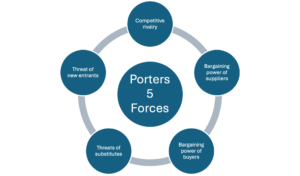
Issues (Legislation): The model developed by Porter is capable of assisting Camellia in comprehending the impact of legislation on the competition. E.g., regulatory compliance costs (e.g. employment law, manufacturing standards) can raise supplier or operations costs, which influence the bargaining power and profitability. The advantage lies in that it will prompt the leaders to view regulatory pressures as being part of the bigger market environment. The limitation is, however, that the model does not give a detailed advice on internal compliance procedures, thus, further tools would be required to diagnose fully legislative problems.
Challenges (New Competitors): The threat of new entrants factor is also specifically applicable in determining threats of new manufacturers with advanced technologies or cheap methods of production. The intensity of competitive rivalry can also be used to point out the increasing market congestion. The advantage of the tool in this case is that it is structured in evaluating the competitive threats (Goyal, 2020). Nevertheless, the model might be simplistic about chaotic markets and depends upon good external information, which Camellia might not have because of poor digital capacity.
Opportunities (Growth): Porters Five Forces has the ability of creating opportunities by examining the buyer demand, supplier alliances, and potential alternatives that would stimulate innovativeness. As an illustration, high buyer demand and low substitutes may be good signs of favourable growth. The problem is that this tool is oriented on the structure of industry, not on inner preparedness to the growth, and it is better to supplement internal analysis.
Analysis Method: Interviews
Interviews are a qualitative approach that aims to collect in-depth insights into employees and stakeholders to be useful in diagnosing organisational concerns and opportunities as revealed by Rutledge and Hogg (2020).
Issues (Legislation): Manager and employee interviews may be used to determine areas of knowledge of the employment legislation or compliance risk in people practices. The advantage is deep, wisdom-based knowledge which is not necessarily reflected in statistics. Nevertheless, the answers can be subjective or are affected by the fear of speaking freely.
Challenges (New Competitors): The interviews with the leadership and operational teams may bring to light perceptions of competitor activity, skills gaps, or willingness to react to the changes in the market. This is helpful in gaining a deeper understanding yet it might be subjective and time consuming to carry out effectively.
Opportunities (Growth): Interviews will be able to assess the ability of employees, their commitment, and enthusiasm to contribute to the expansion and find out what needs development. The drawback is that the results are sensitive to interviewer competence and integrity of participants.
Judgement: Camellia Effectiveness:
Application of both Porters Five Forces and interviews would be effective in Camellia since the two approaches incorporate the external strategic perspective and the internal organisational knowledge. Such a moderated view would allow achieving more precise diagnosis of legislative risks, competitive issues, and business growth opportunities, which would facilitate decision-making in the course of expansion.
Q3: AC 1.3 Applying Critical Thinking to Support Rational Debate at Camellia
Critical Thinking and its Principles.
Critical thinking can be described as the reflective skill of objectively analysing and assessing information to make rational judgements (The Foundation for Critical Thinking, 2019). It entails doubting, evaluating reliability of sources and being aware of prejudice prior to making conclusions. Critical thinking is based on three key principles;
Please click the following icon to access this assessment in full
Related to:https://rankedprofessionals.com/downloads/solution-cipd-level-5-5c002-technivara-organisation/