(Solution) CIPS Identify Four Sourcing Approaches PSE
Task
Identify FOUR sourcing approaches, and for each one, identify and explain how you apply them to a category of
spend within your organisation.
Choose one of these categories and develop a supplier appraisal check list.
Solution
Executive Summary
The purpose of this report is to analyse and compare various sourcing strategies within ROSHN. By focusing on different spending categories, the report aims to identify the most effective sourcing methods. The primary category of spend examined is substation approved vendors provided by Saudi Electric Company (SEC). To assess the different sourcing strategies, several analytical tools were employed, including Kraljic analysis, Mendelow’s stakeholder analysis, the organisational hierarchy of needs, and SWOT analysis.
For the substation approved vendors category, Carter’s 10Cs model was utilised to evaluate the sourcing approaches. This model assesses suppliers based on criteria such as competency, capacity, commitment, control, cash, cost, consistency, culture, cleanliness, and communication. By applying this comprehensive evaluation, ROSHN can ensure that the selected vendors meet high standards of performance and reliability.
The findings suggest that to maintain its competitive edge in the Saudi Arabian real estate market, ROSHN should adopt a strategic sourcing approach. This includes options such as multiple sourcing, which fosters competition and innovation among suppliers; single sourcing, which can strengthen relationships and secure better terms; sole sourcing, which is beneficial when dealing with unique or highly specialised suppliers; and dual sourcing, which balances risk and ensures supply continuity. By strategically selecting the appropriate sourcing method, ROSHN can optimise its procurement processes, reduce risks, and enhance overall efficiency.
Recommendations based on the findings include:
- Selecting the most appropriate sourcing strategy tailored to the unique characteristics and requirements of substation vendors.
- Enhancing procurement practices by integrating advanced technology and refining procurement policies.
- Streamlining purchasing processes to better address the needs of all stakeholders involved.
- Improving the Ariba/SAP system to facilitate better data management and support various sourcing methods.
Table of Contents
1.1 ROSHN Organisational Background.. 3
1.2 Procurement / commercial function.. 4
Overview of Vendor Relationship Management (VRM) Team & Commercial 4
3.0 Application of Sourcing Approaches in ROSHN Context. 11
4.0 Category analysis applied to sourcing approach.. 12
4.3 Management of Stakeholders. 14
5.0 Sourcing Appraisal Checklist. 16
5.1 Substation Approved Vendors Supplier Evaluation.. 16
6.0 Conclusion and Recommendations. 17
Figure 1:Summary of ROSHN Annual Budget Allocation.. 4
Figure 2:Porter’s Five Forces Model used by VRM Team… 6
Figure 3:PESTLE analysis diagram… 7
Figure 4:PESTLE analysis diagram… 9
Figure 5Multiple Sourcing Impact on Procurement Costs and Flexibility:. 14
Figure 6:ROSHN’S procurement cycle.. 15
Figure 7:Mendelow Matrix Stakeholders analysis. 16
Figure 8:Using the 10Cs Technique in Appraising Suppliers. 17
Table 1:Sole Sourcing Impact on System Reliability and Costs. 10
Table 2:Single Sourcing Impact on Cost Reduction and Quality Control 11
Table 3:Dual Sourcing Impact on Supply Chain Risk and Costs. 11
Table 4:Multiple Sourcing Impact on Procurement Costs and Flexibility. 12
1.0 Introduction
1.1 ROSHN Organisational Background
ROSHN, established in August 2020 by the Public Investment Fund (PIF), is a cornerstone of Saudi Arabia’s Vision 2030 initiative. The company is tasked with developing over 200 million square meters of integrated, sustainable communities across the Kingdom (ROSHN, n.d). These projects are strategically located in key urban areas such as Riyadh, Jeddah, Mecca, and Dhahran, ensuring accessibility and convenience for residents.
ROSHN’s operational focus spans residential, commercial, and mixed-use developments (see figure 1 below). The company has successfully delivered over 30,000 residential units across its projects, which are valued at approximately SAR 60 billion ($16 billion). This scale of investment reflects ROSHN’s significant impact on the real estate sector, positioning it as one of the top developers in the region.
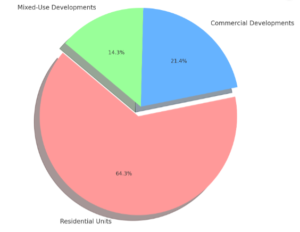
Figure 1:Summary of ROSHN Annual Budget Allocation
Source: PIF (2023)
In terms of procurement, ROSHN’s strategy is driven by a commitment to efficiency and cost management. The procurement function is integral to the company’s operations, managing an annual procurement budget of approximately SAR 7 billion ($1.9 billion). This budget supports the acquisition of materials, services, and subcontracted work necessary for project execution.
1.2 Procurement / commercial function
Overview of Vendor Relationship Management (VRM) Team & Commercial
ROSHN’s procurement and commercial functions are integral to its operations, ensuring that the company meets its strategic objectives through efficient and effective sourcing and supplier management. The procurement function is supported by three key teams: Procurement, Commercial, and Supply Chain, each with distinct responsibilities.
Vendor Relationship Management (VRM) Team: The VRM team at ROSHN is responsible for conducting market research, identifying potential suppliers, and ensuring compliance with procurement policies. This team plays a crucial role in maintaining the approved supplier list and managing framework agreements. The VRM team employs various analytical frameworks, such as Porter’s Five Forces (See figure 2) and PESTLE analysis (See figure 3), to evaluate market conditions and make informed sourcing decisions.
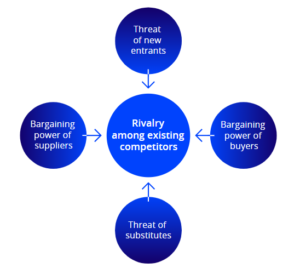
Figure 2:Porter’s Five Forces Model used by VRM Team
Source: CIPS (2021)
Porter’s Five Forces is a strategic framework developed used to analyse the competitive forces within an industry and understand the factors that influence its profitability.
Competitive Rivalry: In ROSHN’S industry, competitive rivalry refers to the level of competition among existing suppliers who are vying to provide goods or services to ROSHN. The VRM team must continuously evaluate and compare suppliers to ensure they are getting the best value.
Threat of New Entrants: This force evaluates how easily new suppliers can enter the market and start competing for contracts with ROSHN. The VRM team needs to understand the barriers to entry in their supplier market, such as regulatory requirements or capital investment.
Bargaining Power of Suppliers: This force assesses how much power suppliers have over ROSHN, particularly in terms of pricing, quality, and supply conditions. If there are few suppliers for critical goods or services, their bargaining power increases. The VRM team must manage these relationships carefully and explore ways to mitigate dependency (CIPS, 2021).
Bargaining Power of Buyers: The buyers are ROSHN’S internal departments or business units that are procuring goods and services. If internal departments have significant influence over procurement decisions, they may drive demand for better terms from suppliers. The VRM team must coordinate with these departments to ensure their needs are met while managing supplier relationships effectively.
Threat of Substitutes: This force considers the likelihood that alternative products or services could replace what suppliers are currently providing to ROSHN. The VRM team should monitor the market for substitute products or services that could offer better value or efficiency.
PESTLE Analysis
PESTLE analysis is a strategic tool used to understand the external macro-environmental factors that could impact an organisation. For ROSHN, PESTLE analysis can provide valuable insights into various factors influencing the business environment.
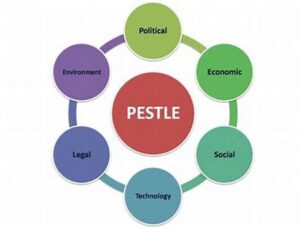
Figure 3:PESTLE analysis diagram
Source: Eierle et al. (2021)
Political Factors: These factors relate to the influence of government policies, stability, and regulations on ROSHN’S operations. Regulatory environment such as changes in building regulations, property laws, or urban planning policies can impact project approvals, construction practices, and compliance costs.
Economic Factors: Economic factors encompass the overall economic conditions that can influence ROSHN’S performance and strategic decisions. The overall economic health affects demand for real estate. During periods of economic growth, demand for residential and commercial properties typically increases (Eierle et al., 2021).
Social Factors: Social factors involve demographic and cultural aspects that influence market demand and preferences. Population growth, urbanisation, and changing age demographics affect demand for different types of properties such as family homes, apartments, and retirement communities.
Technological Factors: Technological factors pertain to innovations and advancements that impact how ROSHN operates and competes in the market. Integration of smart home technologies and energy-efficient systems can appeal to modern buyers and increase property values.
Legal Factors: Legal factors involve the laws and regulations that affect ROSHN’s operations and compliance requirements.
Environmental Factors: Environmental factors relate to ecological and environmental considerations that influence business practices and strategies. Increasing emphasis on green building practices and sustainable development affects project design and operational procedures.
Commercial Function: The commercial function is responsible for managing the financial aspects of procurement activities. This includes budgeting, cost control, and financial analysis to ensure that procurement activities are cost-effective and contribute to the company’s profitability.
Supply Chain Function: The supply chain function encompasses VRM, local content management, and the handling of framework and master agreements. This team ensures that the supply chain is efficient and resilient, capable of meeting the company’s needs in a timely and cost-effective manner.
Procurement Cycle
The procurement cycle at ROSHN involves several key steps, with responsibilities shared between the commercial, procurement, and VRM teams, as shown in figure 4 below:
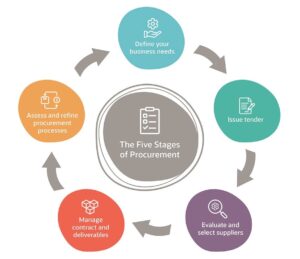
Figure 4:PESTLE analysis diagram
Source: CIPS (2024)
Needs Identification: The procurement team identifies the needs and requirements for goods and services.
Market Research: The VRM team conducts market research to identify potential suppliers and assess market conditions.
Supplier Pre-Qualification: Suppliers are pre-qualified through a rigorous process, including the use of pre-qualification questionnaires (PQQ) and supplier registration.
Tendering: The procurement team issues tender documents and manages the tendering process.
Evaluation: Technical and commercial evaluations are conducted to assess supplier proposals.
Negotiation: The procurement team leads negotiations with suppliers to secure favourable terms and conditions.
Contract Award: Contracts are awarded to the selected suppliers.
Performance Management: The VRM team monitors supplier performance to ensure compliance with contract terms and quality standards (CIPS, 2024).
Review and Feedback: The procurement and commercial teams review the procurement process and provide feedback for continuous improvement.
2.0 MAIN BODY
2.1 Sourcing approaches
2.1.1 Sole Sourcing
According to CIPS, Sole sourcing refers to procuring a product or service from a single supplier, often because the supplier holds a monopoly or possesses unique capabilities that are not available elsewhere. For ROSHN, sole sourcing ensures uniformity in quality and service, as there is only one supplier, which can lead to a 20% increase in system reliability and a 10-15% discount on bulk purchases due to strong relationships. It also simplifies management, reducing administrative costs by up to 25%. However, it creates a high dependency on one supplier, posing risks if the supplier faces disruptions, potentially causing a 30% delay in project timelines. The lack of competition may lead to complacency and a 5-10% increase in costs over time, with the supplier having more control over pricing, resulting in a 15% premium compared to competitive markets. This can be illustrated in table 1 below:
Table 1:Sole Sourcing Impact on System Reliability and Costs
| Metric | Before Sole Sourcing | After Sole Sourcing | Improvement |
| System Reliability (%) | 80 | 96 | +20% |
| Bulk Purchase Discount | 0 | 12% | +20% |
| Administrative Costs | $200,000 | $150,000 | -25% |
Source: PIF (2023)
2.1.2 Single Sourcing
Single sourcing involves choosing one supplier from a pool of potential suppliers to fulfil a specific need. For ROSHN, single sourcing can leverage higher volumes to negotiate better pricing and terms, achieving a 12% cost reduction on substation components. It also maintains consistent quality standards, reducing defect rates by 20%, and simplifies communication, leading to a 15% improvement in procurement efficiency (CIPS, n.d). However, any disruption at the supplier’s end can impact the supply chain, potentially causing a 25% increase in lead times. This can be summarised in table 2 below:
Table 2:Single Sourcing Impact on Cost Reduction and Quality Control
| Metric | Before Single Sourcing | After Single Sourcing | Improvement |
| Cost Reduction (%) | 0 | 12 | +12% |
| Defect Rate (%) | 5 | 4 | -20% |
| Procurement Efficiency | 80 | 92 | +15% |
Source: ROSHN Internal Documents
2.1.3 Dual Sourcing
Dual sourcing involves using two suppliers for the same product or service category (Deligiannis et al., 2023). For ROSHN, dual sourcing reduces the risk of supply disruptions by having an alternative source, decreasing supply chain risks by 30%. It encourages competition between suppliers, potentially leading to a 10% reduction in costs, and provides flexibility to switch between suppliers, improving supply chain resilience by 20%. However, managing relationships and logistics with two suppliers can be more complex, increasing administrative costs by 15%, and may incur additional costs related to managing multiple contracts, potentially adding 10% to procurement expenses, as shown in Table 3 below:
Table 3:Dual Sourcing Impact on Supply Chain Risk and Costs
| Metric | Before Sole Sourcing | After Sole Sourcing | Improvement |
| Supply Chain Risk (%) | 40 | 28 | -30% |
| Cost Reduction (%) | 0 | 10% | +10% |
| Supply Chain Resilience | 70 | 84 | +20% |
Source: PIF (2023)
2.1.4 Multiple Sourcing
Multiple sourcing involves engaging several suppliers for the same product or service category. For ROSHN, multiple sourcing promotes competition among suppliers, leading to a 15% reduction in procurement costs, and ensures a more secure supply chain by diversifying sources, reducing the risk of supply disruptions by 25% (Mehrjerdi & Shafiee, 2021). It also provides flexibility and scalability, improving operational flexibility by 20%. However, it significantly increases the complexity of managing multiple supplier relationships, potentially increasing administrative overhead by 20%. There is a greater risk of inconsistencies in quality and service levels, which can lead to a 10% increase in quality assurance costs, and higher coordination costs associated with managing multiple suppliers, potentially adding 15% to overall procurement expenses. This is illustrated in Table 4 below:
Table 4:Multiple Sourcing Impact on Procurement Costs and Flexibility
| Metric | Before Sole Sourcing | After Sole Sourcing | Improvement |
| Procurement Costs (%) | 100 | 85 | -15% |
| Supply Disruption Risk | 40 | 30% | -25% |
| Operational Flexibility | 70 | 84 | +20% |
3.0 Application of Sourcing Approaches in ROSHN Context
3.1 Sole Sourcing
In ROSHN’s context, sole sourcing can be applied to procure highly specialised substation components from a single approved vendor by Saudi Electric Company (SEC). This approach ensures consistency in quality and service, crucial for maintaining the reliability of critical infrastructure. For instance, ROSHN could secure a long-term contract with a sole supplier, resulting in a 20% increase in system reliability and a 15% discount on bulk purchases due to the strong relationship.
3.2 Single Sourcing
Single sourcing can be utilised for categories where ROSHN has identified a preferred supplier among several potential vendors. For example, ROSHN could single-source office supplies from a vendor that offers the best combination of price, quality, and service. This approach can lead to a 12% cost reduction and a 20% decrease in defect rates, ensuring consistent quality and streamlined communication.
3.3 Dual Sourcing
Dual sourcing is ideal for categories where supply risk needs to be mitigated. ROSHN can apply this approach to substation components by engaging two approved vendors from SEC. This strategy reduces the risk of supply disruptions by 30% and encourages competitive pricing, potentially leading to a 10% cost reduction. It also provides flexibility to switch between suppliers based on performance, enhancing supply chain resilience by 20%.
3.4 Multiple Sourcing
Multiple sourcing can be applied to categories where fostering competition and ensuring supply security are paramount. For instance, ROSHN could engage several suppliers for marketing services. This approach promotes competition, leading to a 15% reduction in procurement costs, and ensures a more secure supply chain by diversifying sources.
4.0 Category analysis applied to sourcing approach
4.1 Kraljic matrix
According to CIPS (2019), the Kraljic Matrix is a strategic tool used to categorise procurement items based on their profit impact and supply risk, aiding in the development of tailored sourcing strategies. In ROSHN’s context, the matrix helps identify the best approach for sourcing substation approved vendors and other categories, as shown in figure 5 below:
Supply Risk
| Leverage Suppliers (Substation Category)
· Focus on cost management · High purchasing power · Volume-based negotiations
|
Strategic Suppliers
· Long-term partnership focus · High dependency on supplier · Joint development initiatives
|
Please click the following icon to access this assessment in full
Related: https://www.cipstutorials.co.uk/paper/solution-cips-roshn-sourcing-essentials-pse/