(Solution) University College of Bahrain STS501
Solution
Abstract
This paper discusses the role of employee engagement on talent retention in the Bahrainian organisations. With high turnover being expensive and strategic significance of retaining talented employees, the study will attempt to unpack this by determining how engaged employees are likely to stay. A quantitative cross-sectional design will be used whereby data will be collected among the staff in the private and the public sector organisations in Bahrain. Stratified random sampling will be used to obtain a target population of about 200-300 respondents working in different sectors. Engagement (cognitive, emotional, behavioural dimensions) and retention intention / actual retention measures will be measured by a survey instrument (questionnaire). Descriptive statistics, reliability and validity tests, correlation, and regression analysis (or structural equation modelling, SEM) will be used as empirical techniques of analysis. Higher engagement is supposed to have a positive and significant prediction of retention even after the control factors like compensation, career development, leader support, and organisational learning. The findings will have an impact as they will offer local evidence to the HR practitioners of Bahrain and incorporate the new aspects of the role of AI-enhanced engagement tools and succession planning within the retention strategies. The policy, HR strategy and theory implications of the findings in the Gulf context are discussed.
Keywords: employee engagement, talent retention, quantitative design, AI-enhanced HR tools, succession planning.
Table of Contents
1.1 Background of the Study. 2
1.6 Significance of the Study. 4
2.3 Critical Review of Previous Studies 7
3.3 Data Collection, Population, and Sampling. 9
3.4 Variables and Operational Definition. 12
3.6 Development of the Questionnaire. 13
3.7 Quantitative Empirical Analysis. 14
3.7.1 Descriptive Statistics. 14
3.7.2 Classical Assumption Tests. 14
3.7.3 Validation of Measures. 14
3.7.4 Correlation and Regression Analysis 14
4.1 Demographic Profile of Respondents. 15
1. Introduction
In a highly globalised digital age, organisations are becoming more aware that their competitiveness will take the principles of human capital as opposed to technology. Employee engagement which can be described as the emotional and cognitive investment that individuals make into their working environments has emerged as a pillar of good human resource management. The issue of talent retention has become even more acute in the dynamic labour market in Bahrain in the context of the changing workforce demands and mobility across the region (Bahrain News Agency, 2025). In this paper, the author will focus on the impact of employee engagement on talent retention in the Bahraini organisations, with the help of mediating variables (succession planning, leadership development, and AI-driven HR systems). This study hypothesises that employee engagement plays a big role in talent retention since it promotes organisational commitment and employee loyalty in the long term.
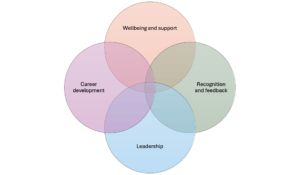
1.1 Background of the Study
Human resource management (HRM) practises have become global issues that involve employee engagement and retention due to their interdependence. Such ideas are also becoming critical in keeping productivity, innovativeness, and organisational resilience in Bahrain (Alzoraiki et al., 2024). Engagement, which Sahni (2021) defines as the emotional and cognitive attachment of the employees to their work, has been generally accepted as a major predictor of job satisfaction, discretionary effort, and lower turnover. Retention on the other hand is the capacity of the organisation to retain its skilled employees in the long run, which may be affected by the culture, leadership, payments, and career advancement opportunities among other things (CIPD, 2025). Companies which are successful in incorporating engagement strategies into their HR systems are more likely to have increased employee loyalty, innovation and overall performance.
The Bahrain labour market is also typified by increased competition of skilled professionals especially in the finance, ICT, and oil industries. As the Kingdom continues to strategically move towards digital transformation and economic diversification as part of Vision 2030, the mobility of talent has only increased, and engagement and retention has become the primary concern of both state and non-state organisations (Aljedaani, 2024). The most recent research in Bahrain indicates that organisations that focus more on employee-centric approaches, including inclusive leadership and transparency in performance recognition and continuous professional development, report high organisational commitment and the reduced rate of attrition. In addition to the impact of the integration of AI-based HR analytics and employee experience platforms in the context of other strategic tools in the slightly exchanging economic environment of Bahrain, the need to embrace post-pandemic realities has further highlighted the value and benefits of these solutions in enhancing engagement and retention in the long term, which contributes to preserving a competitive edge in the region.
1.2 Problem Statement
Even with the increased investment of human resource practises, most organisations still experience high employee turnover in Bahrain especially in the financial, technology and public sectors. This has a chronic attrition effect that disturbs organisational performance at the expense of rising the cost According to the Labour Market Regulatory Authority, private-sector turnover among Bahraini nationals exceeds 35%, signaling an urgent need for targeted engagement and retention strategies (Bahrain News Agency, 2025). Even though international research demonstrates that employee engagement is highly correlated with employee retention, there is not much empirical evidence in the context of Bahrain. As an example, the involvement was found to have a significant effect on retention by conducting research in the National Bank of Bahrain (Briones de Araluze & Cassinello Plaza, 2023). Nevertheless, most HR strategies are generic, and they do not consider the local cultural and organisational dynamics. With the greater implementation of technology in the workplace and the introduction of AI into HR, it is essential to comprehend the way the engagement works within the specifics of Bahrain to create the retention strategies that can be effective and evidence-based.
1.3 Research Aim
To explore the dependence between the engagement of the employees and the retention of talent in the organisations in Bahrain with the mediating variables of leadership, organisational learning, and AI-enabled HR analytics.
1.4 Research Objectives
- To investigate the level and type of employee engagement practises that are being applied in Bahraini organisations in various sectors.
- To determine the direct relationship between employee engagement and level of talent retention among Bahraini employees.
- To determine the moderate relationships between succession planning, leadership development, and organisational culture in reinforcing engagement-retention relationships.
- To explore the opportunities of artificial intelligence (AI) and digital HR tools to improve employee engagement and predict turnover trends.
- To design and present a comprehensive, AI-based conceptual framework of enhancing engagement and retention plans, in line with the workforce development objectives of the Vision 2030 of Bahrain.
1.5 Research Questions
- What are the implications of employee engagement programmes on retention of talent within organisations in Bahrain?
- Which areas of employee engagement (e.g. leadership, recognition, professional growth) have the most significant impact on retention outcomes?
- In what ways are succession planning and organisational development mediating or moderating variables between engagement and retention?
- How can AI technologies and predictive HR analytics be used to enhance engagement and minimise employee turnover?
- What can be created to help Bahraini organisations make use of engagement as a strategic instrument of retaining talent in the long run?
1.6 Significance of the Study
The study is of great importance in that it offers insightful information to HR leaders, policymakers, and scholars who may need to learn the dynamics between employee engagement and talent retention in the changing labour market of Bahrain. The results will help organisations to align their HR practises to the Vision 2030 of the Kingdom, especially in improving succession planning, leadership development and digital transformation of HR (Aldhabaib, 2025). The study focuses on sustainable workforce growth based on the combination of AI-driven analytics and organisational learning methods. In addition, it adds value to the local research by filling the gap in the Middle Eastern engagement retention research, providing both theoretical and empirical data to facilitate this process within HR professionals to create a committed, innovative and future-ready workforce (AlMannai et al., 2017).
2. Theoretical Framework & Literature Review
2.1 Theories
In order to know the effect of employee engagement on retention of talent, it is helpful to note that various underlining theories offer a conceptual framework. To begin with, the Social Exchange Theory (SET) proposes that once organisations offer them good terms (support, recognition, development), employees feel compelled to respond by their actions (greater engagement and loyalty and remaining in the organisation) (Ahmad et al., 2023). In this perspective, employee engagement is a reciprocation of perceived organisational investment and employee retention is a natural extension of such relationship exchange.
Second, another perspective is the Job Demands Resources (JD-R) Model: the more employees have high job resource amount (autonomy, feedback, career development, supervisor support) in comparison with job demands (workload, role conflict, emotional demand), the higher the probability of becoming engaged; engaged employees, in their turn, demonstrate higher performance and lower turnover intention (Li et al., 2025).
Third, theories like the Two-Factor Theory by Herzberg and the Hierarchy of Needs theory by Maslow can give additional insight on motivation. Herzberg (1959) suggested that positive attitudes are caused by motivator factors (recognition, achievement, growth), whereas hygiene factors (salary, working conditions) inhibit the dissatisfaction (Alrawahi et al., 2020). The Maslow model also assumes that when lower-order needs are fulfilled, higher-order psychological needs, esteem needs, and self-actualisation needs emerge, and organisations that help individuals to satisfy these needs make them engaged, which, in turn, contributes to retention (McLeod, 2025).
The above models are augmented by the Job Embeddedness Theory, which focuses on the links, fit and sacrifice of remaining in an organisation, which provides an explanation of why employees never get completely satisfied, they are embedded in their organisation and community (Yoon et al., 2022), When applied to the changing labour market in Bahrain, with nationalisation policies, cultural requirements and digitalisation influencing employment relation, these theories help shed light on how organisational support and job resources can lead to engagement and retention of skilled professionals.
Collectively, these theories define a course: organisational investments and job resources to employee engagement (cognitive, emotional, behavioural) to organisational outcomes such as retention. This theoretical background contributes to the proposed research subject of the engagementretention relationship, and also contributes to the rationale of including moderating/mediating variables (including succession planning, leadership development and AI-based HR tools) which can be considered either as job resources or organisational mechanisms.
2.2 Previous Studies
Alzoraiki et al. (2024) developed the mediating role of employee engagement in the connexion between recruitment and selection practises and employee retention at the National Bank of Bahrain. As they analysed survey results of 257 employees of banks, they found that engagement played an important role in mediating how recruitment practises impacted retention. The paper is one of the very few empirical studies conducted in Bahrain, which highlights the fact that despite successful recruitment efforts, they should be maintained by further involvement to be able to attain the results in the long-term retention.
Expanding the context, Azeez (2017) has performed an extensive literature review on the topic of HRM practises and employee retention and concluded that engagement is a key mediator between the HR initiatives, including training, compensation, and performance management, and retention. The review has highlighted how the contras at a transactional level of HR practise transforms into a relational relationship, which makes employees want to remain longer with their companies. Such findings can be discussed in terms of the new interest in strategic HR practises in Bahraini institutions that aim to enhance workforce stability.
Baloch et al. (2019) tested the relationship between core self-evaluations of employees and engagement, and the moderation of organisational culture. They employed quantitative techniques in order to demonstrate that positive self-appraisals contributed greatly to engagement especially in supportive and innovative cultures. The implications of the study apply to Bahrain, where self-driven engagement and, hence, retention can be enhanced by organisational cultures that are collectivist in nature. An environment that supports self-esteem and psychological security becomes useful in decreasing voluntary turnover.
In their study, Pandey and Kaur (2021) conducted a systematic literature review to explore the topic of talent management and employee retention practises. Their review of several empirical studies has determined that engagement programmes, including mentorship, learning, and career advancement, had a consistent positive effect on retention. The authors emphasised the fact that engagement and retention are not separated HR outcomes but rather inseparable processes prompted by organisational commitment and perceived growth opportunities. This observation is particularly pertinent to Bahraini organisations, which are aligned with Vision 2030, with the national workforce development and the succession planning being the strategic goals.
Khwaja and Yang (2022) in another industrial scenario used a quantitative method to examine the relationship between employee engagement and the customer satisfaction and retention in car rental businesses. Their result showed that there is a strong positive correlation implying that engagement does not only lead to internal retention but also external loyalty to customers. In spite of the fact that their research centred on the service sector, it reveals the overall behavioural uniformity between engagement and long-term commitment-elements that can be used in Bahrain service-based economy.
As digital transformation progresses, Dutta and Mishra (2025) investigated the role of virtual assistants that are implemented through artificial intelligence in improving employee engagement. In their empirical investigation, they discovered that AI tools enhanced efficiency in communication, feedback, and empowerment of employees, which increased the level of engagement and decreased the intention to leave the company. Such results have found a special echo in Bahrain, where the use of AI-enabling HR technologies is becoming increasingly popular to facilitate real-time working with employees and predictive retention analytics.
In another study, Al Jawali et al. (2022) examined the practise of talent management in the Dubai government, which is an emerging economy in the GCC. Based on empirical evidence of various organisations across different governments, they discovered that the talent-management system, leadership development and employee engagement programmes were structured and played a key role in enhancing retention and performance. Their results emphasise the increased awareness among the Gulf States, Bahrain being among them, that strategic involvement and HR practises oriented towards leadership, creates continuity, motivation, and long-term commitment of the workforce in their organisation.
Lastly, Young (2012) used Job Embeddedness Theory in explaining retention of employees and postulated that engagement is a prerequisite of embeddedness because it enhanced organisational fit, ties, and perceived losses of employees by quitting. The researchers concluded that the more engaged employees developed strong relational and professional relationships in their organisations, which reduced turnover intention. The theory provides the Bahraini organisations with an effective prism through which retention could be viewed as a multi-dimensional concept that is not only job satisfaction but also social and cultural integration.
Cumulatively, these pieces of research findings all claim to the fact that employee engagement is a critical factor in talent retention in a variety of situations. Engagement takes the form of a psychological state and a strategic HR mechanism whether in its relational HR practises, AI integration, or cultural reinforcement. Although there are strong evidence on the topic globally and in the region, there is a lack of empirical research in Bahrain on the topic – this means that there is need to conduct localised studies that will explore the role of engagement in relation to succession planning, leadership, and digital HR resources to retain talent in the Kingdom developed labour market.
2.3 Critical Review of Previous Studies
The analysed literature has sufficient evidence that employee engagement has a significant effect on talent retention in various organisation and cultural settings. Nevertheless, most of these studies, including Azeez (2017), Pandey and Kaur (2021), and Baloch et al. (2019), are performed in non-Gulf settings, and the workforce designs, cultural values, and HRM practises are quite different in Bahrain. Consequently, their results, despite their value, might not be exhaustive of the contextual variables like collectivism, relational loyalty, and leadership hierarchy that are of significant value in the motivation and retention of employees in Bahraini organisations.
The number of studies that have offered empirical information on the Bahraini context is limited: one of such studies, Alzoraiki et al. (2024), is specific to the banking sector. The study of the role of engagement strategies in the public, private, and service sectors of Bahrain is still quite insufficiently researched across industries. Moreover, the vast majority of available studies utilise the cross-sectional designs, which prevents the establishment of causal correlations or long-term outcomes of engagement interventions.
In addition, not much research has explored moderating or mediating effects of variables like succession planning, leadership development, and organisational learning parameters that are gaining more prominence on Bahrain under the human-capital development campaigns of Vision 2030. Current literature, such as Dutta and Mishra (2025), has begun including digital transformation and AI-based HR systems as the means of increasing engagement and turnover predictability, but there is no empirical validation in the context of the changing digital HR in Bahrain.
To conclude, although the worldwide literature is unanimous on the existence of an engagement–retention connexion, limited evidence is available that captures the localised labour market nature and culture peculiarities of Bahrain. The proposed gap is crucial to creating context-specific HR policies that can capitalise on engagement, leadership, and technology to empower talent retention and the long-term economic perspective in Bahrain.
2.4 Conceptual Framework
Fig 2.4: Conceptual Framework
This study will adopt a conceptual framework based on the reviewed theories and studies, which will be used to investigate the impact of employee engagement on retaining talent in Bahraini organisations. The independent variable is defined as employee engagement and determined by cognitive, emotional and behavioural dimensions. The dependent variable is talent retention, which is measured in the intention to remain and retention deliverables.
Some of the control variables are also covered by the framework, including the compensation, career development, leadership support, organisational learning, and the use of AI-enabled HR tools. The succession planning and leadership development are placed as both the possible mediators and moderators. Their role as mediators makes the relationship between the engagement and retention stronger because the employees start to feel like they are growing and stable. Moderators as they are, enhance the effect of engagement on retention by increasing the capability of organisations and strategic alignment.
This framework shows the dynamic nature of the relationship between HR practises, employee engagement, and retention with the focus on how digital transformation, as well as succession planning, affect the labour market in Bahrain, which is constantly evolving.
2.5 Research Hypotheses
Based on the literature on the topic reviewed and the conceptual framework proposed, the following hypotheses are developed:
H1: There is a positive linkage between employee engagement and talent retention in Bahraini organisations.
H2: With compensation, career development opportunities, leadership support, organisational learning/succession planning practises and perceptions of AI-enabled HR tools factor held constant, employee engagement continues to be a strong predictor of talent retention.
H3: The relationship between employee engagement and talent retention is mediated by succession planning practises in that the positive role of employee engagement in retention is heavier in organisations that have good succession planning.
H4: The relationships between employee engagement and talent retention are mediated by the perceptions of AI-enabled HR tools in such a way that the engagement -retention relationship is stronger when the employees have more positive perceptions of the fairness, transparency and usefulness of HR technologies.
These hypotheses connect these theoretical models (SET, JD-R, Embeddedness) with the existing literature extrapolated to the Bahraini organisation through the introduction of contemporary HR practises (succession planning, AI-based tools) and the ability to control the known retention drivers.
3. Data and Methodology
3.1 Research Method
The research design adopted in this study..
Please click the following icon to access this assessment in full on how to work on this report