(Solution) MKTM028 Strategic Marketing STP
Solution
Contents
2.0 Segmentation, Targeting and Positioning. 3
Figure 1: Sabic’s Business Model 4
Figure 2: STP Marketing Model 5
Figure 3: Types of Market Segmentation. 6
Figure 4: Examples of Solutions Provided by Sabic. 7
Figure 5: Market Targeting Strategies. 9
Figure 6: Market Positioning Strategies. 11
Figure 7:Survey Responses Portraying Amazon as the leading E-Commerce Platform.. 13
Figure 8: Walmart Target Market Segmentation and Marketing. 14
Figure 9: Walmart’s Net Sales by Year 15
Figure 10: Johnson & Johnson Organisational Performance. 17
Figure 11: Effective Pfizer’s targeting strategy enhanced its vaccine’s global reach. 18
1.0 Introduction
Segmentation, Targeting and Positioning (STP) concepts have become very relevant in the business environment where competition is high (Hanlon, 2024). This approach helps organisations subdivide large markets into segments, determine which segments are most profitable, and tailor their offerings in a way that will best satisfy customer needs. Thus, the use of STP helps companies to operate in the highly segmented markets and oversee the resource distribution as well as to offer the suitable products and services that meet the customers’ needs and generate the sustainable revenues (Islam, 2020).
This paper aims at examining how STP concepts are relevant in today’s business environment in order to achieve market penetration and operational effectiveness. It explains how firms can use segmentation to understand the needs of different markets, targeting to focus on the most profitable consumers, and positioning to differentiate themselves in competitive markets. By doing so, businesses not only meet present challenges but also get ready for the future opportunities and ensure their strategic compliance with the industry development.
2.0 Segmentation, Targeting and Positioning
STP marketing model (See Figure 1) helps organisations to find out the potential segments, prepare marketing strategies, and enter into the global market strategically (Correia & Rodrigues, 2023). All the components of STP are important for matching a company’s product portfolio with the customers’ requirements.
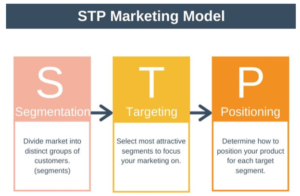
Source: Mukherjee (2024)
2.1 Segmentatio
Adopting a definition by Carpenter (2024), market segmentation is the process of partitioning a large market into smaller segments based on geographical, demographic, psychographic and behavioural components, which can be easily targeted and served (See Figure 2). Segmentation strategies show a profound knowledge of industries, but raise questions about the potential consequences and relevance of such approaches.
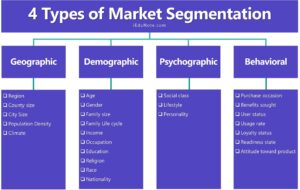
Figure 2: Types of Market Segmentation
Source: Tarver (2024)
Geographic Segmentation: Geographical segmentation, a method that divides markets according to location, is useful as it allows companies to tailor offerings to suit local demand and policy (Directive, 2024). For instance, the companies can provide climate-oriented solutions or product complying to the climate of certain regions. However, such approach may cause over customisation which means that the organisation may end up with inefficiencies and inconceivable brand strategies.
Demographic Segmentation: The demographic segmentation that divides customers into subgroups by their characteristics like age, sex, and occupation, is common to use because of its comprehensible and easy application (Ernawati et al., 2021). According to (Das & Nayak (2022), this helps organisations to develop products that meet certain requirements for specific population. However, this method may reduce the understanding of consumer needs to a simplified level, ignoring the needs of different demographic groups and new market opportunities.
Behavioural Segmentation: Behavioural segmentation segments the market according to the consumer’s behaviour which includes actions like buying frequency or brand commitment. This approach is especially useful in segmenting the customer base in terms of their value and in meeting current trends such as the sustainability concern (Mukherjee, 2024). For instance, firms that market their products to the environmentally sensitive consumers with green products can foster strong brand equity. However, there are some drawbacks, such as the problem of profitability and adaptability, especially in specialized segments, for example, renewable materials where production costs may be too high for commercial use.
Although segmentation strategies are effective in targeting particular markets and enhancing customer satisfaction, the potential risks of such strategies should not be overlooked. Hoyer et al. (2022) states that they might not have the flexibility to change in the dynamic markets and the sustainability-conscious segments could be challenging to manage due to financial considerations. It is, however, important for businesses to ensure that the approach they choose is not too rigid but rather fluid and dependent on well-researched data.
2.2 Targeting
Targeting, which is the second component of the STP model, helps businesses determine which market segments they should concentrate on in order to achieve their strategic goals (MBA, 2023). Targeting strategies improve customer satisfaction, increase the efficiency of resource use, and guarantee the organisation’s competitiveness. The four strategies of targeting include undifferentiated targeting, differentiated targeting, niche targeting, and micromarketing each having its uniqueness (See Figure 3)
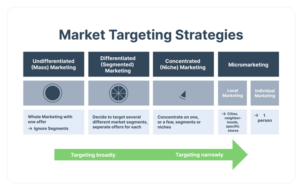
Figure 3: Market Targeting Strategies
Source: Hugel (2024)
Differentiated Targeting: This strategy entails developing products or services that are distinct for different markets. In this way, businesses can increase their potential customer base and make their presence felt across various industries (Farooq, 2020). However, the adoption of differentiated targeting has some implications on resource allocation. The diversification across several sectors may weaken the focus and push the resources to the extent of weakening the depth of market penetration in potential sectors such as renewable energy or digital manufacturing (Toha & Supriyanto, 2023). Strategic alignment is a necessity to avoid over stretching and for the sustainability of the strategy in the future.
Niche Targeting: Niche targeting is the targeting of particular, specific segments of the market based on the concept of identifying the nature, wants, and needs of the chosen target market as well as the value that the business hopes to offer the target market (Shaw, 2022). For example, firms in aerospace industry may sell products such as advanced materials that are durable and conform to specific safety and efficiency classifications. Although this strategy is creative and specific, it has its drawbacks. Bhasin (2023) contend that concentrating too much on defined markets may limit the identification of new opportunities where new economies like circular economies or sustainable development opportunities are created. Organisations have to be flexible to notice changes in the market and trends that are emerging in it.
Undifferentiated and Micromarketing Approaches: The undifferentiated targeting strategy that is a one size fits all approach is efficient in terms of cost but lacks the ability to meet the consumers’ needs and hence is not very effective in competitive market environments (Soberman & Xiang, 2022). On the other hand, micromarketing targets individual consumers or specific segments within markets, allowing for customisation but at the cost of requiring more resources and operational complexity (Etuk et al., 2024).
2.3 Positioning
Positioning is the strategic process by which a company builds its market with a unique position for its product or service as compared to its competitors (see Figure 4). There are three elements that can help to achieve effective positioning: target customers, a clear competitive frame, and a strong point of difference that aligns with evolving market needs (Hakim, 2023).
Figure 4: Market Positioning Strategies
Target Customers: To formulate strategies that suit the needs and preferences of their target market, organisations aim at identifying the characteristics of their customer base (Rissman et al., 2020). For instance, a company may be interested in the automotive sector because it recognises the importance of innovation in improving the efficiency and performance of cars or in the construction sector where durability and reliability are key to project specifications. In this way, organisations tailor their strategies to the interests of these customer segments and create value, trust, and strong partnerships that enable them to meet particular industry needs (Ilham Abu & Ridwan, 2023).
Competitive Frame: Positioning also entails the comparison of the product with the competitors to show the strengths that the product has (Lee, 2024). Companies that adopt sustainability and innovation strategies stand to benefit from positioning themselves to meet some of the world’s most critical needs such as environmental concerns. The strategies directed towards the renewable energy or towards the circular economy can help the organisation to build up the image of the innovative leader and gain a competitive advantage in the current rapidly changing environment (Bertassini et al., 2021).
Point of Difference: A unique value proposition, for instance, green products or services, or customer-oriented strategies, defines a company. Such focus on differentiation ensures customer retention, and enhanced positioning on the market especially in sectors that focus on innovation and sustainability (Farahsari et al., 2022).
3.0 Industry Application
3.1 Retail Industry
The retail industry’s STP strategies revolve around identifying consumer behaviour, needs, and trends, as well as the best time to target them (Thomas & George, 2021). Due to the development of e-commerce, retailers have formed sub categories of markets to cater for the needs and wants of different consumers.
3.1.1 Amazon
Amazon’s STP strategy is based on the use of statistical models and artificial intelligence to identify the most suitable segments of customers and position the company’s products accordingly (Dudovskiy, 2022). Through market segmentation that considers the purchasing behaviour, product interest, demography, and geographical location, Amazon is in a position to meet the specific needs of the consumers. This segmentation approach helps Amazon to define certain customer segments, including the frequent shoppers, Prime members and new customers, and adjust marketing and service approaches to reach out to these segments (Bhasin, 2018).
Targeting in Amazon’s STP framework entails providing the segments with specific product recommendations, special offers, and advertisements that would be appealing to them. The analysis of customer interactions through machine learning algorithms makes Amazon’s targeting both effective and flexible since it changes as the preferences and behaviours of customers evolve (Pereira, 2024). Positioning is one of the key concepts that underpin Amazon’s approach. As the ultimate online shopping destination, the company focuses on the aspects of convenience, selection, and affordable prices. This positioning strategy is evident in Amazon Prime, a key service that provides delivery within two days, special offers, and access to other content. The use of this approach further complements Amazon’s position as the leading e-commerce platform as depicted in Figure 5;
Figure 5: Survey Responses Portraying Amazon as the leading E-Commerce Platform
Source: Kim (2019)
Nevertheless, the company has some critical issues to work on, such as privacy issues arising from its data-oriented approach and competition with local e-commerce competitors across different regions. In addition, Hodgson (2022) explains that the problem of balancing customer trust and innovation in a competitive market environment is a challenge that the company has to address.
3.1.2 Walmart
Walmart uses a diverse approach to segmentation where the company mainly targets consumers in terms of their income (See Figure 6). According to Pereira (2023), this approach helps the company to target a large audience, from consumers looking for affordable products to those who are willing to pay a moderate price for better quality. Through stocking a diverse product line, including groceries, clothing, and electronic items, Walmart guarantees its appeal to families and other people who prioritise price.
Figure 6: Walmart Target Market Segmentation and Marketing
Source: Pereira (2023)
The company’s targeting strategy focuses on affordability and convenience and uses marketing initiatives that appeal to its target market, thus boosting its net sales (See Figure 7). Walmart’s “Save Money. Live Better.” slogan reflects its goal of offering economic products for the use of the people in their day-to-day life (Kwak & Wallace, 2023). The company is also appealing to price conscious consumers through the availability of private label brands which provide cheaper options to those of national brands.
Figure 7: Walmart’s Net Sales by Year
Source: Ozbun (2024)
Walmart’s strategy cannot be complete without positioning. It embraces the “Everyday Low Prices” strategy by providing convenient access through the numerous store outlets and the ever-expanding online platform. It has a unique model that incorporates both physical and online platforms, which include added services such as pickup from the store and home delivery (Sheridan, 2024).
Nevertheless, Walmart has faced rising customer expectations for individualised service and the use of technology in e-commerce, presenting opportunities that the company must capture to stay competitive.
3.2 Healthcare
Understanding of the healthcare industry’s use of STP strategies is important in order to meet the diverse needs of patients, caregivers and institutions (Ningsih & Marwati, 2023). In this industry, segmentation may be based on demography, health status, and accessibility.
3.2.1 Johnson & Johnson
Johnson & Johnson (J&J) has benefited from segmentation strategies that
Please click the following icon to access this assessment in full
Related to: https://rankedprofessionals.com/downloads/solution-mba-mgt506-human-resource-management/