(Solution) MN7650 Managing Change and Technology at Work
Solution
Table of Contents
2.1 Rational Incremental Model of Change. 2
2.2 The Concept of Discontinuous Change. 5
2.3 The Kubler-Ross Model of Change. 6
2.4 Person–Environment (PE) Fit Theory. 8
2.5 Sociotechnical Systems (STS) Theory. 10
1.0 Introduction
Organisational change is a dynamic and challenging process through which leaders have to address new and emerging issues while managing organisational goals and people (Harrison et al., 2021). It is crucial to comprehend how theoretical frameworks can be applied in the real-world context as it relates to change management. Based on the experiences of change management in organisations, this essay analyses five theories and concepts that are considered to be useful in practice; namely, the Rational Incremental Model of Change, The Concept of Discontinuous Change, The Kubler-Ross Grief Model, Person–Environment (PE) Fit Theory, and Sociotechnical Systems Design (STS).
The setting of my reflection is a mid-sized technology company going through a digital change where teams were realigned, new tools were introduced, and organisational culture was changed to encourage innovation. All these theories offered a way of understanding and navigating through different facets of change (Wijethilake et al., 2021). However, their effectiveness was dependent on factors including culture, resources, and rate of change of organisations. This paper reflects on the applicability of the theories in the light of their potential, the opportunities and threats for their utilisation and concludes with more general considerations of the relationship between theory and practice in the field of organisational change management.
Thus, based on these theoretical frameworks, I will assess the applicability of the approaches for achieving sustainable change impact. The analysis of the framework suggests that the concept of integration of structured frameworks with contextual flexibility is more suitable for the effective management of various challenges which may arise. This way not only enhances decision making but also it fills the gap between the theoretical models and real-life implementation of change management (Sancak, 2023).
2.0 Evaluation of the Usefulness of Theories and Concepts in the Practice of the Management of Change
2.1 Rational Incremental Model of Change
Rational incremental change (See Figure 1) often advances through a series of uniformly sized phases, each accompanied by a period of ‘down-time’ allowing the changes to be integrated, as explained by Kaur Bagga et al. (2023). This process illustrates that the primary issue with change is not the initial transformation of behaviours, but rather preventing individuals from reverting to their previous behaviours once the explicit emphasis on the change shifts (de Lucas Ancillo et al., 2020). Considering this, incremental change requires the participation of all individuals and is implemented through alternating phases of activity (the acquisition of new knowledge/skills) and inactivity (time for the new behaviours to become routinised).
The primary assumption underlying the rational incremental model of change is that the necessary change can be divided into uniformly sized episodes (Hamidi et al., 2021). This may pose challenges if, as the theory indicates, all parties concerned are consulted and guided through the transition. Essentially, excessive time may be devoted to convincing others to embrace various episodes of change. Furthermore, certain adjustments may prove more challenging to adjust to than others. Similarly, certain aspects of the change process may necessitate significant modifications, whereas others may simply demand small adjustments.
A principal advantage of this method of change is its inclusivity, providing individuals with the opportunity to develop and subsequently improve their skills prior to the commencement of the following episode. According to Greenwood et al. (2022), this also permits any small adjustments to the modifications to be implemented prior to the commencement of the next phase of the procedure. This inclusionary strategy, which avoids displacing individuals from their comfort zones, theoretically facilitates group learning and fosters a sense of collegiality as participants navigate the processes of change collaboratively (Yun et al., 2022).
Nonetheless, there are also constraints. Initially, individuals are likely to experience change fatigue. Despite the downtime between episodes, this is simply to integrate the new methodologies, as the subsequent modification will occur shortly (Finsel et al., 2023). The second criticism, which threatens to entirely undermine the fundamental objective of the rational incremental approach, is that the downtime is not effectively employed to reinforce new behaviours, but rather serves as a chance for individuals to revert to their previous methods of operation.
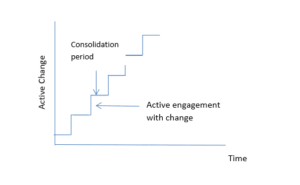
Figure 1: Rational Incremental Change
Source: Finsel et al. (2023)
This method was particularly useful when my organisation was switching to a new project management software. Using this approach, we were able to gradually implement the software and collect feedback from the employees to improve the processes before fully deploying the program. The model was more systematic and it helped the staff to cope with the change better because there were no drastic shifts that could make them uncomfortable (Hayes, 2023). However, one of the model’s major limitations was that it oversimplified the process of change by assuming that it was primarily a rational decision-making process that did not take into account people’s emotions or cultural beliefs (Kim et al., 2022). The employees complained of the slow pace of change and viewed the incremental approach as indecisive leadership.
In essence, as much as the Rational Incremental Model is helpful for recommending deliberation and stakeholder involvement, it stands weak in the face of situations that require flexibility and quick decision making. It serves as a foundational guide but requires supplementation with more dynamic approaches to address real-time challenges effectively.
2.2 The Concept of Discontinuous Change
Discontinuous change is both radical and periodic. It seeks to implement significant modifications to the strategy, structure, or culture of the organisation. According to König et al. (2020) observations on organisational responses to their environment, these responses may be either remedial and reactive or opportunistic and proactive. Discontinuous change frequently serves as a response by the organisation to rectify the issue of strategic drift (Mladenova, 2022). The basis of an organisational crisis is that organisational change will, at best, be communicated to individuals rather than subjected to any consultative process, or at worst, be imposed suddenly.
The radical nature of discontinuous change indicates that it cannot be achieved swiftly or without difficulty. The significant alterations to the organisation’s strategy, structure, or culture necessitate that individuals adjust to changes that are both extensive and profound (Carpino et al., 2021). Furthermore, it is expected that the technical and social changes will be of equal importance, affecting not only the methods of work but also interpersonal dynamics inside the workplace (See Figure 2).
Figure 2: Discontinuous Change
Source: Jansson (2013)
Discontinuous change assumes that drastic transformation is necessary and the sole alternative accessible (Errida & Lotfi, 2021). It is essential for management to oversee this process in a manner that minimises harm to both the technical and operational facets of the organisation, as well as to the ongoing relationships with employees.
The strength of discontinuous change is evident when viewed as one-time occurrence designed to address a crisis. Nonetheless, a broader debate exists over whether change leaders and managers can solely employ the concept of selling change as a means to address a crisis more comprehensively (Barlette & Baillette, 2020). There are evident moral arguments regarding dishonesty, leadership, and managerial integrity, along with implications of the consequences when individuals discover that a crisis never truly existed. Therefore, as explained by Li et al. (2021), discontinuous change necessitates consideration of the degree to which enforcing change on individuals adversely affects the psychological contract.
This concept was visible in my organisation when the market took a sudden downturn. Due to the decline in revenues, leadership made swift organisational changes such as downsizing and changes in products and services offered. These changes were sudden, which meant that there was a need to assess the current procedures and make decisions quickly (Miller et al., 2019).
Although the idea of discontinuous change emphasises the need for agility, its implementation in practice produced undesirable outcomes (Hanelt et al., 2020). People faced increased stress and anxiety leading to low morale and reduced performances. Also, there was no clear transition process, which led to the loss of institutional knowledge, especially when experienced employees resigned, and the new ones were expected to adapt quickly with little to no preparation. In a critical perspective, discontinuous change is a proper reaction to crises but, at the same time, the process should be handled professionally to avoid negative effects (Jansson, 2013).
2.3 The Kubler-Ross Model of Change
The Kubler-Ross Model of Change, which was initially designed to describe the stages of grief, has been often used in organisations to predict and manage employees’ emotions during change processes (Tarnoff et al., 2021). The model’s five stages: denial, anger, bargaining, depression, and acceptance provide a map for the emotions that one goes through when facing change (See Figure 3).
Figure 3: The Kubler-Ross Grief Curve
Source: Smollan & Sayers (2009)
In a recent organisational change process in my organisation, the Kubler-Ross Model was very helpful in understanding and dealing with the emotional phase. The denial stage was observed at the first stage of the change as employees did not see the need for change and stuck to the traditional ways of working even when they know that the current process was not effective (Gerhardt & Puchkov, 2023). Open communication and information sharing in the form of data-driven conversations and town halls also helped in dispelling myths and raising awareness. As the need for change could not be avoided, anger was expressed especially from people who are most likely to be affected by the changes especially in employment and career. Empathetic leadership that involved one on one consultations and group meetings was useful in reducing these tensions by recognising them and offering solutions where possible.
The bargaining stage captured employees’ struggle to find middle ground as well as gaps within the change management plan. This feedback helped the leadership to make proper corrections, which showed the concern for inclusiveness. Nevertheless, the depression stage proved to be the most problematic, as morale was low, and the rates of production went down. These effects were mitigated by interventions like mental health support, peer support, and having leaders around, which slowly rebuilt the confidence of employees (Wang & Wang, 2021).
Acceptance was the last phase where employees embraced new changes and roles and new processes because of the changes that were evident and continuous support from the management. Although it provided a helpful framework, the model was overly simplistic in its linear portrayal of change, as individuals repeatedly moved through stages. This necessitated the development of iterative communication and fluid approaches to ensuring that the momentum was not easily derailed.
However, the major drawback of the Kubler-Ross Model when applied in organisational change management is that it only focuses on the emotional experiences that are involved in change process (Tarnoff et al., 2021). The human-centred approach is a strength of the model, which implies compassion and active listening to the employees’ needs. However, without being linked to the operational and strategic perspectives, its ability to produce organisational change is somewhat constrained. For example, if resistance is being dealt with while not relating it to the organisation’s objectives then the change management process will be threatened. In addition, the linear and sequential process that it suggests might not capture the complex and intertwined nature of emotions, which demands flexible and cyclical approaches to management (Chavan & Bhattacharya, 2022).
In essence, the Kubler-Ross Model is more useful when combined with models that consider the elements and stages of organisational change. By integrating the empathy factor with the strategic approach, this makes it easier to achieve a balance between the human and the organisational aspects (Smollan & Sayers, 2009). This integration makes it more applicable to actual managerial situations and provides tools to help managers deal with change more effectively and flexibly.
2.4 Person–Environment (PE) Fit Theory
The Person Environment (PE) Fit Theory is one of the popular theories used in organisational change management and it deals with the fit between person and environment (FOLLMER et al., 2008). This
Please click the following icon to access this assessment in full
Related to: https://rankedprofessionals.com/downloads/solution-mktm028-strategic-marketing-stp/