(Solution) Emirates Airlines Leadership Report
Solution
Executive Summary
This report evaluates how Emirates Airlines may successfully lead the organization through a time of crisis and change by employing the concept of situational leadership theories and the use of systematic change management models. As its market share was quickly eroding because of agile competitors, Emirates was pursuing a transformative three-step move: restructuring operational teams through agile adoption, repositioning its brand and services, and merging with a longstanding industry competitor. The aim of the report is to critically examine how the CEO can change their style and approach depending on the different team dynamics, resistance to change and challenges of cultural integration in such turbulent times.
The report starts by presenting a situational analysis that diagnoses the level of employees’ readiness in three different scenarios of crisis. It proceeds to use the Situational Leadership Theory to prescribe the suitable leadership styles regarding each of them, contrasting the alternatives to explain why the chosen methods were the best. The second part of the report presents a systematic approach to change management during the merger stage based on the Kotter’s 8-Step Model, with an emphasis on maintaining urgency, overcoming complacency, and institutionalizing the cultural change through symbolic acts, rituals, and leader-sponsored programs. Lastly, a critical analysis examines the leadership performance of the CEO based on Path-Goal Theory, Transformational Leadership, and Leader-Member Exchange (LMX) Theory, evaluating the areas of strength and strategic leadership weakness and then providing specific recommendations.
The report findings imply that every crisis circumstance in this change process requires a unique leadership approach. Situation A demonstrated technically proficient yet demoralized staff who were opposed to agile adoption, and which demanded a Supportive Leadership style. In Situation B where the marketing managers were moderately competent and anxious, Transformational Leadership would be more effective to increase engagement. Situation C demonstrated the presence of mixed preparedness and cultural conflicts after the merger, and Servant Leadership would be paramount to restore trust and cohesiveness.
Based on the key findings, the following recommendations are made:
- Adopt Supportive Leadership during agile adoption to address resistance and boost engagement.
- Apply Transformational Leadership during rebranding to inspire intrinsic motivation and creative commitment.
- Use Servant Leadership post-merger to rebuild trust, empower informal influencers, and promote inclusivity.
- Introduce symbolic acts like cross-team projects, joint celebrations, and integrated branding to anchor cultural change.
Table of Contents
2.1 Situation A: Resistance to Agile Adoption. 5
2.1.1 Follower Readiness Diagnosis. 5
2.1.2 Justification of Leadership Style. 5
2.1.3 Comparison with Alternatives. 5
2.2 Situation B: Marketing Team Paralyzed by Rebranding Pressure. 5
2.2.1 Follower Readiness Diagnosis. 5
2.2.2 Justification of Leadership Style. 6
2.2.3 Comparison with Alternatives. 6
2.3 Situation C: Post-merger Cultural Clashes Threaten Integration. 6
2.3.1 Follower Readiness Diagnosis. 6
2.3.2 Justification of Leadership Style. 6
2.3.3 Justification of Leadership Style. 7
3.0 Change Management Strategy. 7
3.1 Applying Kotter’s 8-Step Model to Phase 3. 7
3.2 Building Urgency and Addressing Complacency. 9
3.2.2 Addressing Complacency. 9
3.3 Anchoring Changes in Culture. 10
4.0 Critical Evaluation and Recommendations. 10
4.1 Critiquing Leader’s Effectiveness Using Leadership Theories. 10
1.0 Introduction
Managing an organization during a crisis requires not only technical skills but also the capacity to change leadership behavior based on the fast-evolving situations. Even the most established brands can be disrupted by unexpected market disruptions and new entrants seen in highly competitive industries such as the aviation sector (Bakreen et al., 2022). Emirates Airlines, with its high-quality service and extensive network, is losing its market share drastically due to emerging nimble competitors that are changing customer expectations and business models.
To manage such a critical situation, Emirates has come up with a three-phase transformation strategy. This includes restructuring its internal teams through agile working methods, repositioning its brand with new products and services, and merging with a legacy competitor to reinforce its market position. Nevertheless, both phases come with distinct leadership and people management issues, which demand keen diagnosis, and a dynamic and situationally relevant leadership style.
This report examines the Situational Leadership Theory that the Emirates leadership can use to effectively react to the different levels of team preparedness and opposition. It also compares the various leadership styles with particular organizational challenges and rationalizes the use of the most effective styles in each situation. Additionally, the report suggests a systematic approach based on the Kotter 8-Step Model to address cultural integration in the merger phase. Lastly, it critically evaluates leadership performance using the existing theories and provides practical recommendations on how to enhance leadership competency and cultural fit.
2.0 Situational Analysis
Effective leadership during organizational crises depends on accurately diagnosing follower readiness and applying leadership styles that suit the situation. The Situational Leadership Theory categorizes follower readiness into four levels, from R1 (low readiness) to R4 (high readiness), based on competence and commitment (Rodić & Marić, 2021). Emirates Airlines faces three distinct people-related challenges within its transformation plan, each requiring a tailored leadership response.
2.1 Situation A: Resistance to Agile Adoption
2.1.1 Follower Readiness Diagnosis
Emirate’s operational teams in this case exhibit Readiness Level R3, meaning that they are highly competent, yet have low commitment. At this level, Wuryani et al. (2021) describe employees as having good technical expertise and operating experience but are resistant and reluctant to embrace agile practices. They are able, but not willing to adopt new systems because they believe change will affect the normal way of doing things.
2.1.2 Justification of Leadership Style
The participative leadership style is the suitable style among the R3 followers. According to Khassawneh & Elrehail (2022), this strategy implies that leaders distribute decision-making authority, facilitate open communication, and provide emotional and practical support. It empowers employees to voice concerns and collaboratively shape agile practices, reducing resistance while affirming their expertise and value in the transformation.
2.1.3 Comparison with Alternatives
Other alternative leadership styles would not be effective in this case. For example, a directive leadership style is designed for R1 followers with low skills and motivation, which emphasizes strict supervision and task control, which could alienate skilled staff and increase resistance (Post et al., 2022). Similarly, a delegating style, suitable for R4 followers, would be premature since employees lack the commitment necessary for independent, motivated performance (Baker & Murphy, 2022). A transactional Leadership approach might enforce compliance through incentives or penalties but would fail to address the underlying reluctance to embrace agile working, risking disengagement and turnover.
2.2 Situation B: Marketing Team Paralyzed by Rebranding Pressure
2.2.1 Follower Readiness Diagnosis
The mid-level marketing managers fall into readiness level R2, with moderate competence and low commitment (Arisman & Prihatin, 2021). While they understand branding principles and have operational knowledge, the stress of managing a large-scale rebranding during crisis has created high anxiety and undermined their confidence. Their competence is developing, but commitment and morale are fragile.
2.2.2 Justification of Leadership Style
For R2 followers, the most effective approach is the coaching approach. This leadership style offers clear direction while providing emotional reassurance and rationale behind decisions (Halliwell et al., 2023). Leaders actively guide anxious managers through rebranding strategies, reducing uncertainty, clarifying objectives, and fostering trust in leadership decisions. It builds both confidence and competence gradually, helping managers feel supported while developing decision-making autonomy.
2.2.3 Comparison with Alternatives
A Laissez-faire style would be highly ineffective. This approach lets groups make their own decisions, which would leave the anxious, moderately skilled managers without direction, amplifying stress and indecision during a critical business phase (Ahsan & Khalid, 2023). A Transformational Leadership style, while potentially inspiring, may overwhelm the team with visionary concepts when practical, immediate reassurance and clear action plans are required. A Delegating style is also unsuitable for R2 followers, who still require guidance and are not ready for full autonomy under high-stakes conditions.
2.3 Situation C: Post-merger Cultural Clashes Threaten Integration
2.3.1 Follower Readiness Diagnosis
The post-merger environment involves cross-functional teams displaying varying readiness levels from R2 to R4. Some employees are highly skilled and committed (R4), while others possess moderate skills and low commitment (R2) due to uncertainty about new cultural norms, job security, and operational changes.
2.3.2 Justification of Leadership Style
Given the mixed readiness, a participative style is appropriate as it emphasizes shared decision-making, active listening, and empathy. To further manage the cultural tensions, it is essential to integrate the concepts of servant leadership. Mata et al. (2023) note that this style emphasizes the well-being of teams, trust-building, and empowerment, which are critical to overcoming cultural differences and promoting inclusivity in a merged context. Leaders can support team-building efforts and open forums to air grievances, slowly equalizing divergent skill levels and attitudes.
2.3.3 Justification of Leadership Style
A directive style can further widen the cultural divide through top-down decision-making, which harms morale and psychological safety. Moreover, a transactional leadership style could be used to ensure short-term performance, but it would overlook the necessity of emotional bonding and cultural alignment in a delicate post-merger condition. Meanwhile, transformational leadership, although helpful in describing a cohesive vision, Ladkin & Patrick (2022) claim that it might not be as effective in tackling urgent practical and relational issues that could influence team dynamic and daily functioning at this delicate stage.
Overall, every crisis in the transformation of Emirates Airlines implies a different profile of follower readiness that leads to different leadership interventions. Situation A (R3) requires participative approach to handle resistance in the midst of proficient yet resistant employees. Situation B (R2) demands a Coaching style to help moderately incompetent, anxious managers. Situation C (R2-R4) benefits from an empathetic leadership to resolve cultural tensions and unify diverse teams. Alternative leadership styles, including laissez-faire, transactional, directive, and transformational, are less suitable due to their misalignment with team readiness and the emotional demands of each situation.
3.0 Change Management Strategy
3.1 Applying Kotter’s 8-Step Model to Phase 3
This model offers a reliable framework for Emirates Airlines to manage the transformation systematically by following the 8 steps described below;
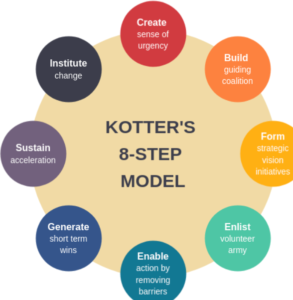
Step 1: Create a Sense of Urgency
Please click the following icon to access this assessment in full