(Solution) CIPD 5HR01 1.1 Differences between Employee Involvement and Employee Participation
Solution
Participation; Building Relationships
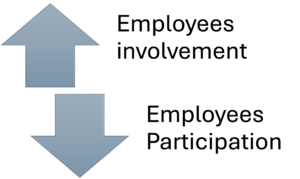
In an organisation business environment, employee involvement is an undertaking where the employees get involved to work with management. According to CIPD (2025a) involvement is by informing, consulting and involvement actively on organisation issues. There is no provision for making decisions by the employees, but this is left to the managers. In AnchorBridge context, the examples of this include annual-based surveys, whistleblowing hotlines, suggestion schemes presentation and the ‘Quiz Liz’. The outcomes of these in AnchorBridge would be improving interactions/communication and performance with a full management control maintained.
Employees Participation is on the other hand identified in Sentoso and Muchsinati (2024) as detailed scope of influences where the employees or reps are having an input to the organisation decision. In AnchorBridge, in the ‘Bridge’ platform, the employees possess a significant say in regard to organisation projects and workplace relations. Also, the EDI networks being collective voice mechanisms are relevant examples. Comparative to involvement, these are highly formalised and elaborate structure informed by statutory and collective agreement systems particularly in public sector organisations such as AnchorBridge.
Summarising their difference, with involvement enhancing commitment and input, priority in participation is sharing support and partnering. Their relevance in AnchorBridge is informed by sharing capacity and partnering a reflection of how powers are distributed.
Building Relationships
In an organisation such as AnchorBridge, owing to the various issues which have been impacting their operations, building relations is core. For example, the 3% pay increase would have been done through an embrace of Employee Involvement to build transparent relations. The rationale of this is active awareness and consultation in regard to organisation decisions impacting function.
According to Scott et al. (2022), the openness would assist in mitigating uncertainties, reduce resisting and assist trust-based relations with the management and employees. With transparency enhanced, the employees would not opt for taking home some of the cleaning materials as unofficial pay increase. With the employees involved in active listening of their insights, this would contribute to improving overall morale and having engaged teams.
Employee Participation
Please click the following icon to access this assessment in full
Related to: https://rankedprofessionals.com/downloads/solution-cipd-level-5-5hr01-saudi-arabia/