(Solution) Corporate Award Programme Assignment PDV
Solution
Executive Summary
In this report, ADNOC’s (Abu Dhabi National Oil Company) procurement of IT and Enterprise Resource Planning (ERP) systems (with specific focus on SAP Ariba), a platform critical to procurement, supplier collaboration and financial operations is examined. As part of ADNOC’s digital transformation journey, this spend category serves as an integral part of improving operational efficiency, cost management, compliance and supplier performance. This directly impacts internal stakeholders such as IT, Finance, Procurement, and Business Units, as well as external stakeholders such as vendors, consultants and regulatory bodies.
The report findings indicate that SAP Ariba has become a mission-critical system for ADNOC with which it enables standardized procurement processes and enhanced spend visibility. However, the stakeholder analysis conducted using the Mendelow’s Matrix and the RACI model showed that, although internal departments possess much power and interest, external vendors are reluctant to change because of contract rigidities. Further, the market analysis performed using STEEPLED, Porter’s five forces, Kraljic matrix and SWOT analysis shows that ADNOC’s reliance on long term, fixed contracts restrict the company’s ability to respond to market innovations and to test alternative vendors and maintain flexibility on pricing. Moreover, the absence of integrated AI tools and sophisticated analytics further weakens ADNOC’s ability to forecast and optimize spend, while cyber threats expose weaknesses in its digital supply chain infrastructure. Reliance on a single vendor also raises risk in the case of system disruption or vendor failure.
To close these gaps, the following recommendations are made:
- Deploy AI-driven analytics within SAP Ariba to enhance forecasting and real-time decision-making.
- Conduct structured market testing and benchmarking to improve competitiveness and pricing outcomes.
- Strengthen cybersecurity protocols to safeguard ERP data and operations.
- Shift to flexible contracts for non-core IT services to increase responsiveness to innovation.
- Implement a Supplier Relationship Management (SRM) system to improve vendor performance and collaboration.
Table of Contents
1.1 Organization’s Background. 4
2.0 ADNOC’s Stakeholders Analysis. 5
3.1 Market Size and Trends. 10
3.3 Porters 5 forces Analysis. 13
3.6 Impact of markets to secure cost savings. 16
4.0 Producing value for money outcomes. 16
5.0 Current approaches to managing prices and costs. 17
6.0 Conclusion and Recommendations. 18
Figure 1: ADNOC’s Current Operations. 4
Figure 2: ADNOC’s Stakeholder Categories. 6
Figure 4: The Mendelow’s Matrix. 9
Figure 5: Global Procurement Software Market Size. 10
Figure 6: Global Procurement Software Market, By Deployment 11
Figure 7: Porter’s Five Forces Analysis. 13
Figure 8: The Kraljic matrix. 14
Figure 9: ADNOC’s SWOT Analysis. 15
Figure 10: The 4Es Value for Money Model 17
Table 1: STEEPLED Analysis for ADNOC.. 12
1.0 Introduction
1.1 Organisation’s Background
The Abu Dhabi National Oil Company (ADNOC) is one of the world’s leading energy producers and contributes to the UAE’s economic growth. The company was founded in 1971 and currently operates various upstream, midstream and downstream operations (refer to Figure 1), producing approximately 4 million barrels of oil and more than 11.5 billion cubic feet of natural gas per day (ADNOC, 2025). The organization is based in Abu Dhabi and has several subsidiaries focusing on the exploration, production, refining, petrochemicals and logistics. ADNOC plays a strategic role in securing the UAE’s energy needs while supporting its global energy exports.
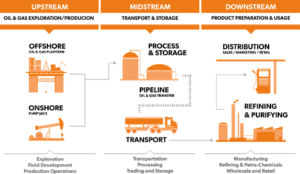
Figure 1: ADNOC’s Current Operations
Source: ADNOC (2025)
In recent years, the company has placed strong emphasis on digital transformation and operational efficiency, integrating advanced technologies such as artificial intelligence, big data, and enterprise resource planning (ERP) systems to modernize its operations (Nongrum, 2019). This commitment to innovation ensures ADNOC remains competitive, sustainable, and aligned with the UAE’s long-term economic diversification vision.
1.2 Category of Spend
IT and Enterprise Resource Planning (ERP) systems, with a specific focus on SAP Ariba, is the category of spend selected for this report. Central to ADNOC’s procurement, supplier management and financial operations, this cloud-based Platform facilitates efficient sourcing, contract management and supplier collaboration. SAP Ariba is one of the key components of ADNOC’s wider digital transformation strategy aimed at streamlining procurement processes, improving data transparency and improving operational control (Gayatri, 2019). ADNOC’s choice of SAP Ariba is largely driven by its ability to integrate with current IT infrastructure and enable adoption of enterprise-wide procurement standardization which is especially important given that the ERP market, in the energy sector in particular, is extremely competitive. This report will assess the importance, market landscape, procurement value outcomes, and cost management approaches related to this essential system.
2.0 ADNOC’s Stakeholders Analysis
Stakeholders are individuals, groups, or organizations that have an interest in, are affected by, or can influence ADNOC’s procurement, implementation, and operation of the SAP Ariba ERP system. According to Fernando (2024), they are directly or indirectly impacted by the system’s performance, procurement decisions, and overall contribution to operational and financial outcomes. These stakeholders can be internal, external or connected as show in figure 2 below;
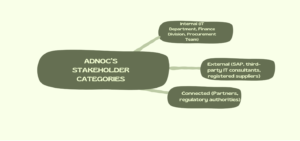
Figure 2: ADNOC’s Stakeholder Categories
Source: CIPS (2022)
Internal stakeholders: These are individuals or departments within ADNOC such as the IT Department, Finance Division, Procurement Team, and Business Units who rely on or manage SAP Ariba’s processes and infrastructure (Tam, 2023). The procurement of SAP Ariba is critical to them as it directly impacts operational efficiency, financial control, and procurement transparency.
External stakeholders: These comprises of vendors and service providers like SAP, third-party IT consultants, and suppliers registered on the Ariba platform who provide the ERP software, support services, and goods through the system (CIPS, 2022). SAP’s revenue and regional market presence depend on retaining ADNOC as a strategic client. Consultants gain from system implementation and support services, while suppliers require system access for tenders, orders, and payments, impacting their cash flow and business growth.
Connected stakeholders: This category is made up of partners and regulatory authorities indirectly linked to the procurement process through compliance, data security, and operational standards (Fernando, 2024). These parties value SAP Ariba’s ability to support compliance, enforce governance standards, and promote operational transparency. The system also aligns with national digitalization strategies, making procurement efficiency and data security crucial to broader stakeholder interests.
Further, to analyze the importance and impact of the identified stakeholders, we can use the Mendelow’s and the RACI Matrix to understand the positioning of these stakeholders.
2.1 The RACI Matrix
To effectively manage stakeholders involved in ADNOC’s procurement of SAP Ariba, the RACI Matrix provides a valuable framework. RACI stands for Responsible, Accountable, Consulted, and Informed, and is used to clarify stakeholder roles and involvement across each stage of the procurement and system management process (Matthews, 2024).
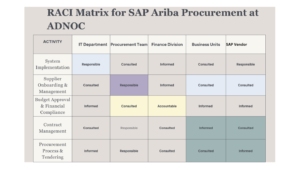
Source: Matthews (2024)
As evidenced in Figure 3, the RACI Matrix outlines the key responsibilities and involvement of ADNOC’s core stakeholders in the procurement and management of SAP Ariba. In this case, the IT Department and Procurement Team are marked as Responsible for system implementation, supplier onboarding, contract management, and ongoing system support. They handle the operational delivery of procurement and ERP-related tasks (Day, 2025). The Finance Division is Accountable for financial governance, budget approvals, and ensuring compliance with internal and external financial regulations.
Business Units and strategic partners are typically Consulted, providing operational requirements, feedback on system performance, and procurement needs to ensure that the solution aligns with end-user expectations. Meanwhile, suppliers, SAP as the vendor, and regulatory authorities are Informed about procurement processes, compliance expectations, and system changes impacting their interaction with ADNOC.
Overall, using the RACI Matrix helps ADNOC clarify responsibilities, reduce overlaps, and ensure efficient communication and decision-making. It enables the procurement team to manage stakeholder expectations, mitigate risks, and enhance collaboration throughout the ERP procurement and operational lifecycle.
2.2 The Mendelow’s Matrix
To further analyze the stakeholders involved in ADNOC’s procurement of SAP Ariba, Mendelow’s Matrix is an effective tool for categorizing stakeholders based on their power (influence) and interest (concern) in the procurement process (Weijers, 2025). This model can help ADNOC prioritize stakeholder engagement strategies, ensuring resources and communication are focused appropriately.
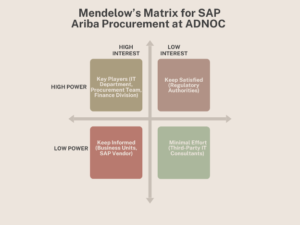
Figure 4: The Mendelow’s Matrix
Source: Francis (2024)
According to the Mendelow’s matrix, the IT Department, Procurement Team, and Finance Division possess high power and high interest, placing them in the ‘Key Players’ quadrant. Their power derives from decision-making authority over system integration, supplier selection, budget approval, and operational oversight (Cuofano, 2024). Their interest stems from the direct impact SAP Ariba has on procurement workflows, financial control, and system security (ADNOC, 2024). These groups must be closely managed and involved throughout the system’s procurement, implementation, and operational phases, as their decisions and inputs directly affect project success.
Regulatory authorities hold high power but lower interest, positioned in the ‘Keep Satisfied’ category. Their power lies in enforcing compliance, data governance, and procurement regulations, although their day-to-day interest remains minimal unless non-compliance arises.
Business Units have high interest but lower power, as system performance affects operational efficiency, supplier interaction, and procurement turnaround times. They sit in the ‘Keep Informed’ group.
Lastly, SAP and third-party IT consultants typically have moderate influence and variable interest, depending on contract terms, making them suitable for the ‘Monitor’ or ‘Keep Informed’ categories throughout the project lifecycle.
3.0 Market Analysis
3.1 Market Size and Trends
The global procurement software market is experiencing significant growth, driven by digital transformation and the increasing adoption of cloud-based solutions (Technavio, 2025). In 2025, the market is projected to reach approximately USD 9.82 billion, with expectations to grow to USD 15.75 billion by 2030, reflecting a Compound Annual Growth Rate (CAGR) of 9.92% (See Figure 5).
Figure 5: Global Procurement Software Market Size
Source: Data Bridge Market Research (2025)
This expansion is fueled by the demand for automation,………………………………….
Please click the following icon to access this assessment in full
Related: https://rankedprofessionals.com/downloads/solution-managing-expenditures-with-suppliers-pdv/