(Solution) CIPS Assignment 1 PDV ROSHN
Solution
Executive Summary
This report evaluates procurement within ROSHN, focusing on construction services as the most critical spend category. Construction accounts for the largest share of ROSHN’s expenditure and directly influences the success of its housing and community projects. The findings show that procurement in this category affects multiple stakeholders including internal project managers, finance teams, external contractors, regulators, and end-users. Effective management of construction procurement is therefore central to delivering sustainable value and achieving Vision 2030 housing targets.
Stakeholder analysis using Mendelow’s Matrix and the RACI framework revealed that project managers, procurement teams, and contractors hold high power and interest, requiring close engagement. Regulators and government bodies exert influence through compliance, while end-users, though less powerful, remain essential for ROSHN’s long-term reputation. The report finds that while ROSHN maintains clear accountability structures, earlier involvement of consultants and contractors is needed.
In addition, market analysis highlighted robust growth in the Saudi construction sector, driven by Vision 2030, with GDP contributions exceeding SAR 80 billion per quarter. However, the findings also identified inflationary pressures, labour shortages, and supplier power as significant risks. SWOT analysis showed ROSHN’s strengths in government backing and scale but weaknesses in reliance on imports and exposure to delays. Porter’s and STEEPLED frameworks further confirmed rising competition and regulatory pressures, balanced by opportunities in localisation and innovation.
Following these findings, the report provides recommendations as follows;
- Implement Cost Breakdown Analysis (CBA) across all high-value construction contracts to achieve greater transparency, fact-based negotiations and prevent inflated pricing
- Establish framework agreements to stabilise costs and protect against price volatility
- Develop a supplier localisation programme to strengthen domestic construction capabilities in line with Vision 2030
- Roll out an early-involvement protocol for all mega-projects, ensuring design and procurement risks are addressed upfront.
Table of Contents
2.0 Organisation Background and Selected Category. 5
2.1 Organisation Background. 5
2.2 Selected Category of Spend. 6
3.0 Importance of the Construction Category and Influence to ROSHN Stakeholders. 7
3.1 Importance of the Construction Category to ROSHN.. 7
3.2 Influence to Stakeholders. 8
3.2.1 The Mendelow’s matrix. 9
4.1 Relevant Market Trends. 13
4.3 Porters 5 forces Analysis. 17
5.0 Cost Management Approaches for ROSHN.. 19
6.0 Market Condition on Cost Savings. 20
7.0 Conclusion and Recommendations. 20
Figure 1: A Summary of ROSHN’s Core Products and Services. 5
Figure 2: A Summary of ROSHN Stakeholders. 7
Figure 3: The Mendelow’s Stakeholder Matrix. 9
Figure 5: Saudi Arabia GDP from Construction. 13
Figure 6: GDP in the Construction Sector in Saudi Arabia. 14
Figure 7: Saudi Arabia’s Gross Domestic Product (GDP) from Construction Sector 15
Figure 8: ROSHN SWOT Analysis. 16
Figure 9: Porter’s Five Forces. 17
Figure 10: Cost Benefit Analysis. 19
1.0 Introduction
Procurement is a vital function for ensuring cost efficiency, quality, and timely delivery in large-scale development projects (Overvest, 2025). This report will focus on construction as a primary category of spend within ROSHN. Construction spend represents a significant portion of the organisation’s budget and directly influences the success of its housing and community development projects. By examining this category, the report will highlight how procurement decisions shape project outcomes and stakeholder satisfaction.
The analysis will begin by identifying the importance of construction procurement and its impact on stakeholders, including internal teams, external contractors, regulatory authorities, and end-users. A structured stakeholder analysis will be applied to assess varying levels of influence and interest. The report will then provide a market overview of the construction sector, considering current trends, competitive dynamics, and supplier behaviours, to demonstrate how procurement can leverage market conditions to secure value-for-money outcomes.
Finally, the report will review ROSHN’s current approaches to managing construction-related costs and prices, evaluating strengths and limitations, while suggesting opportunities for improvement. The report will conclude with actionable recommendations outlining how procurement within construction can provide sustainable value, enhance efficiency, and align with ROSHN’s overall business goals.
2.0 Organisation Background and Selected Category
2.1 Organisation Background
ROSHN is a Saudi Arabian real estate developer, which delivers large-scale, modern, and sustainable communities. The organisation supports Vision 2030 by increasing homeownership, addressing housing shortages, and enhancing the quality of life through integrated urban developments (ROSHN, 2025).
The organisation offers a wide portfolio of products and services that extend beyond residential housing. These include construction of large-scale housing units, commercial facilities, and community infrastructure. Supporting services such as project management consultancy (PMC), supervision, lead design consultancy, land valuation, and facility management ensure projects are delivered to international standards of quality, safety, and sustainability. See a summary in Figure 1;
Figure 1: A Summary of ROSHN’s Core Products and Services
Source: ROSHN (2025)
Figure 1 highlights ROSHN’s integrated approach, where construction forms the core spend category supported by specialist services such as consultancy, design, and supervision. These products and services demonstrate why construction procurement is critical as it underpins not only residential and commercial delivery but also ensures long-term operational value through facility management and related services.
2.2 Selected Category of Spend
The selected category of spend for this report is construction services, which represents the largest and most critical expenditure area for ROSHN. Construction supports the organisation’s developments, encompassing the delivery of residential housing, commercial facilities, and supporting community infrastructure (Trade.gov, 2025). It also integrates sub-categories such as project management consultancy, supervision, design consultancy, land valuation, and facility management, all of which contribute to the successful execution and sustainability of large-scale projects as summarised in table 1.
Table 1: Sub-Categories Under the Construction Spend at ROSHN
Source: ROSHN (2025)
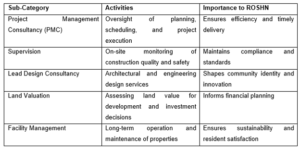
The importance of construction procurement lies in its direct impact on cost, quality, timelines, and stakeholder satisfaction. Decisions in this category influence internal stakeholders, such as project managers and finance teams, and also external ones, including contractors, regulators, and end-users of the communities. Due to its complexity and susceptibility to shifts in the market, construction procurement needs to be managed strategically to attain value-for-money results and to achieve the sustainable outcomes desired in ROSHN’s vision.
3.0 Importance of the Construction Category and Influence to ROSHN Stakeholders
3.1 Importance of the Construction Category to ROSHN
For ROSHN, construction is the most important category of spend because it facilitates the complex community developments underpinned by the company’s large-scale operations. It impacts cost control, project timelines, and the quality of housing and infrastructure delivered to end-users. Considering the residential, commercial, and lifestyle aspects of each project, effective construction procurement facilitates seamless execution across all phases (ROSHN Group, 2025). Beyond operational efficiency, it safeguards compliance with regulatory standards and sustainability commitments. The category’s scale and complexity make it essential for achieving ROSHN’s strategic goals, positioning it as a core enabler of Vision 2030’s ambition to increase homeownership and transform urban living in Saudi Arabia.
3.2 Influence to Stakeholders
Stakeholders are individuals or groups with an interest or influence in organisational activities, outcomes, or resources (Fernando, 2025). For ROSHN, stakeholders in the construction category can be grouped into internal, connected, and external categories as seen in Figure 2 below.
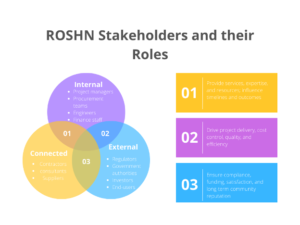
Figure 2: A Summary of ROSHN Stakeholders
Source: ROSHN (2025)
As illustrated in Figure 2, internal stakeholders include project managers, procurement teams, engineers, and finance staff who are directly responsible for cost control, quality, and delivery timelines. Their high involvement makes them central advocates for efficient procurement.
Connected stakeholders are parties with contractual or professional links to ROSHN, such as contractors, consultants, and suppliers. They strongly influence performance through their expertise, resource availability, and service quality (CIPS, 2022). While many are advocates, some may act as blockers when contractual disputes or delays arise.
External stakeholders consist of regulators, government authorities, investors, and end-users of ROSHN’s communities. Regulators and government agencies influence compliance and approvals, investors shape financial expectations, and residents determine satisfaction and long-term reputation.
After identifying ROSHN stakeholders, it is important to categorise and analyse them to ensure each stakeholder’s role and impact is realised in achieving value for money outcomes. To do this, the Mendelow’s matrix and the RACI Matrix will be used;
3.2.1 The Mendelow’s matrix
According to Francis (2025), the Mendelow’s Matrix provides a structured way to categorise stakeholders by assessing their power and interest (See Figure 3). For ROSHN, this is important in managing relationships strategically and aligning stakeholder roles with value-for-money procurement outcomes in construction.
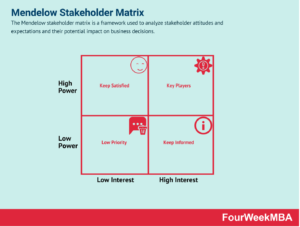
Figure 3: The Mendelow’s Stakeholder Matrix
Source: Cuofano (2024)
For ROSHN this matrix can be summarised as follows;
High Power-High Interest:Stakeholders such as project managers, procurement teams, contractors, and consultants are critical. They directly control cost efficiency, timelines, and quality, making them active advocates who must be closely managed. Effective collaboration with these groups ensures projects meet strategic and operational objectives.
High Power-Low Interest: Stakeholders like regulators, government agencies, and some investors hold authority to approve, fund, or enforce compliance. While they may not be engaged daily in project execution, failure to satisfy their expectations can cause costly delays or reputational damage. These stakeholders should be kept satisfied through compliance reporting and transparent communication (Cuofano, 2024).
Low Power-High Interest: For ROSHN, this includes end-users, residents, and local communities. While they cannot directly influence procurement decisions, their satisfaction is important for ROSHN’s long-term reputation and Vision 2030 objectives. Engaging them through feedback and community involvement helps ensure the developments meet societal expectations.
Low Power-Low Interest: For ROSHN, this quadrant covers suppliers and minor service providers whose influence on outcomes is limited. Although minimal effort is required, maintaining positive relationships with them supports supply chain flexibility and avoids risks of neglect.
3.2.2 The RACI Matrix
The RACI Matrix is a responsibility assignment tool that clarifies stakeholder roles in relation to project activities by defining who is Responsible, Accountable, Consulted, and Informed, as illustrated in Figure 4 below (Webster, 2025). Applying this model to ROSHN’s construction procurement ensures clear role allocation, prevents duplication of efforts, and supports delivery of value-for-money outcomes.
Source: Webster (2025)
Responsible: Project managers, procurement teams, and site engineers take ownership of day-to-day construction activities, supplier negotiations, and quality monitoring. Their responsibility ensures that costs are controlled, timelines are met, and safety standards are upheld.
Accountable: This is the role of senior management and executive leadership within ROSHN, who approve major procurement decisions, budgets, and contracts. They ensure that resources are distributed according to strategic goals.
Consulted: This category of stakeholders involves contractors, design consultants, and supervisory firms who provide technical skill as well as relevant market expertise. Their expertise is invaluable in evaluating proposals, improving designs, and mitigating the associated risks. Involving them in decision-making enables ROSHN to get external expertise to enhance efficiency and innovation.
Informed: This category of stakeholders entails regulatory bodies, investors, and end-users. Compliance updates are provided to regulators and government agencies, while investors are updated on the financial and milestone achievements of the project. Although end-users are not directly involved in procurement, they must be informed about delivery timelines and community features, as their satisfaction determines long-term success.
The RACI Matrix table can further summarise these roles as shown below;
Table 2: The RACI Matrix Table
Source: Harned (2025)
Table 2 highlights stakeholders and their responsibilities regarding the construction procurement process within ROSHN and how roles are defined for effective collaboration and accountability. Responsible roles, such as procurement teams, project managers, and site engineers ensure operational execution through supplier selection, construction delivery, and compliance monitoring. Accountable roles, held by senior management and executive leadership, provide oversight by approving budgets, contracts, and ensuring alignment with strategic goals. Consulted roles include contractors, consultants, and supervisory firms, who contribute expertise in design, risk management, and technical input, strengthening decision-making processes. Finally, Informed stakeholders such as regulators, investors, and end-users are updated regularly to maintain transparency, compliance, and confidence in project progress.
4.0 Market Analysis…………..
Please click the following icon to access this assessment in full