(Solution) CIPS Driving Value through Procurement & Supply AND Managing Expenditures with Suppliers
Solution
4.1.1 Importance of Category of Spend in the Organisation. 7
4.1.2 Impact – Risk of Stationery Spend Category. 8
4.2.1 Brief Market Analysis 11
4.2.2. Demonstrate how your procurement function will produce Value for money. 13
4.3 Review the current approach: 13
4.3.1 Pre-Qualification and Registration Process 13
4.3.4 Sourcing / Bidding Process 15
4.3.4 Performance Evaluation. 15
4.4 Highlight the impact of the market to secure cost savings 16
Figure 1:Company XXXXX strategic solutions (Sources from company documents) 5
Figure 2:5Rs of the Procurement model 6
Figure 3:Triple Bottom Line (TBL) Model 7
Figure 5:Kraljic Matrix model (CIPS, 2022). 9
Figure 6:Mendelow’s Matrix. 11
Figure 7:Porter’s Five Forces – Stationery Market (Saudi Arabia) 12
Figure 8:Total Cost of Ownership (TCO) in XXXXX.. 18
Table 1:Monthly Stationery Expense Breakdown: Sourced from organisation data. 8
Table 2:Stationery Spend – Risks and Mitigation Matrix, 10
Table 3: Stkeholders categories summary. 10
Table 4:Request for Quotation (RFQ) Process Overview.. 15
Table 5:Sourcing Process – Gaps and Recommendations 16
Table 6:Supplier Performance Evaluation Criteria. 17
1.0 Executive Summary
This report investigates the procurement activities of Company XXXXX, an organization supported by Saudi government, which was started in the year 2010 to encourage economic growth and innovation. On the one hand, in the context of the indirect spend category, i.e., stationery, the analysis demonstrates how procurement, as a strategic process, can bring value in terms other than cost reduction.
The process of procurement was evaluated based on the following models: the 5Rs of Procurement, Mendelow Matrix, Kraljic Matrix and Triple Bottom Line (TBL). Through these models, it was demonstrated that even a non-critical product such as stationery has the capabilities of impacting on operational efficiency, sustainability and stakeholder satisfaction when sourced strategically. Close examination of the expenditure information revealed efficiency in expenditure as well as saving opportunities in the existing practices.
The most important findings are that procurement can be seen as a cost gate keeper, and is only loosely incorporated in the early stages of strategic decision making. There exists poor relationships with internal stakeholders, transactional relationships with suppliers and paper based processes that lack uniformity across the departments.
Recommendations:
- Transformation of the internal perception of procurement role.
- Enhance internal customer relationships through SLAs and communique.
- Be proactive in the management of services by use of category planning.
- Build supplier association with SRM systems and cooperation.
- Digitize and automate the procurement process and standardized processes.
- Life-long training and development should be provided to the procurement personnel.
The above changes will bring about procurement as a strategic role to bring the procurement to the next level with efficiency and risk management with sustainable value creation translated across the Company XXXXX.
2.0 Background
Company XXXXX has been established in 2010 with a capital of 100 million SAR and is an arm of the Saudi government, which executes public-private partnerships. It aims at economic promotion, augmentation of human resources, and augmentation of business infrastructures, and provision of economic stability. Using dedicated subsidiaries, XXXXX provides strategic mobility, workforce enabling, smart cities, and digital transformation solutions (see figure 1).
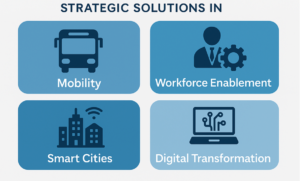
Figure 1:Company XXXXX strategic solutions (Sources from company documents)
In summary, the model delivers integrated solutions through four pillars: strategic mobility enhances transport and logistics; workforce enabling boosts employee productivity; smart cities improve urban living through technology; and digital transformation modernizes operations with AI, automation, and cloud-based innovations.
3.0 Introduction
Procurement has been defined as that strategic task of obtaining goods and services, needed by the operations of an organization. It guarantees the access of resources in the correct quantity, quality, at the correct time, source, and at the correct price that is the 5Rs of Procurement which is common terms used (CIPS, 2025c). Procurement, in the case of modern enterprises, particularly those with support by the government such as XXXXX, is more than the purchasing process, it is one of the elements of cost effectiveness, risk reduction, and sustainable value creation.
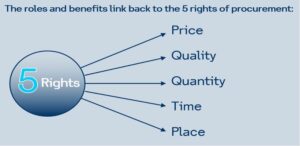
Figure 2:5Rs of the Procurement model
Source: CIPS Module Notes
In summary, Company XXXXX procures stationary effectively using five rights methodology: get the right supplies to the right people to increase employee efficiency and satisfaction, obtain right quantity to avoid overstocks and shortages, get great supplies at right time to avoid disruption, get the right suppliers with the right suppliers who are responsible, ethical, and cost-effective to ensure sustainability, get competitive prices when procuring stationary through competitive bidding to ensure obtaining the right value. These principles correspond to the best procurement practices, which prioritize strategic sourcing, evaluation of suppliers, and cost effectiveness (Ogechi et al. 2024).
Successful procurement has direct effects on the performance of business in that it streamlines expenditures, it can facilitate compliance to existing regulations and it also facilitates business continuity. Indirect sourcing, such as on stationery that can be neglected, can be done strategically to achieve up to 15% cost savings, through Category Management, as an example (CIPS, 2023). Procurement assists all the stakeholders internally including finance, operations, and HR as well as external stakeholders including vendors and regulators. An example of mapping the influence and the interest of the stakeholders is the Mendelow Matrix, which has been used to facilitate the engagement of the stakeholders accordingly (figure 5) (CIPS, 2025).
Total Cost of Ownership (TCO) and Triple Bottom Line (TBL) products are also used to optimize value, so that the result of the procurement process considers the cost implications but also the social and ecological effects of the products acquired (Jurevicius, 2024).
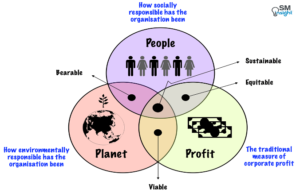
Figure 3:Triple Bottom Line (TBL) Model
Source: CIPS Module Notes
People: The Company XXXXX enables workforce, inclusive growth, and public-private partnership to empower people. It promotes national objectives in the labor market, fairness and it enhances innovation.
Planet: XXXXX is devoted to environmental responsibility via intelligent cities, digital services, and sustainability sourcing.
Profit: XXX makes sure that it is financially viable through the relationship between price, threat, and worth. It becomes efficient and stable through the process of strategic procurement, digital tools, and long-term contracts.
4.0 Task
4.1 Category of Spend
The Indirect Spend category includes stationery items and any other goods not associated with production but necessary to perform daily operations. They are paper, pens, folders, and printer cartridges (Figure 1). Even though it is not directly connected with revenue generation, a successful control of stationery expenditure can make expenses and cover administrative expenses (Table 1). In a government-supported establishment such as XXXXX, strategic sourcing of such consumables will improve transparency, cost effectiveness, and sustainability in the establishment. CIPS (2023) estimates that up to 15 percent savings can be realized using optimal procurement of indirect spend categories in organizations.
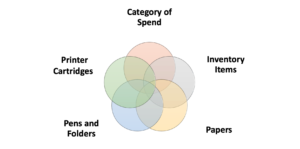
Table 1 assists in analyzing what items take the largest percentage of the stationery expenditure to assist in optimizing costs and negotiations with suppliers.
Table 1:Monthly Stationery Expense Breakdown: Sourced from organisation data.
4.1.1 Importance of Category of Spend in the Organisation
Stationery is an indirect spend category, which is important in the management of costs and efficiency of operations at XXXXX.
Figure 5:Kraljic Matrix model (CIPS, 2022).
Non-critical: Using the Kraljic Matrix, stationery would also be classified in the non-critical quadrant since the risk is low as well as the impact on profit (Figure 1).
Leverage items: possess big positive influence on the profit with small hazard and permit cost benefits.
Strategic items are both high risk and impact to the profits and need to be managed carefully with the suppliers.
Bottleneck items: they are low profit effect but high risk requiring management in order to avoid supply hitches.
Nevertheless, the consolidated procurement can lead to the achievement of considerable savings and increase the reliability of supplying the resources. Under supplier standardizations, the organization will be able to maintain a smooth administrative process with minimum waste (CIPS, 2022b). According to Monczka et al. (2021), efficient category management enhances visibility, promotes strategic sourcing, as well as meets sustainability objectives.
Stationery is a low-risk category where the lack of proper management may be the cause of operational failures, including budget and efficiency decline among employees. The risks, such as the delay in supply, quality problems, and overconsumption, can occur. As shown in Table 2, there are also standard risks and mitigation mechanisms that help an organization to maintain its operations and efficiency. Reputational risk, caused by inefficiencies of the procurement process, is also an issue in a government organization such as XXXXX. Schiele (2019) believes that low-risk categories need to be managed structurally to facilitate the value of money and continuity of operations.
Table 2:Stationery Spend – Risks and Mitigation Matrix,
4.1.3 Stakeholders
Here is a new stakeholder mapping table for Organisation XXX. Sourced from Organisation documents.
Table 3: Stkeholders categories summary
Knowledge of stakeholder interest and influence is crucial in the procurement management of stationery. Through the help of the Mendelow Matrix (Figure 5), stakeholders are grouped to facilitate intervention tactics (CIPS, 2025).
- Key players: (Board of Management, Procurement Heads) possess high power and interest and will have to be actively involved.
- Keep satisfied :( Suppliers, IT Managers) possess high power, low interest, and they require a strategy to update information.
- Keep informed: Tendering Teams, Admin Staff are low-powered and highly interested.
- Minimal effort: (General Employees) need low communication. Effective stakeholder mapping guarantees openness, encouragement, and clean procurement.
4.2 Prepare a brief market analysis and demonstrate how your procurement function will produce Value for money./……..
Please click the following icon to access this assessment in full
Related;https://rankedprofessionals.com/downloads/solution-corporate-award-programme-assignment-pdv/