(Solution) CIPS Advanced Practitioner Assignment 1 APGLM
Solution
Executive Summary
In this first module of Advanced Practitioner qualification, an analysis of leadership and management strategies is pursued. This is by focusing on ROSHN Group in Saudi Arabia (KSA). The areas of interest have been inclusive of organisation behaviours, stakeholders’ powers, satisfaction in assigned roles, equality and diversity. In order to achieve the intended aim of this report, the data has been sourced quantitatively by use of survey, different models (Kotter’s leadership, Blake and Mouton’s Managerial Grid, Leadership-membership exchange theory and congruence theory. Also, the CIPS Module Notes have been used in guiding the analysis. The key findings in this report note that in ROSHN Group, they primarily pursue task-based approach rarely prioritising on her staff in regard to engaging, empowering and well-being . Further, existence of well-structured and compliance-based cultural strategies lead to implementing top-down leadership strategy. Despite of its effectiveness in guiding operations management, it negatively impacts team-based working, flexible and trust relations.
Further, for the findings on satisfaction, the key findings evidence on existence of a positive relationship of leadership and management and satisfaction. The findings identify these to be in areas of how effective they are, offer support and communication. The findings highlight lack thereof of these contribute to issues with motivation and morale. ROSHN owing to nature of their operations have uneven distribution of individual power. The areas of operations, technical dominate owing to real estate sector demand. These findings were supported by using French and Raven 5 Bases of Power.
With ROSHN Group evidencing inclusivity in recruitment of different people of varying gender and origin. Also, their resourcing is diverse and informed by the KSA Saudisation policy embrace. With a formalised support inexistence, inclusion is distinctly interpreted.
From the challenges noted, a set of findings are recommended including;
- Pursing cross-functional consultations for improving inclusivity and engagement levels
- Enhancing existence of formalised Equality and Diversity (E&D) policies for alignment of Saudi vision 2030 hence enhanced fair-based practice and inclusivity
- Implementing leadership and management development initiatives for enhancing controls and people centric leadership approaches
Table of Contents
1.1 Organisation Background. 3
2.0 Leadership and Management Impact on Organisational Behaviour. 5
2.2 ROSHN Leadership Style Factors and Forces Influencing it 7
2.3 Internal Factors which Affect Organisation Behaviours. 9
2.4 External Factoers which impact Organisation Behaviours. 10
2.5 Identified Gaps and Areas for Development 11
3.0 Leadership Strategies Impact on Job Satisfaction. 13
3.1 ROSHN Job satisfaction Context 13
3.2 Impacts of Leadership Strategies on job Satisfaction. 17
3.3 Leadership Concern on Wellbeing. 18
3.4 Summary Improvement Areas. 18
4.0 Power Sources in Organisations. 18
4.1 Summary of ROSHN Group Stakeholders. 18
4.2 Individual Power Sources. 21
5.0 Equality and Diversity Policies Relevance. 23
5.1 Equality and Diversity Policies in ROSHN Group. 24
6.0 Conclusion and Recommendations. 24
Figure 1:Summary of ROSHN Organisation operations. 5
Figure 2:Kotter’s Leadership Vs. Management Framework. 7
Figure 3:Leader-Member Exchange Theory. 8
Figure 4:ROSHN Organisation Departments. 9
Figure 5:Blake Mouton Grid.. 10
Figure 6:Components of Organisation Behaviours. 11
Figure 7:Nadler-Tushman Congruence Model 12
Figure 8:Summary of Tannenbaum Schmidt Leadership Continuum… 14
Figure 9:McKinsey 7s Framework. 15
Figure 10:Leadership and support relations with job satisfaction.. 16
Figure 11:Communication and Trust Findings. 17
Figure 12:Respondents Findings in regard to organisation culture and behaviours. 18
Figure 13:Job satisfaction impacting employee diversity and equality. 19
Figure 14:ROSHN Group Stakeholders Classifications. 21
Figure 15:Summary of components of Mendelow Stakeholders Matrix. 22
Figure 16:Classifications of the powers of different stakeholders. 23
Figure 17:5 forms of power. 24
Figure 18:Yukl and Falbe’s Influence strategies Model 25
1.0 Introduction
1.1 Organisation Background
ROSHN organisation operates in Saudi Arabia (KSA) Real Estate as a community-based projects development. According to ROSHN (2025), it is a Public Investment Fund (PIF) owned organisation ranked as a leader in wealth funding. PIF owned organisation, they prioritise on pursuing sustainable and strategic investments in KSA and expanded 40% of their operations internationally. For ROSHN organisation, operating in real estate, it is anchored on enhancing and developing popular residents;
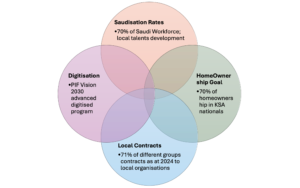
Figure 1:Summary of ROSHN Organisation operations
Source: Summarised from ROSHN (2025a )
Considering ROSHN is ranked to be the most popular real estate development organisation in KSA, the Ministry of Housing (ROSHN, 2025b). Also, a different level of leadership is National Housing Company (NHC) ensure that they achieve 70% of the entire ownership as at year 2030 (ROSHN, 2025). A major ROSHN goal is working by partnerships with local players for jobs creation targeting Saudi Nationals. Further, their management is collaborating with the Saudi Vision 2030 for guaranteeing an increased Quality of Life initiatives.
In the organisation, I work as a Supply Chain Senior Specialist in ROSHN’s Procurement and Vendor Relationship Management (VRM) team. I am tasked with a responsibility of preparing bind lists, management of supplier’s pre-qualification scope and due diligence. This is at the same time coordinating internal stakeholders and external suppliers to comply with entire procurement policies and achieving vision 2030 demands. Also, I ensure supporting suppliers’ active engagement through SMEs involvement and Tier ¾ contract for enhancing competitiveness, costs management and project results implications.
1.2 Scope of Report
In this report, the focus is on evaluating the impact of leadership and management. This is in the areas of organisation behaviours, job satisfaction, and power dynamics. In order to achieve this, ROSHN organisation is used. Further, part of this report also includes evaluating Equality and Diversity in organisation operation and culture strategy.
By focusing on ROSHN, their different departments are put into account to understand scope of Leadership Style influencing Team-based dynamics and wellbeing in these levels. This is in terms of scope of people and departments power impacting active collaboration and actively making decisions.
2.0 Leadership and Management Impact on Organisational Behaviour
Adopting Gavin (2019) research, leadership is a process of influencing, guiding how vision is set, and people support in change process. The effectiveness of leadership process is inspiring, motivating and aligning people to achieve common set goals. Conversely, Martins (2025) define the process of management as pursued to plan, organise, engage and maintain scope of control in Kotter’s Leadership compared to Management Framework;
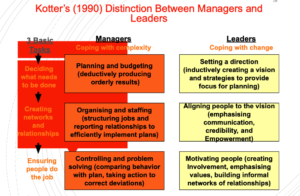
Figure 2:Kotter’s Leadership Vs. Management Framework
Source: Jıbreal (2021)
By referencing on Kotter’s Leadership Vs. Management Framework, ROSHN scope of operations is primarily anchored on management behavioural strategies. For instance, in Vendor Relationship Management (VRM), decision making is anchored and procedure-based with contractual process implemented strictly in line with policies in place. In line with Hamilton (2023), the leadership strategy enhances compliant teams and controlling risks.
For appreciation relational dynamics in ROSHN Teams, Leader-Member Exchange (LMX) Theory are relevant (Sa’adah & Rijanti, 2022);
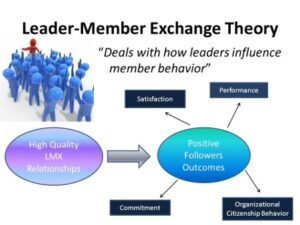
Figure 3:Leader-Member Exchange Theory
Source: (Sa’adah & Rijanti, 2022)
Managers operate through various in-groups which are made up of highly trusted team members who grant autonomous and inclusivity in core decision making. Also, out-group teams gain core communication opportunities and guidance hence disparity in engagement, motivated and trust-based teams. According to Cuofano (2024), the tiered interactions strategies impact broad organisation behaviours, lower openness scope and departmental cooperations.
In conclusion, despite ROSHN organisation structure demanding detailed management, there lack opportunity for operating leadership behaviours encouraging adaptable teams, autonomous cooperation and vision-driven alignment;
Figure 4:ROSHN Organisation Departments
Source: (ROSHN, 2025)
2.2 ROSHN Leadership Style Factors and Forces Influencing it
ROSHN leadership style is anchored on a set of organisation and environment forces. Basically, ROSHN implement authoritarian or directive strategy specifically in real estate’s technical and operation segments. Having more than 2,500 employees, these departments need high-level compliant requirements, health&safety and precise operations.
In my department which is VRM, transactional approach is a common undertaking. According to CIPS (2025), the transactional style is popular informed by need to meet overall target for productivity and adhering strictly to vendors appropriate relations (ROSHN, 2025b). In order to further illustrated this, the Blake and Mouton Leadership Grid is relevant;
Source: TechTarget (2025)
In ROSHN organisation, majority of leadership are aligned with 9,1 which is Authority-Comliance Management classification which is “high on task; low on people”. With these enhancing efficiencies, controlling and predictable practices, it reduces scope of being engaged and flexible core factors for Adaptive Organisational Behaviours ( Fripp, 2023).
The identified styles are also aligned with ROSHN scale of operations, regulations in place and KSA Top-Down Culture strategies/norms in collective encouraging direct leadership process. According to Shonk (2024), the outcome is employees gaining the essential discipline and compliance levels while at some time being reactive and customised to cross-functional teamwork and change-based initiatives.
2.3 Internal Factors which Affect Organisation Behaviours
In ROSHN organisation, their behaviours are impacted by set of internal aspects. These are identified in CIPS (2025a) these are classified as follows;…………………
Please click the following icon to access this assessment in full