(Solution) Assignment 2 PDC Terms and Conditions
Solution
Executive Summary
This report evaluates how TAQA Water Solutions (TWS) applies its General Terms and Conditions (T&C) to manage procurement and contract execution risks in high-value, high-risk infrastructure projects, such as network construction. The analysis focuses on four core risk areas: poor quality, extension of time, increased cost, and unethical practice, assessing the contractual provisions governing each, their legal enforceability, and performance monitoring mechanisms. TWS’s T&C are tailored to safeguard operational, financial, and ethical interests, with express conditions that allocate risk to the party best positioned to manage it.
The findings of the report indicate that quality risk is mitigated through Clause 1.1.31 (Approval of Technical Deliverables), supported by audit rights, staged approvals, and rejection of defective work. Delays are managed under Clause 1.1.15 (Delay in Milestones) and related provisions on variations, force majeure, and liquidated damages, ensuring only justified extensions are granted. Cost control is embedded in Clause 1.1.13 (Payment Terms), linking disbursements to approved deliverables and enabling deductions for non-performance. Ethical compliance, mandated under Clause 1.1.4 (Whistleblowing, Fraud and Corruption), is reinforced by flow-down obligations to subcontractors and audit provisions. Performance management is embedded through milestone-linked payments, inspection rights, and audit mechanisms, with opportunities for supplier feedback. The Balanced Scorecard model could strengthen this further by integrating financial, customer, process, and learning perspectives into contract monitoring. The “battle of the forms” risk is addressed through Clause 1.1.1 (Contract Documents), ensuring TWS’s terms prevail, supported by procedural controls to maintain contractual precedence.
As a result of these findings, the following recommendations are made:
- Embed a supplier innovation and continuous improvement clause in all high-value contracts, targeting a 15% efficiency and project value gain.
- Implement structured benchmarking of KPIs against UAE infrastructure projects to improve scores by 20% in one year.
- Establish a multi-tier subcontractor compliance monitoring framework to ensure 100% alignment with ethical, quality, and safety clauses.
- Strengthen battle of the forms safeguards through procurement staff training and a standardised acceptance protocol to achieve zero disputes over T&C precedence.
Table of Contents
2.0 Organisation Background. 5
4.0 Ways TWS Apply its General Terms and Conditions. 8
4.1 To Manage the Risks of Poor Quality. 8
4.2 Managing the Risks of Extension of Time. 10
4.3 Managing the Risks of Increased Costs. 12
4.4 Managing the Risks of Unethical Practice. 14
4.5 Relevant Performance Measures Used in the Contract 15
5.0 The concept of the “battle of the forms” in TWS Contract. 17
5.1 Ensuring Any Agreement is Carried Out Under TWS Own Terms and Conditions. 18
6.0 Conclusion and Recommendations. 19
Appendix 1: TAQA Water Solutions (TWS) General Terms and Conditions. 25
Figure 1: Key Service Areas of TAQA Water Solutions (TWS) 6
Figure 2: Risk register chart for “Risk of Poor Quality” in TWS contract 10
Figure 3: Classification of TWS Contract Delays and Their EOT Implications. 11
Figure 4: The CIPS Ethical Supply Chain Framework. 15
Figure 5: The Balanced Scorecard. 17
Table 1: A summary of TWS General Terms and Conditions. 7
Table 2: TWS Risk Register in Contracts. 9
Table 3: The fixed-payment schedule in TWS Contract 14
Table of Abbreviations
| Abbreviation | Definition | |
| 1 | TWS | TAQA Water Solutions |
| 2 | T&C | Terms and Conditions |
| 3 | ADSWS | Abu Dhabi Sustainable Water Solutions |
| 4 | PM | Project Manager |
| 5 | QA | Quality Assurance |
| 6 | QC | Quality Control |
| 7 | KPIs | Key Performance Indicators |
| 8 | EOT | Extension of Time |
| 9 | LD | Liquidated Damages |
| 10 | HSE | Health, Safety and Environment |
1.0 Introduction
TAQA Water Solutions (TWS), a subsidiary of Abu Dhabi National Energy Company, plays a pivotal role in delivering sustainable water infrastructure and management solutions across the UAE. Specialising in wastewater treatment, desalination, and network services, TWS supports national objectives for water security and environmental stewardship (TAQA Water Solutions, 2025). This report examines how the organisation’s General Terms and Conditions (T&C), specifically applied to high-value, high-risk projects such as network construction, function as a strategic tool for risk allocation, quality assurance, performance monitoring, and ethical compliance.
The T&C are tailored to safeguard against risks of poor quality, project delays, escalating costs, and unethical practices. They embed clear clauses on quality standards, milestone adherence, pricing frameworks, anti-corruption measures, and dispute resolution, ensuring that obligations are legally enforceable and operationally transparent. By allocating specific risks to the party best positioned to manage them, TWS minimises the likelihood of cost overruns, time extensions, and reputational damage. In addition, the T&C outline robust performance management mechanisms, linking payment milestones to deliverables and incorporating provisions for audits, inspections, and penalties for non-compliance. This framework supports continuous monitoring and encourages accountability between TWS and its contractors. The report will also explore the “battle of the forms” concept, evaluating how TWS can ensure contractual engagements operate strictly under its own T&C. The report will conclude with recommendations on how TWS can enhance its T&C to further strengthen risk management, compliance, and performance outcomes.
2.0 Organisation Background
TAQA Water Solutions (TWS) operates as a specialist subsidiary of Abu Dhabi National Energy Company, focusing on the delivery of sustainable water and wastewater services across the UAE (TAQA Water Solutions, 2025). Established to address the nation’s growing demand for efficient water management, TWS’s portfolio covers wastewater treatment, desalination, sewer network construction, and return-to-sewer projects (See Figure 1).
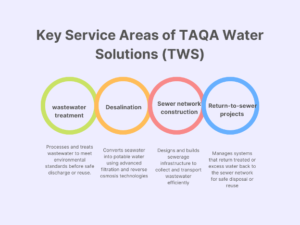
Figure 1: Key Service Areas of TAQA Water Solutions (TWS)
Source: TAQA Water Solutions (2025)
Its operations summarised in Figure 1 above align with the UAE’s strategic objectives for water security, environmental sustainability, and infrastructure resilience. TWS works closely with government entities, municipalities, and private sector partners to deliver high-quality, compliant, and cost-effective solutions. The organisation’s approach integrates advanced engineering, strict health and safety protocols, and robust contractual frameworks to ensure projects are delivered on time, within budget, and to specified quality standards (TAQA Water Solutions, 2025). By embedding strong governance in its General Terms and Conditions, TWS safeguards against operational, financial, and ethical risks, positioning itself as a trusted leader in the region’s water infrastructure sector.
3.0 TWS Contract Context
The TWS contract under review is governed by its bespoke Volume 1 General Terms and Conditions (T&C), tailored for high-value, high-risk projects. These terms are designed to safeguard quality, control timelines, prevent cost escalation, and ensure ethical compliance. They clearly define the roles and responsibilities of both TWS (as client) and the consultant, establishing a legal and operational framework for delivering projects efficiently and transparently (Refer to Appendix 1). The T&C also embed robust mechanisms for performance monitoring, including milestone-based payments, quality audits, right-of-audit provisions, and penalties for non-compliance. Risk allocation is carefully structured so that the party best positioned to manage each risk assumes responsibility, reducing the likelihood of disputes, delays, or financial loss. A summary of this contract is provided in table 1 as follows;
Table 1: A summary of TWS General Terms and Conditions
Source: TAQA Water Solutions (2025)
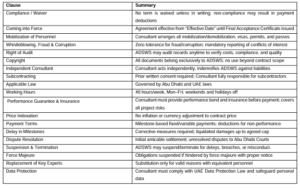
These are core clauses within Volume 1 of the General Terms and Conditions, each highlighting its primary intent, showing how the contract addresses operational, financial, legal, and ethical considerations.
4.0 Ways TWS Apply its General Terms and Conditions
4.1 To Manage the Risks of Poor Quality
In the context of this contract, quality refers to the standard of deliverables and services required to meet the technical specifications, performance criteria, and compliance obligations outlined in the Terms and Conditions (T&C) (Taqa Water Solutions, 2025). It is measured through milestone inspections, technical reviews, and adherence to approved designs, ensuring outputs meet both contractual and regulatory requirements. The aspect of quality is further enhanced under Clause 1.1.31. on Approval of Technical Deliverables, which requires all technical documents to be formally approved by ADSWS within an agreed timeframe, while making it clear that such approval does not absolve the consultant from correcting any errors or defects identified later.
This clause is a condition, as it directly affects project acceptance and completion, and an express term, being explicitly stated in the contract (Powell, 2025).
Further, risk management for poor quality is achieved by combining preventive and corrective controls (Hoare, 2025). Preventive measures include defining technical specifications at contract inception, requiring compliance with regulatory standards, and approving subcontractors (Clause 1.1.8) to ensure competency. Corrective measures include rejection of non-conforming deliverables, withholding of payment until rectification, and application of liquidated damages (Clause 1.1.20) if delays result from rework.
These controls are supported by a risk register that tracks probability and impact, assigns responsibilities, and documents mitigation actions (See table 2)
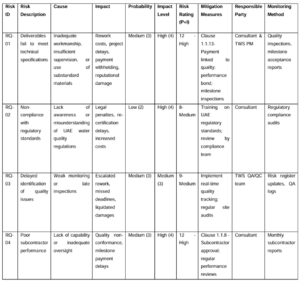
Table 2: TWS Risk Register in Contracts
This can be further summarised in the Figure below;
Figure 2: Risk register chart for “Risk of Poor Quality” in TWS contract
The risk register in Table 2 and Figure 2 identifies high-risk areas such as failure to meet technical specifications and subcontractor underperformance (>=12), both mitigated by payment withholding until quality standards are met. Medium risks (8-11), including regulatory non-compliance and late defect identification, are addressed through audit rights and staged approvals. The contract protects against poor quality through remedies including non-payment, rejection of defective work, application of liquidated damages, and recourse to performance guarantees (See Appendix 1). However, Twin (2025) explain that gaps may occur where quality benchmarks are not defined in measurable KPIs, potentially leaving room for interpretation disputes, although these can be supported by statutory implied duties. The statutory implied duties ensures all the stakeholders work in active collaboration in their entire assigned roles in the contracts implementation.
4.2 Managing the Risks of Extension of Time
In this contract, “Extension of Time” (EOT) refers to………….
Please click the following icon to access this assessment in full