(Solution) CIPS ENOC PSE Sourcing Essentials
Solution
Executive Summary
The aim of this report is to evaluate the different approaches to sourcing with specific focus on Lubricants and Specialty Oils at ENOC, which account 40 percent of the overall procurement costs of the company. As a result, effective sourcing in this category ensures continuity of the operations, performance, safety, and cost effectiveness. The analysis employs the strategic procurement models, market analysis and supplier evaluation tools in developing evidence-based sourcing decisions.
Using the Kraljic Matrix, Lubricants & Specialty Oils are strategic products with high supply risk and high business impact and hence need strong sourcing approaches. The Business Hierarchy of Needs helps to align procurement priorities with organisational objectives in the areas of continuity, risk management, working with suppliers and helping to create long term value. Stakeholder analyses, including Mendelow’s Matrix and Peter Block’s model, are used to ensure that key stakeholders are engaged and insights are gathered from technical, operational and executive teams.
Market and competitive situation, using Porter’s five forces, and SWOT analysis show that there is high supplier power, intense competitive rivalry, and emerging substitutes. However, there is also opportunity in digital procurement, regional expansion and renewable energy collaborations. The Supplier Preferencing Model, and Five Rights of Procurement, provide additional guidance in choosing sourcing strategies to find a balance between quality, cost and supply assurance.
The report highlighted a number of gaps such as dependence on single suppliers for key products, lack of consistent management of multiple suppliers, and lack of structured supplier performance monitoring. Several recommendations are made which include:
- Use dual sourcing for critical Lubricants and Specialty Oils, to reduce the reliance on one supplier and ensure supply continuity.
- In cases of less critical grade of lubricant, use multiple sourcing to leverage competitive pricing and become more responsive to market changes.
- Implement a structured supplier performance monitoring program tied to the sourcing approach, to monitor delivery, quality, and technical support.
Contents
1.1 Organization Background. 4
1.3 The Kraljic Analysis Tool 7
1.4 Business Hierarchy of Needs 8
2.2 Peter’s block stakeholders’ categories Analysis 11
3.0 Analysing ENOC’s Current Situation of the Sourcing Plan. 12
3.3 Supplier Preferencing Model 15
3.4 The Five Rights of Procurement 15
4.0 Sourcing Approaches and their Application to Lubricants & Specialty Oils Category. 16
5.0 Supplier Appraisal Check List 18
6.0 Conclusion and Recommendations 20
Figure 1: ENOC’s Procurement Spend Distribution by Category. 7
Figure 2: The Kraljic Analysis Tool 8
Figure 3: Maslow’s Hierarchy of Needs. 9
Figure 4: The Mendelow’s Matrix. 10
Figure 5: Peter’s block stakeholders’ categories 11
Figure 6: Porter’s Five Forces 13
Figure 8: Supplier Preferencing Model 15
Figure 9: The Five Rights of Procurement 16
Figure 10: Carter’s 10 Cs of Supplier Evaluation. 18
Table 1: Summary of ENOC’s Portfolio Activities 5
Table 2: ENOC’s Supplier Evaluation using Carter’s 10 Cs 19
1.0 Introduction
Sourcing is a core component of procurement and supply chain management activities as it has a direct impact on cost, quality, continuity of supply, level of risk, and organisational value (Jonker, 2025). Selecting the most appropriate sourcing approach requires an understanding of market conditions, supplier availability, business objectives and the criticality of the goods or services being procured. This assignment discusses four approaches to sourcing: single sourcing, sole sourcing, dual sourcing and multiple sourcing and how they can be appropriately applied to different categories of organisational spend. The purpose is to show how the sourcing decisions vary depending on the level of risk, competition, dependency, needs for innovation and the capabilities of the suppliers. After exploring the application of each approach, one of the spend categories will be chosen for deeper evaluation using a structured supplier appraisal checklist. The checklist will be a tool to evaluate the suitability of suppliers and ensure procurement decisions are objective, evidence based and meet organisational requirements in terms of performance, compliance and sustainability.
1.1 Organization Background
ENOC (Emirates National Oil Company) is a fully government-owned, Dubai based energy group. Founded in 1993, ENOC is a leading force in the development of the Dubai economy and one of the world’s largest integrated oil and gas players with operations spanning the entire energy value chain, including exploration, production, refining, supply trading, storage, aviation fuel, lubricants and fuel retail (ENOC, 2025). It has a wide portfolio, which points towards the local as well as the global markets (See Table 1).
Table 1: Summary of ENOC’s Portfolio Activities
Source: ENOC (2025)
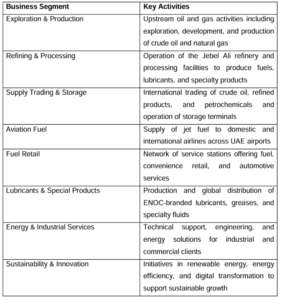
These activities help ENOC to align its strategic vision to the long-term economic growth and sustainability objectives of Dubai. The company has more than 30 subsidiaries and joint ventures which provide scale, flexibility and innovation in project delivery. Procurement is a key aspect of ENOC operations, which helps the company to source goods, equipment, and services at the right time and at the right cost. Through the use of different sourcing approaches and strong supplier management systems, ENOC achieve supply chain efficiency and maintain quality, ethical compliance and value optimisation in all its projects.
1.2 Category of Spend
Lubricants and specialty oils constitute one of the strategic spend categories owing to the importance of their role in making machinery, vehicles, and industrial assets run smoothly, safely, and efficiently (ENOC, 2025b). This category goes beyond the usual lubricant supply, as it encompasses technical performance standards, product innovation, environmental considerations and compatibility with different operational conditions. The market for lubricants is very competitive where several local and international suppliers of differentiated products in terms of quality, formulation and after sales technical support are available. Given that performance reliability directly affects the longevity of assets, cost of maintenance, safety of operations, and overall efficiency, the purchase decisions in this category must be based on evidence and risk awareness. Effective sourcing therefore requires rigorous assessment of suppliers to ensure that select suppliers can meet technical specifications, regulatory requirements, sustainability expectations, and service level commitments and can do so at a cost-effective level and with continuity of supply (Patil, 2025).
Figure 1 presents a comparison between ENOC’s major expenditure areas in order to demonstrate the relative importance of Lubricants and Specialty Oils in the overall procurement spend of the organisation.
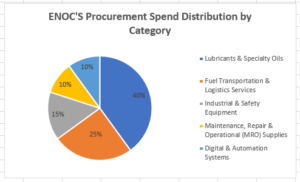
Figure 1: ENOC’s Procurement Spend Distribution by Category
Source: ENOC (2025)
Figure 1 indicates Lubricants & Specialty Oils represent the largest portion of procurement expenditure at 40%, and this demonstrates its strategic and operational importance. Fuel transportation and logistics follow at 25% and other categories account for much smaller shares. This distribution is a key to ensure robust sourcing, supplier performance evaluation and risk management in the lubricants category to safeguard value and continuity.
Further, to understand the best sourcing approach for ENOC, it is important to categorise the spend categories in form of their demand. We will do this using the Kraljic Analysis tool.
1.3 The Kraljic Analysis Tool
The Kraljic Analysis Tool is a strategic model for procurement which classifies spend categories by supply risk and business impact (Overvest, 2025). It will help ENOC realise appropriate sourcing strategies by segmenting items into four quadrants for informed decision-making. See Figure 2 for further illustration;
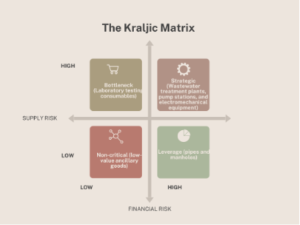
Figure 2: The Kraljic Analysis Tool
Source: CIPS (2025)
Applying the Kraljic Matrix enables the categorization of ENOC’s procurement spend relative to business impact and supply risk, having a direct impact on making sourcing decisions. For example, Lubricants & Specialty Oils are considered strategic products since they have high profit impact and high supply risk. This means that they need a careful and robust sourcing approach to ensure continuity, quality and cost-effectiveness. Other categories with lower risk or impact may justify the dual or multiple sourcing strategies. By relating each category of spend to its quadrant, the Kraljic Analysis demonstrates which approach to sourcing is best suited to managing risk and generating maximum value.
1.4 Business Hierarchy of Needs
Having categorized ENOC’s procurement expenditure based on the Kraljic Matrix, it is clear which categories require strategic attention, mitigation of risk or routine sourcing. To further understand how procurement priorities are determined and how supplier needs are aligned to organisational objectives, the Business Hierarchy of Needs is a complementary framework. According to McLeod (2025), this model helps to establish what is necessary and important at each level, ranging from the basic operational continuity to the value creation for the business in order to ensure that procurement decisions and supplier management are aligned with the immediate operational needs and the long-term business needs (See Figure 3).
Figure 3: Maslow’s Hierarchy of Needs
Source: Juneja (2025)
Figure 3 can be used to guide procurement prioritisation as it connects supplier and spend category requirements to organisational objectives. Physiological needs are fundamental continuity of supply availability of critical products such as Lubricants & Specialty Oils. Safety needs include risk management, compliance and reliability of suppliers. Belongingness and love needs reflect collaborative relations and effective communication with key suppliers. Esteem needs focus on recognising high performing suppliers and strategic partnerships (McLeod, 2025). Finally, self-actualisation is aligned with innovation, sustainability and long-term value creation in sourcing. Using this framework helps establish the best way to source each of the categories in a way that is both operationally necessary and strategically beneficial.
2.0 Stakeholder Analysis
The stakeholder analysis will help identify the different levels of influence for each ENOC stakeholders in the selection of the best sourcing approach. To analyse them, we use the Mendelow’s Matrix and the Peter’s block stakeholders’ categories Analysis.
2.1 The Mendelow’s Matrix
Mendelow’s Matrix is a stakeholder mapping tool that categorises stakeholders according to their level of power and interest. It helps determine communication and engagement strategies to ensure stakeholders are managed appropriately based on their influence and involvement in procurement decisions (See Figure 4).
Please click the following icon to access this assessment in full
Related; https://rankedprofessionals.com/downloads/solution-cips-emaar-properties-sourcing-essentials-pse/