(Solution) 5HR03 Eco-Insulate Reward for Performance and Contribution
Solution
Table of Contents
1.1 Principles of reward and importance. 2
Importance to Eco-Insulate’s Organisational Culture. 2
Importance to Eco-Insulate’s Performance Management. 3
1.2 Contribution of extrinsic and intrinsic rewards. 3
2.1 Types of grade and pay structures. 4
- Formal Pay Structure: Broadbanding. 4
- Informal Pay Structure: Skill-Based Pay. 5
- Differences Between Broadbanding and Skill-Based Pay. 5
2.2 Contingent rewards impact individual, team and organisation performance. 6
Impact on Individual Performance at Eco-Insulate. 6
Impact on Team Performance at Eco-Insulate. 6
Impact on Organisational Performance at Eco-Insulate. 6
2.3 Types of benefits offered by organisations. 7
Merit 1: Core Benefit – Health Insurance. 7
Merit 2: Voluntary Benefit – Flexible Working Arrangements. 7
Merit 3: Housing Allowances. 8
2.4 Merits of different types of recognition schemes. 8
Merit 1: Formal Recognition – Annual Awards. 8
Merit 2: Informal Recognition – Peer-to-Peer Acknowledgment. 9
Merit 3: Workplace-Specific Recognition – Team Shoutouts. 9
3.1 Context of reward environment 9
Impact of These Elements on Reward Decisions. 10
Benchmarking and Its Importance in Reward Strategy. 10
Three Ways to Gather Benchmarking Data: 11
The Most Useful Method for Eco-Insulate. 11
3.3 Approaches to job evaluation. 12
Analytical Approach: Points-Based System.. 12
Non-Analytical Approach: Job Ranking. 12
The Most Useful Approach for Eco-Insulate. 13
3.4 Legislative requirements. 13
Equal Pay Act – Equality Act 2010. 13
National Minimum Wage and Living Wage – National Minimum Wage Act 1998 (Amended) 13
Discrimination Laws- The Employment Rights Act 1996. 14
Report
1.1 Principles of reward and importance
Three essential principles of reward are Total Rewards Approach, Cultural Fit, and Transparency.
Total Reward Approach: Total Rewards System is the integration of monetary incentives, including pay and incentives, and non-Monetary incentives, including recognition and development. This integrated approach helps to guarantee that people within organisations are inspired, appreciated and kept around.
Cultural fit: Cultural Fit asserts that rewards should reflect the values and culture of the organisation. For example, organisations that embrace teamwork as a policy may develop team loyalty as incentive while organisation with a culture that appreciates innovation may venture in long term motivators such long term incentives like stocks or patents (Tomei et al, 2016).
Transparency- In this context, transparency can be defined as the disclosure of reward systems, policies and decisions made in an organization. There is increased engagement, which is because employees are able to see that there is some certain level of fairness in the distribution of the reward (CIPD, 2019).
Importance to Eco-Insulate’s Organisational Culture
Eco-Insulate’s current lack of incentive schemes and unequal rewards for senior staff versus others have created a negative culture and low morale. The Total Rewards Approach will help the company to assess the interest and value of all employees, ensuring that they get motivated and valued for their effort, as indicated by CIPD (2023).
Through Cultural Fit, Eco-Insulate could guarantee that its reward strategy complements its values and objectives as an environmental conservation company – thus, uniting the employees’ motivation in a common cause. It also means that the company awards should reflect its ethos to ensure that the employees are motivated to support the company’s goals.
Introducing Transparency will address the existing mistrust and perceived inequities in reward practices. Communication on how these rewards will be awarded will also go a long way in solving the issue of fairness in the workplace, increase employee’s morale, and regain their trust. Altogether, these principles will improve the organisation’s culture within Eco-Insulate by making it diverse, equal, and aligned.
Importance to Eco-Insulate’s Performance Management
These principles are equally crucial for effective performance management at Eco-Insulate. The Total Rewards Approach motivates employees by linking rewards to measurable performance, enhancing morale and productivity.
Cultural Fit ensures that rewards incentivise behaviors aligned with organizational goals, such as teamwork and innovation. This alignment supports long-term success by encouraging employees to contribute meaningfully.
Lastly, Transparency links performance clearly to rewards, eliminating confusion and building a performance-driven culture (CIPD, 2023). Employees are more likely to strive for excellence when they understand how their efforts will be recognised. These principles will help Eco-Insulate retain talent, improve performance, and drive sustainable growth.
1.2 Contribution of extrinsic and intrinsic rewards
Extrinsic Rewards
Extrinsic rewards refer to tangible factors that are external to the job that employees received from the organisation such as; pay, bonus, and other emoluments (AIHR, 2024). These rewards are useful to boost short term performance since the individual seeks rewards post completing the goal.
Example: Bonuses- they are given with the basis of going extra length in the sale of products encourage the workers to exhibit hard work in their production. This precise positive relationship enhances attention and activity, especially where activities have laid down goals as evidenced by CIPD (2023a). However, the extrinsic incentives such as bonuses can increase the rate of performance and motivation but might not sustain this in the long run if employees expect it or consider them entitlements instead of incentives for excellence.
Intrinsic Rewards
Intrinsic rewards are intangible incentives that satisfy employees’ internal desires for recognition, personal growth, and a sense of purpose (Indeed Career Guide, 2024). These are particularly so when it comes to establishing long term motivation and commitment and engaging discretionary performance.
Example: Recognition: Recognition awards, such as an “Employee of the Month” program, highlight individual contributions and boost morale. CIPD (2020) points out that these rewards appeal to the psychological asset of the employees hence increases their commitment and loyalty. Intrinsic rewards offer a very strong impact on the aspect of practice and creating organisational identification and affiliation. Unlike extrinsic rewards, the motivation does not change with a short-term exchange and encourages continued efforts by linking the employee incentives to the mission and vision of the organisation.
3. Sustained Organisational Performance at Eco-Insulate
At Eco-Insulate, both extrinsic and intrinsic rewards can support long-term organisational performance. Bonuses motivate staff, gain objective results and retain marketability in the job market. On the other hand, rewards like; recognition program promote organisational culture through encouraging employees to be committed hence increasing their engagement and reducing turnover.
While both types are valuable, intrinsic rewards are more effective in sustaining long-term performance. They build a deep emotional connection between employees and the organisation, encouraging alignment with its values and goals (Harris,2024). Focusing on recognition and the concept of person growth, Eco-Insulate can develop a dedicated, productive team that delivers stable performance. But probably the best practice is to apply both categories of rewards as an integrated reward system: short-term and long-term.
2.1 Types of grade and pay structures
1. Formal Pay Structure: Broadbanding
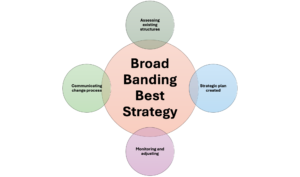
Broadbanding is a pay structure that clusters various pay grades into broader pay bands, thus providing more opportunities for both organisations and employees (AIHR, 2024). In Eco-Insulate, this formal structure would offer all employees a wider range by which they can advance depending on their skills, achievements, or assuming more tasks. Broadbanding is especially applicable when addressing the issues of complexity in the management of multiple grades; in this case it shall enhance a freer movement of employees across the company, independent of the small, rigid steps in the salary structure, which directly impact on the turnover.
2. Informal Pay Structure: Skill-Based Pay
Skill-based pay rewards employees based on the specific skills or competencies they acquire, as opposed to relying solely on job titles or tenure (Fosburgh, 2023). At Eco-Insulate, the skill-based pay structure would motivate the employees to acquire new skills relevant to manufacturing procedures, equipment or environmental conservation. Promotions to higher grades or wages could be attained by merely fulfilling certain training or attaining certain skills in the organisations putting the interests of the individuals and employers in check. This informal structure would encourage improvement and would go a long way to helping with the issues of skills deficits.
3. Differences Between Broadbanding and Skill-Based Pay
The key differences between broadbanding and skill-based pay are in their focus and structure.
Focus on Career Progression vs. Skill Acquisition
Broadbanding involves targeting employees for enhanced higher jobs within a wider pay structure, or for changing positions within the company.
On the other hand, the skill-based pay is focused on the development of clear, tangible skills that will improve competency in relation to the position. While broadbanding enable employees to get paid depending on their higher-level positions, skill-based pay enables the same employees to get paid depending on acquired skills in their current positions (Morris, 2023).
Structure of Pay Adjustments
Broadbanding provides employees with more freedom to progress within a band without strict limits, often based on performance, responsibilities, or experience. This structure is more organisationally driven and flexible. Skill-based pay, on the other hand, is typically more structured around the learning and application of new skills, which directly impact the individual’s pay rate (Fosburgh, 2023). This system encourages continuous education and performance improvement through tangible skill achievements.
Both structures would benefit Eco-Insulate by addressing turnover and enhancing employee engagement, but skill-based pay offers a more direct way to motivate employees to develop relevant competencies for the business.
2.2 Contingent rewards impact individual, team and organisation performance
Contingent reward is a form of incentive in which employees are given incentives tied to attainment of measurable goals, objectives or standards as noted by IG global (2024).
In this way, contingent rewards serve as a motivator for the employee to adhere to the behaviours expected of him by the organisation, thereby fulfilling the objectives of the company. They can be in random forms which include bonuses, commissions and other forms of incentives that relate to performance.
Impact on Individual Performance at Eco-Insulate
Contingent rewards such as commission-based reward system could significantly impact individual performance at Eco-Insulate by encouraging employees to meet sales or production targets (Forma (2024). For instance, if the personnel involved in sales such as the sales representatives, the customer-facing staff, they are likely to work harder to sale more units of the insulation products in order to earn more commissions. This motivation could ensure more effort since the employers’ desire to get more based on their sales would help improve productivity and revenues of the company.
Impact on Team Performance at Eco-Insulate
Contingent rewards such as group incentives reward collective achievement, promoting teamwork and collaboration among employees (Farber, 2023). For instance, Eco-Insulate may introduce a team-based incentive plan in which groups are incentivised when they achieve certain production goals or quality. For example, if a manufacturing team meets a predetermined goal of delivering a certain amount of insulation materials that are environmentally friendly, then the team can get group bonus. This promotes togetherness, oneness and team spirit; since everyone involved will ensure that the set goal or objective is achieved. Might eliminate sub-organization culture within departments and increase unity within the teams which is crucial for enhancing the company’s performance.
Impact on Organisational Performance at Eco-Insulate
Contingent rewards such as profit-sharing is a reward system where employees receive a share of the company’s profits, typically based on company-wide performance (Indeed, 2021). For Eco-Insulate, the relative solution is the introduction of the profit-sharing scheme, as it brings the employees closer to the organisation and its success. If the company is doing well and becomes profitable, employees will be able to get a percentage of that profit to encourage them to work harder in getting the objectives of that company. This approach is more effective in enhancing the organisational performance since Implementation of this ideas will enhance sense of responsibility among the employees resulting into high motivation, increased performance, and low turnover.
2.3 Types of benefits offered by organisations
A benefit is a non-wage compensation provided to employees as part of their employment package, such as health insurance, pensions, or paid time off. In contrast to rewards, which are often associated with performance and directly related to achieving a set of objectives, benefits are often predetermined and are supposed to make an employee’s life better, more secure and more enjoyable as indicated by CIPP (2024). The key difference is that while benefits are expected to address more extended-term requirements, reward is transient and personal or group performance based.
Merit 1: Core Benefit – Health Insurance
Providing health insurance could greatly enhance employee retention and satisfaction…..
Please click the following icon to access this assessment in full