(Solution) Avado PQ CIPD Level 5 5HR03 Eco-Insulate Rewards
Solution
1.1 Principles of reward
Principles of Reward
Fairness: Fairness is a reward principle which helps ensure that employees are paid according to their contributions, skills, and responsibilities (Ceplenski et al., 2023). A fair reward system includes internal equity where people doing similar work get paid similarly and external equity where salaries are aligned to market standards. Employee trust is developed through fairness and reduces employee dissatisfaction and turnover.
Transparency: This means engaging in open dialogue in relation to how rewards are determined in an organisation. Reward structures should be clear so that employees have a clear understanding of pay progression, bonuses and incentives that motivate and engage them (Hounsell, 2024). Transparency creates an ethical and trustworthy organisation in which employees will likely consider being loyal and productive.
Importance of Reward to Culture and Performance Management
Organisational culture and performance management are shaped by reward. Having a well-structured reward system helps to reinforce company values and to promote behaviours that are consistent with the desired business objectives (CIPD, 2025). For instance, Eco-Insulate may provide rewards for sustainability initiatives at the company and reinforce the company’s eco-friendly focus. Reward, from a cultural perspective, is an important driver of employee motivation, engagement, and commitment. Employees who feel highly valued through incentive and recognition are more likely to have positive attitude, thus improving their collaboration and innovation (CIPD, 2021). On the other hand, poor reward structures like those at Eco-Insulate can create disengagement, high turnover, and negative morale. In terms of performance management, rewards motivate employees to meet and exceed performance expectations. Tangible incentives such as bonuses or recognition awards are great motivators that increase the productivity and efficiency (CIPD, 2024a). Both standard times and performance expectations should be supplemented with rewards in instances where an employee contribution was exceptional. Introducing a structured reward system will enable Eco Insulate to develop a more motivated workforce, enhance organisational culture and support the organisation’s overall success.
1.2 Contribution of extrinsic and intrinsic rewards
Positive Assessment of Extrinsic Rewards Contribution
Extrinsic rewards like benefits, salary increases, and bonuses have a great role in increasing employee contribution and sustaining the organisational performance (AIHR, 2024a). Financial incentives provide direct motivation for employees to contribute to meeting or exceeding performance targets. For example, introducing a structured incentive scheme can help increase productivity and decrease turnover at Eco-Insulate. Likewise, competitive pay and benefits attract and keep skilled workers. Extrinsic rewards also ensure a performance driven culture that facilitates efforts of employees to align with the business objectives to achieve sustained organisational performance. Efficiency is encouraged by performance-based bonuses, while benefit such as pension enhancement for all employees improves job satisfaction (Indeed, 2024). Through equitable extrinsic rewards, Eco-Insulate can achieve a stable workforce that will reduce hiring costs and achieve consistent output quality, all of which will help the firm in maintaining a strong market position.
Positive Assessment of Intrinsic Rewards Contribution
Intrinsic rewards like career development opportunities, recognition, and job autonomy enhance employee engagement. Anees (2025) asserts that intrinsic rewards fulfill psychological desires, making them the most effective motivators of employee commitment. Employees who perceive their work as important and valued exhibit more commitment. Implementing employee appreciation programs can enhance employee morale and elevate work satisfaction at Eco-Insulate. In addition, intrinsic rewards contribute to long-term employee retention and innovation, both of which are crucial for sustained organisational performance. Skill development and career progression paths encourage workforce capability and adaptability. Similarly, problem solving and creativity are enhanced by having autonomy in decision-making (Francis, 2024). Through creating a supportive environment, Eco-Insulate can contribute to improving employees’ wellbeing, resulting in a more engaged and resilient workforce that can continue to add to the organisational success.
Overall Judgement and Recommendations
Both extrinsic and intrinsic rewards are essential for achieving a balance between short-term motivation and long-term employee engagement. Although extrinsic rewards offer immediate financial incentives, over dependence on them may fail to sustain commitment. On the other hand, intrinsic rewards instil long term loyalty and commitment, but only if there is a strong organisational culture. Therefore, a blended reward strategy is recommended for Eco-Insulate (Indeed, 2023). Performance based incentives like bonuses and skill-based pay will deal with immediate concerns of turnover. At the same time, workplace culture will be enriched by career development, recognition programs and employee involvement. Fair and transparent reward structures for all employees, not just senior staff, will act as an important means to enhance trust and morale.
2.1 Grade and pay structures
Types of Grade Structures
Narrow-Graded Structure: A narrow-graded structure consists of various pay grades with small salary discrepancy between them. Salary for each grade is specified, and employees move through the grades as per performance, experience or qualifications (Morris, 2025). The framework of this structure is clear and widely used in traditional organisations with hierarchical frameworks as career progression is clear.
Broadband Structure: A broadband structure combines many narrow grades into fewer, broader ones. There is more flexibility in pay adjustments across each band as each band covers a larger salary range. According to Blakely-Gray (2025), this structure provides greater internal mobility and offers greater rewards for skills and contribution as opposed to rigid grade steps. It is normally used in dynamic organisations where workforce flexibility is necessary.
Differences
Career progression clarity is one key difference. The narrow-graded structure sets up well defined career paths, with employees moving up several grades of increasingly small size. This approach is more useful in structured environments where the promotions are linked to performance milestones (CIPD, 2024b). On the contrary, a broadband structure expands the range of pay per band, but with fewer bands, enabling progression without formality of promotion and to facilitate role flexibility and skill-based reward. Another difference is pay flexibility. Salary adjustments in a narrow-graded structure are predictable but rigid because these involve fixed pay increments. Broadband structures, on the contrary, are considered to have wide pay bands to allow the employers to compensate the employees based on their contribution and not on predefined steps. An advantage to this flexibility is that it can increase motivation, but if not carefully managed, it can cause pay inconsistencies. Eco-Insulate UK could achieve flexibility to retain and motivate employees by employing a broadband structure as it will provide the flexibility to use skill-based pay, whereas a narrow-graded structure would assist in structured and fair career progression (Verasai, 2022). This depends ultimately on which are the strategic priorities of the organisation and the expectations of its workforce.
2.2 Impact of Contingent Rewards on Individual, Team and Organisational Performance
Performance-Related Pay (PRP)
Individual Performance: PRP encourages employees to enhance their efficiency and production by providing direct rewards for achieving performance objectives (CIPD, 2024c). PRP might encourage individual commitment at Eco-Insulate UK where motivation is said to be low by linking effort with financial gain. In this case, employees would be rewarded for tangible results which would act as an incentive for them to meet deadlines, enhance quality and decrease errors.
Team Performance: While PRP is primarily focused on the individual contribution, it can impact teamwork if designed effectively. If PRP incorporates team-based incentives, collaboration would improve since the employees know that their collective success would bring collective financial benefits. However, if PRP is just focused on the individual, it becomes a competition rather than collaboration and consequently, team dynamics may be negatively impacted.
Organisational Performance: PRP can promote a high-performance culture where employees constantly strive to contribute towards the organisational goals. Higher efficiency and profitability result from increased individual and team productivity (Indeed, 2022). Eco-Insulate could benefit from implementing PRP to decrease employee turnover by motivating high performing employees to feel recognised and fairly rewarded to reduce employee turnover while at the same time, improving the retention and overall organisational stability.
Skill-Based Pay (SBP)
Individual Performance: Employees are incentivised to expand their knowledge which increases their confidence as well as job satisfaction. For the employees at Eco-Insulate, adopting SBP could encourage employees to take further training on eco-friendly insulation technologies which in turn could improve job proficiency and career progression. With financial rewards anticipated for skill acquisition, learning becomes more attractive, fostering continuous professional development (Jahan, 2023).
Team Performance: SBP improves team adaptability as the employees are skilled in more than one function, thus reducing their reliance on a particular individual to perform a task (Lindberg, 2022). When this is applied at Eco Insulate, multi skilled teams would be more agile and better equipped to handle fluctuating workloads, increasing overall productivity and problem-solving capacity.
Organisational Performance: A skilled workforce provides for an organisation’s innovation, an operational excellence and competitive advantage. Introducing SBP would enable Eco-Insulate to increase employee retention by providing employees with potential for career progression, for which financial incentives are granted. Furthermore, a skilled workforce would result in better quality of products, which means a higher customer satisfaction, and as a result better market position of the company (Smith, 2019).
2.3 Merits of Organisational Benefits
Performance-Related Pay
Performance related pay (PRP) directly links financial reward to an employee’s performance, strongly motivating employees to perform better and become more productive.
Increased motivation is one key merit as employees work harder to meet targets because they know that their efforts would lead to rewards. Apart from that, PRP encourages the organisation’s culture to be results-driven, connecting individual performance to business outcomes (Indeed, 2022). Retention is another advantage as people feel valued and are less likely to experience the need to look for jobs elsewhere. In the case of Eco-Insulate where there is a high turnover and low morale, PRP can help create a work environment that is dependent on incentives thereby reducing disengagement and increasing productivity. However, it must be structured in the right way to not encourage unhealthy competition and maintain fairness in all the roles.
Profit-Sharing
Profit sharing schemes share a proportion of a company’s profits with employees in a way that fosters a feeling of collective ownership. One of the merits is increased employee engagement through the feeling of being directly associated with the company’s success. This is also beneficial in cultivating loyalty and the long-term commitment of employees as they can see that higher profits equates to personal financial gain (Kenton, 2024).
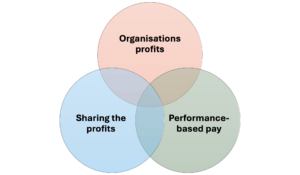
Furthermore, the system of profit sharing contributes to team coherence since it goes along with the idea of cooperation, rather than competition, in which team members join efforts to achieve the organisation’s success. Within Eco Insulate, implementing profit sharing would increase employees’ morale and also improve their desire to become innovative as the employees can come up with ideas in order to increase profitability.
Gainsharing
Gainsharing is a reward system in which an employee bonus is given based on cost savings and efficiency improvements. One major benefit is that workers are more involved in finding cost saving measures, which increases engagement and innovation. Moreover, gainsharing promotes financial stability since it entails payouts based on measurable improvements, as opposed to profits that could vary (AIHR, 2024b). When employees’ contributions contribute to tangible business success, they feel a greater sense of achievement. Gainsharing would encourage employees at Eco Insulate to improve production efficiency, reducing waste and increasing sustainability. In addition, it aligns with the company’s eco-friendly mission while providing a culture of ongoing improvement.
2.4 Merits of Recognition Schemes Offered by Organisations
Formal Recognition Schemes
Employee of the Month: Employee of the Month scheme rewards high performing employees based on predefined…………..
Please click the following icon to access this assessment in full
Related to: https://rankedprofessionals.com/downloads/solution-new-cipd-5hro3-assessment-id-cipd_5hr03_24_01/