(Solution) Avado New 50S02 Task One- Written Responses to Questions
Solution
Task One- Written Responses to Questions
1.1 Technology development and digital collaboration impact design and delivery of L&D
Technology development over the years has had a significant impact on the Learning and Development (L&D) strategies and its outcomes. According to Overton (2024), the influence is in areas of accessing, interacting and flexible nature owing to the increased emergence of digitised tools and platforms. After COVID-19 pandemic, the technology and digitised collaboration have influenced effectiveness of L&D strategies. The outcome entails accommodating demand change in L&D and overall expectations of teams.
Impact on Design
Personalised learning experience– The technology development grants a chance for personalised packages issued to learners based on their capabilities. For example, working in my current organisation, there are tools including Learning Management Systems (LMS) example is Moodle and BlackBoard granting designers in monitoring retention scope by learners. This is while updating them with relevant contents in a position of handling. This enhances custom-made learners content noted in Evanick (2023) as positively enhancing objectives attainment, learning preference beyond normalcy of L&D.
Advancing Multi-Media Incorporation– This technology development include gaming, VR and AR enhance learning programs development. The examples of the software which are embraced include attractive content including the Articulate 360 and Adobe Captivate content. According to Laros et al. (2023), these are a reflection of multi-media content improving knowledge development by learners with upto 40% beyond text format.
Impact on Delivery
Blended Learning Models– Completely online and face-to-face learning strategies, they are defined as integrating both strategies. For instance, in my current organisation, detailed and rich information is offered online by use of computerised capacity development. This is with psychomotor content done in live-based session. Also, according to CIPD (2025), the embrace of blended learning facilitates existence of resources for online learning hence well positioned in reinforcing taught contents. The blended learning similarly achieves necessity for learners’ inclusion owing to distinct strategies for learning and capacity development adapted.
Virtual Learning Environments– In active practice, my current organisation has been embracing various platforms including Google classrooms, Zoom and Microsoft teams all coordinating capacity development in physical and virtual-based. Post-pandemic changes in organisations, there has been e-learning embrace in entities and significantly increased with 90%. The learning content virtually delivery eliminate barriers of geographic orientations hence granting learners located in various areas take part actively in real-time based capacity development.
1.2 Main Risks and/Challenges of Technology-based L&D
A set of risks and challenges directly influence L&D successful implementation. These risks are guided by how they presented and embraced;
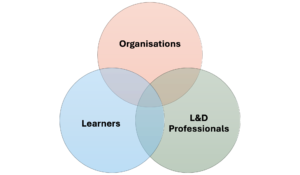
Organisations
Finance and other resources challenges are highly ranked as impacting entities in technology embrace as appropriate L&D strategies.
The risks include costly capacity development provision by the L&D which are incurred in the process embrace, capacity development initiatives and software embrace all core in the SMEs case study. Further, it is challenging maintaining pace with the significantly technology growth owing to the prompt pace they end up becoming out-dated. This influence organisation undergoing constant and prompt upgrading.
To address identified risk/challenge, organisations have been actively implementing most affordable strategies with less costs. These include the PAYG SaaS Solutions assisting cost reduction and economy of scale. The return on investment is similarly essential for investing on different technologies. According to Vithana et al. (2021), this target strategic initiatives of different entities.
Learning and Development Professionals
This is varying for different professionals as they could lack sufficient levels of qualifications. With changing world dynamics and trends, possession of technical skills would assist in success of the development. By lacking sufficient qualifications, they are noted to fail in implementing the learning programs such as VR and gaming and data analytics
To address the challenges, the L&D professionals would need to be equipped with sufficient opportunities for learning. This is while getting certified in different areas for practical embrace of technology. In my current organisation, there are opportunities offered in CIPD and employees’ dedication in L&D while at the same time pursuing success of digitised literacy.
Also, in line with CIPD (2019) recommendations, by embrace of peer-learning through community and strategies lead to possibility of identifying best strategy. This would enhance how they are sharing practice data and guidance.
Learners
A major risk or challenge is existence of digitised information differences. There are learners possessing inefficiency and lacking accessing devices for active usage. They are also not in a position of embrace of technology supported L&D initiatives. Also, learners in far flagged areas not easily accessed would feel disadvantaged.
To address the challenge/risk, an entity and government offer cost effective devices. Also, they can support them with mobile-supported opportunities which would be accessed online/offline. For example, SMEs would embrace use of Google ChromeBook, EduLearn programs all readily available. Also, development of learning materials for reaching good standards would facilitate their appropriateness of use by learners.
1.3 L&D Professional Role impact Emerging L&D Technologies
The L&D professionals’ roles have substantially been impacted by emerging technologies. Conventionally, Jacobs (2024) highlight the delivery of face-to-face capacity development and management of print media, L&D practitioners work as digital strategists. This is in verge of designing, delivering and evaluating learning by embrace of modernised technologies.
The examples of changes are;
Shifting towards Digital Strategist– The L&D professionals’ role has been evolving from conventional in-person capacity development to becoming digitised experts. The process is not only constrained towards the design and management of digitised learning contents in alignment with organisation objectives. Strategically shifting demand and needs for digitised success and integrating technologies to be part of learning opportunity successfully.
Learning Platforms and Data Analytics-….
Please click the Download icon to access this assessment in full