(Solution) CIPD New 5LD03- Facilitate Structured Learning and Development Activities for Groups
Solution
Table of Contents
Task One – Written Response. 2
1.1 Preparation for Group-Based Learning and Development Activities. 2
1.2 Explanation of Two Principles. 3
Alignment with Learning Objectives. 3
Accessibility and Inclusivity. 4
2.1 Facilitation and Ethical Factors. 4
2.2 Facilitation Methods and Techniques. 6
2.3 Techniques and Real Time Adjustments. 7
Techniques for Monitoring Effectiveness of Learning Activities. 8
Real-Time Adjustments for Individual Learners in a Group Context 8
3.1 Concept of Transfer of Learning. 9
Benefits of Ensuring Learning Transfer 10
3.2 Evaluation of Two Strategies. 10
Follow-Up Coaching and Mentoring. 11
Incorporating Goal-Setting and Action Plans. 11
3.3 Two Ways Line Managers Can Support the Transfer of Learning. 11
Ways Line Managers Can Support Learning Transfer. 11
Ways L&D Can Support Line Managers in Promoting Learning Transfer. 12
Facilitating Regular Check-Ins or Coaching Sessions. 12
Task One – Written Response
1.1 Preparation for Group-Based Learning and Development Activities
Before designing the Learning and Development (L&D) activity, a crucial planning phase is instructive to infuse the sessions with fun, relevance, and an environment that is most appropriate for learning(CIPD, 2022). This involves focusing on three main areas: readiness of the learners, readiness of learners’ learning material, and personal professional readiness or state of the facilitator.
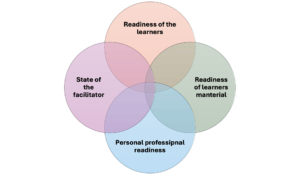
Strengthening these areas makes a sound starting point in facilitating knowledge management applications as well supporting participants to apply acquired knowledge in practise.
Three Factors to Consider
Factor Relating to Preparing Learners: As evidenced by Cabual (2021), availability of learning styles and modality towards learning content, perception and motivation of the learners should be considered in preparation of the learners. This can be done through a pre-assessment before the start of the intervention, questionnaires or interview. Ensuring that such a session is linked to the learning needs, experiences and expectations of the learners, the session can better be designed to build on prior learning, exposing gaps and gaps, appropriately. Also, when objectives have been outlined it enables learners to understand the goals and objectives of the training, intended outcomes as well as the relationship with their work. This preparation step leads to ownership and preparedness among them so as to participate in the next step. This means developing an introduction that also has an inclusive tenor also plays a positive tone in creating the positive environment in which learners feel permissive to contribute their points of view and engage in constructive discussions.
Factor Relating to Preparing Physical Resources: Physical arrangement is important because it affects the reception, comfort and success of the training that is being conducted. According to Cox (2019),incorporating classroom usage which is appropriate for learning keeps the interactivity right; for example, arranging the classroom in a U-shape for group discussions or arranging the classroom in a row for presentations. Equipment should also be observed in advance—for projector, laptops, internet connexion etc., so that all the equipment are in good shape and can run efficiently. Learners should also be given any necessary handouts, notebooks, or links to the digital content from which the material was gathered. Proper lighting condition, temperature control and provision of refreshment makes additional input towards a conducive environment that facilitates learning among the learners. Pre-lesson environmental arrangement displays the seriousness in the learning process, and a willingness to offer the best environment.
Factor Relating to Professional Readiness: Professional readiness refers to the readiness of the trainer and the knowledge that the trainer disposes in addition to the mental angle of the readiness. It enables confirmation of objectives, goals, and outcomes and practising the training material because there is confidence in delivering the content in the right manner. This is to do with preparing answers that are likely to extend the person’s knowledge or cause him to think further. Also, it is essential to be mentally and emotionally ready since the facilitator’s mood defines the work of the session. A captivating, approachable, and a patient facilitator also helps to set the right learning environment. In addition, the manner in which the established goals were attained further shows that the facilitator practises professional growth through constant update on his/her skills and the use of current knowledge and practises on learning and development (Vulpen, 2020). More so, readiness improves challenge response, learner interaction and overall knowledge promotion throughout the activity by the facilitator.
1.2 Explanation of Two Principles
While choosing the L&D contents and materials to be used in delivering learning contents, there are principles that enhance the learning engagement and effectiveness (Vulpen, 2020).. Incorporated resources assist with making the topic or subject matter easier to understand, retain learner interest as well as ensure relevance. The following two principles identify how materials for learning activities are chosen.
Alignment with Learning Objectives
There is one crucial governing principle that learning resources should clearly relate to the learning outcomes of the session. Stapleton-Corcoran (2023) affirms that for one training or learning to be effective, the resources and materials that are to be applied must be relevant in the sense that each leads to a specific learning outcome – when one uses an item it must act as a tool that enhances skills or knowledge. For instance, if the goal involves improving customer relations, constructive activities such as the drama or a simulation of a customer relation scenario is good. This assistance in alignment prevents disruptions that may be irrelevant or wasteful of learners’ attention, time and energy. Further, resources well aligned with objectives helps the learners to relate more deeply since they shall comprehend the usefulness of the training materials in the achievement of the objectives. This principle also helps in training consistency as delivery of all the resources entail repetitive messages with an aim of helping the learners achieve the set objectives.
Accessibility and Inclusivity
Another important principle of choosing material is accessibility for learners, which means that tutor should choose resources, which are suitable for learners of different types (Ed.D, 2023). They enhance differentiation because they will include any elements in them that cater for students’ learning mode, strength and interest. For example, closed captions for videos, transcripts for a show or any content that has been made for helping the screen readers makes the learning material more diverse. In this way, equal access to materials is also equitably beneficial for all learners since all participants know they are equally capable of achieving a pass and are engrossed in the activity. Cultural relevance is also an aspect of diversity since trainers have to develop training materials, which do not offend any ethnic group. This openness in learning environment benefits all learners by promoting their engagement in the learning process and therefore, leaves no learner out in the learning process, grappling with a small perspective of knowledge, commonly promoted when quiet and passive learners are ignored or / or allowed little or no participation in the learning process.
2.1 Facilitation and Ethical Factors
Based on the findings of Vulpen (2020), facilitation was defined as a process of managing and controlling the training and instructing processes of a group-based learning environment, to ensure learners participate meaningfully, contribute to group objectives and learn what was intended to be taught. Facilitation in contrast with traditional forms of dissemating knowledge by the teacher which is an inclining oriented process to a collaborative learner-based and learner-active approach. The locus of control in facilitation shifts from the facilitator to the learners, empowering them to take ownership of their learning process. This involves enabling participants to influence the direction and pace of the session, fostering autonomy, and encouraging them to actively engage in discussions and decision-making. By creating an environment where participants feel free to co-facilitate their learning, facilitation ensures that everyone’s participation is welcomed and embraced.
As in any group learning process, it is the facilitators’ tasks to elicit participation, facilitate interpersonal relationships and manage debate and discussions in a manner that effectively serves the instructional intent, especially to get the participants to connect between literature studied and practical applicability. Here, the facilitator has to adopt good interpersonal skills with the ability to combine effective and efficient communication skills and interpersonal communication skills such as empathy when working with the participants who have different personality types, perceptions on the information and learning styles.
Based on the findings of Vulpen (2020), facilitation is defined as a process of managing and guiding group-based learning to ensure learners participate meaningfully, contribute to group objectives, and achieve the intended learning outcomes. Unlike traditional teacher-centred methods that rely on direct instruction, facilitation shifts towards a collaborative, learner-driven approach where participants actively engage in knowledge construction.
Locus of Control in Facilitation and Learning
The concept of the locus of control, developed by Rotter (1966), refers to the degree to which individuals believe they have control over their learning experiences and outcomes (Botha and Dahmann, 2024). In the context of facilitation, the locus of control shifts from the facilitator to the learners, encouraging autonomy and active participation. Learners with an internal locus of control believe they have the power to influence their learning through effort, engagement, and decision-making. Conversely, those with an external locus of control may perceive learning as something dictated by external factors, such as the facilitator, peers, or structured curriculum.
Effective facilitation fosters an internal locus of control by creating an environment where learners take ownership of their learning journey. This is achieved through:
- Encouraging Self-Direction: Learners are empowered to set learning goals, explore content independently, and apply critical thinking (Robinson and Persky, 2020).
- Facilitating Active Engagement: Group discussions, case studies, and problem-solving exercises encourage learners to take initiative rather than passively receive information.
- Providing Opportunities for Decision-Making: Facilitators guide learners to make informed choices about their learning paths, pacing, and areas of focus.
- Using Reflective Practices: Encouraging self-assessment and peer feedback helps learners recognize their role in shaping their learning experiences.
By shifting the locus of control, facilitators create a more dynamic and participatory learning environment that enhances motivation, engagement, and deeper understanding of concepts.
Two critical ethical factors in the facilitation of group-based learning are confidentiality and respect for diversity.
Confidentiality
Bosley (2023) holds the opinion that confidentiality is one of the most crucial ethical concerns of facilitation. This is especially the case when group learning includes exercises that require people to share their experiences, ideas and opinions with the rest of the group, and participants need to be certain that information they provide will only be used in the group and that it will not be discussed in their absence. Confidentiality aids in establishment of a student friendly environment where every participant is free to express him/herself without any feeling of exposure to public condemnation. It is also important for facilitators to help build trust by providing specifics concerning entitlement and terms of reference for that particular session. For instance, sharing examples from practise can be quite pertinent to the process of learning, but such things as personal data should be changed by the facilitators and the issue of people’s privacy should be stressed constantly. Further, facilitators themselves should not disclose the details of participants to them in any circumstance that will be useful or detrimental to the participant’s existence as a working professional or personal life. This ensures that participants’ identity is kept a secret from other participants in order to maintain a good working relationship, hence participants trust the facilitator.
Respect for Diversity
Another ethical consideration that is important in the optimization of learning within a group is the issue of diversity. In any form of group processing, participants have diverse working experiences, culture, belief systems and perception (Bosley, 2023). This means that it is ethical for the facilitator to mainstream every player in the particular field so that he or she should accept everyone’s feelings of equality: regardless of nature. This means acknowledging and valuing workers’ differences in colour, sex, age, ethnicity, or cultural orientation and learning/communication styles. Participants can observe respect to differences by avoiding ‘isms’ and prejudice, insisting on respect for ethnic and cultural difference, and identifying prejudice where it occurs. Furthermore, they should expect that in order to facilitate, they have to be ready to topple in whatever way will meet such special need[s] for instance, in use of instruction methods that fit learning styles or providing accommodations for disabled participants. Dealing with diversity makes learning more interesting and enjoyable as people look forward to learning from one another bearing in mind that everyone has a different way of doing things, which will enhance productivity of the group.
2.2 Facilitation Methods and Techniques
Within a group learning process, there are specific approaches and strategies that make learning activities more effective, promote interactions and help learners to retain knowledge (ATD, 2017). When selecting the methods of the learning process, the facilitators can obtain the situation in which participants use necessary knowledge practically and easliy can help them achieve the learning objectives. Following are the three most productive facilitation approaches.
Group Discussions
An effective audiovisual which in turn involves the audience is the group discussions which involve the sharing of ideas and opinioN…..
Please click the following icon to access this assessment in full