(Solution) Optimizing Travel Guide Production Efficiency: A Case Study of TRAVEL2GO’s
Solution
Executive Summary
This paper assesses the feasibility of developing travel guides as a project organized by TRAVEL2GO in multiple phases with limited time. The project was divided into three phases, with specific targets for each phase, and the team was split into three departments: The most common areas are Activities, Local Specialists, and Design and Printing. The goal of this report is to evaluate the project’s performance, main problems, and possible solutions.
To carry out the investigation, the structure of the whole project was studied, and the team’s performance in all the different phases was assessed. Data on team characteristics, communication behaviors, and resource utilization was collected.
The research shows that the team achieved most of the production goals but faced communication and resource issues mainly in the second phase of work. The uncertainty formulated in Phase 3, which included job rotation, slightly decreased productivity. However, these factors did not significantly affect the relative quality of the travel guides overall.
The most notable proposals are increasing the availability of the check-in and real-time communication system, consulting with employees before implementing job rotation to adjust job design, and addressing adequate resource distribution across departments regarding access to essential tools. These steps help to prepare for future projects and ensure that overall effectiveness and efficiency of work are significantly improved.
Table of Contents
3.1. Job Design, Feedback Approach, and Targets. 7
3.2. Productivity Measures: Profitability, Speed of Completion, and Accuracy. 9
3.3. Employee Wellbeing, Ability, and Motivation. 10
4.1. Justification of Job Design, Feedback Approach, and Targets 10
4.2. Outcomes on Productivity: Profitability, Speed of Completion, and Accuracy. 12
4.3. Effect of Performance Approaches on Employee Wellbeing, Ability, and Motivation. 12
4.4. Impact of Performance Management Approaches on Productivity Levels 13
4.5. Underlying Reasons for Performance Levels and Wider Implications. 14
4.6. Effectiveness of Approaches in Enhancing Performance and Employee Wellbeing. 14
4.7. Response to Travel Partners’ Request and Minimization of Impact on Performance. 15
1. Introduction
Given the dynamic nature of the travel industry, organizations such as TRAVEL2GO must constantly seek to enhance and adapt to sustain their operations. To meet the market demands and centralize content production, the company TRAVEL2GO produced several travel guides within strict deadlines and a transparent framework. This project was divided into three phases with different goals that presented the number of travel guides that should be produced. The overall objective was to evaluate the performance of the organization and its logistic functions, as well as determine the areas of improvement when implementing similar projects in the future.
The general goal of this report is to assess the project of TRAVEL2GO and to identify the suitability of the job design, collaboration of departments, and the flow of work. This report aims to determine the efficiency of the present operating model by evaluating the efficacy of each phase. In addition, the report will give recommendations that will help the company to improve efficiency and productivity in future projects as well as quality to make TRAVEL2GO responsive to the market needs.
To achieve these objectives, the project was structured around three core departments: Activities, Local Specialists, Design, and Printing. All the sections were divided into specific tasks: The Activities Department was responsible for obtaining and cost of the activities in the morning and evening programs, the Local Specialist Department researched the local currency, and the Design and Printing Department was in charge of combining all the received information and making sure that it was formatted correctly and matched the company’s brand. This finally produced travel guides, which passed through quality checks before the final stages of formatting and being placed in the company’s shared drive.
The escalation of the production targets was an intentional development strategy, with Phase 1 stating six guides, Phase 2 counting seven guides, and Phase 3 aspiring to nine guides. Nonetheless, complications were observed in the last phase of the project, where the implementation of the job rotation option diminished the general output.
This report will evaluate how each project phase was executed and how the various departments interacted. It will also examine the effects of communication, resources, and work and task design on the project. All the information generated from this study will feed into the recommendations section at the end of this report to help improve the operation of TRAVEL2GO and complete all future projects within the set time frame.
2. Research Methods
Data collection for this report was both qualitative and quantitative to provide a proper assessment of the TRAVEL2GO project. The methods used included observation, questionnaire, and interview;
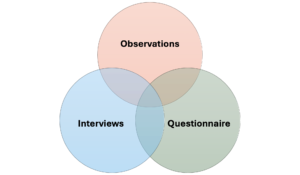
These methods were chosen to give a balanced picture of how the project was being implemented, how efficient the team division was, and the general flow of the work. This work’s implementation of mixed methods was informed by triangulation, which increases the research findings’ reliability and validity (Creswell, 2014).
2.1. Observations
Interviews were part of the study and provided essential data on the daily activities and communication of the team members during the three phases of the study. This method was especially helpful in capturing any concerns about communication, tasks, and resources. It allowed for watching the team at work and gaining a detailed understanding of how the processes were performed and where seeming inefficiencies were apparent.
The choice of observations as an assessment method was influenced by the desire to monitor teams’ performance and interactions effectively. According to Yin (2018), observations help collect data in situ and give a clearer picture of the behavior and the processes involved. This approach helped pin down certain issues: delays in information exchange between organizational units and productivity losses due to job rotation during Phase 3.
2.2. Questionnaires
In addition to the observations, participants completed structured questionnaires after all the project phases involving the team. The questionnaires were structured in a manner that contained questions about the project processes, performance, and challenges faced individually and as a team. A combination of Likert scale options and descriptive questions was used due to the desire for quantitative and qualitative data analysis.
This option was chosen because it covers a significant population in a uniform and comparable method, making the data collected from the questionnaires much more accessible to compare across the project phases (Bryman & Bell, 2015). Based on Task A, questionnaires help collect topic perceptions, such as team members’ satisfaction with communication processes and perceptions of job design. Task A feedback from the questionnaires helped define the areas that require improvements concerning communication and access to resources.
The questionnaires targeted all the project members, which helped capture diverse opinions. Defining a range of perspectives within the team was vital because they would likely have different perceptions based on their jobs.
2.3. Interviews
Semi-structured interviews were also administered to heads of some departments and project managers, besides observations and questionnaires. The interviews were supposed to yield information concerning the strategic and managerial aspects of the project: decision-making, resources, and operational choices.
The semi-structured nature of the interviews meant that different issues could be probed as the case may be while, at the same time, some essential areas of inquiry would always be covered. This method was adopted because it offers both order and opportunities for elaboration when the interviewer considers it necessary to pursue a particular matter deeply (Kvale & Brinkmann, 2015). The interviews were especially fruitful when it came to identifying the issues that arose during the job rotation in Phase 3 and their effects on the project.
In line with Task A findings, the interview sample was chosen purposefully to incorporate crucial people in implementing the project. This is known as purposive sampling, and it is useful when the researcher aims to elicit information from members of the population who have certain knowledge or background regarding the research question (Patton, 2015). Based on Task A findings, the interviews targeting specific stakeholders proved helpful as far as they captured the project’s strategic planning and management of the project.
2.4. Data Analysis
Qualitative data acquired with the help of observations, questionnaires, and interviews were analyzed through thematic analysis and descriptive statistics. In the paper, qualitative data analysis employed thematic analysis to determine patterns and themes that included challenges of the team and communication strategies. This method was employed because it facilitates scrutiny of the data and helps the researcher to identify latent themes and patterns present in the data (Braun & Clarke, 2006).
Quantitative data collected from the questionnaires was analyzed using descriptive statistics to present a systematic description of team members’ response trends. This approach was useful for expressing certain project characteristics, such as satisfaction levels and perceived efficiency, and for differentiating between the project phases identified in Task A.
In general, from Task A findings, observations concerning questionnaires and interviews served as an appropriate methodological basis for this study. Employing mixed methods also enhanced the generalisability and credibility of the findings to the multiple complexities that prevail in the TRAVEL2GO project.
3. Findings
3.1. Job Design, Feedback Approach, and Targets
The TRAVEL2GO project was divided into three phases, each with different job designs, feedback strategies, and targets to ensure optimum performance and quality of the employees. In the phases discussed, the key aspects of job design included clarity of roles, task variety, and autonomy.
The first phase was characterized by a clear line of authority where every team member was supposed to undertake specific duties per his or her experience. Feedback was given daily via short meetings to allow for timely rectification of wrongdoings. This strategy corresponds with Hackman and Oldham’s Job Characteristics Model, in which task significance, autonomy, and feedback are critical to increasing satisfaction and performance (Hackman & Oldham, 1976). In line with Task 1, the relevance of this model to the job design, feedback approach and targets entail the following;
Skill variety– According to Bakker et al. (2023), this element puts an emphasis on incorporation of diverse range of skills and abilities in a job. As evidenced in Task A, the team included members in Activities department, local specialist department and design and printing department. The team members would embrace broad range of their abilities and skills hence feeling more valued and competent in TRAVEL2GO improving engagement and work satisfaction.
Task Identity– Focusing on a different project, Judge et al. (2023) identify task identity as reflecting the scope in which a job entail completion of a whole, identifiable piece of work from the start to the end. In Task A, the employees would engage in emails, shared drive, shared workspace among others. As such in the entire project, the teams would view and relate with tangible outcomes of their input leading to an increased sense of accomplishment.
Task Significance– This factor is linked with perceived importance of a job impact on others (Ade-Adeniji et al., 2022). For the different teams in Task A, an understanding of scope in which their works have a difference, sense of purpose highly motivating is initiated. This would be evident at the level I which the Quality Assurance Team review entire documentation and identify all requirements as having been met successfully.
Autonomy– This is identified as referring to the scope of independence and discretion employees possess in sheduling work and establishing the procedures pursued in its implementation. As evidenced in Task A, with the project classified into 3 phases, the 3 departments teams have higher control on their roles hence increased creativity ad innovativeness in creating the travel guides (Omar et al., 2022).
Feedback– Finally, as evidenced in Siruri and Cheche (2021), this entail scope of a job offering staff with elaborate, specific and actionable information pertaining to performance effectiveness. After each phase of the project, a questionnaire is issued to all participants intended to identify their feedback.
Travel guides created during this phase of development have concentrated on offering specific and extensive routes, such as, for example, the Barcelona, Spain guide. Below are the results for the data collected in Phase 1:
| Town | Morning Activity | Local Lunch | Afternoon Activity | Total Day Cost | Local Currency |
| Barcelona, Spain | Visit La Sagrada Familia | Paella | Park Güell | £142.48 | Euro |
In Phase 2, cross-functional roles…
Please click the following icon to access this assessment in full