(Solution) CIPD Eco-Insulate 5HR03- Reward for Performance and Contribution
Solution
Table of Contents
1.1 Principles of Reward and Importance. 2
Impact on Eco-Insulate Organisation Culture. 2
Impact on Eco-Insulate Performance Management. 2
1.2 Contribution of extrinsic and intrinsic rewards. 3
2.1 Differences of types of grades and pay structures. 4
Formal Pay Structure; Multi-Graded Structure. 4
Informal Pay Structure; Individual Job Grades. 4
Main Differences; Standardisation and Flexibility. 5
2.2 Contingent rewards impact 5
Impact on Individual Performance. 5
Impact on Organisation Performance. 6
2.4 Merits of recognition schemes. 7
Non-Cash Awards (Tickets and Vouchers) 8
Legal factors (Aspect of the Reward Environment) 9
Economic Factors (Aspect of Reward Environment) 9
Social Factors (Aspect of Reward Environment) 10
3.2 Gather and Benchmark Data. 10
Approaches of Gathering Benchmarking Data. 11
Formal Approach (Factor Comparison) 12
Informal Approach (Job Classification) 12
3.4 Legislative requirements impacting reward practice. 13
National Minimum Wage Act 1998. 13
Working Time Regulations 1998. 14
Report
1.1 Principles of Reward and Importance
The different principles of rewards which can be considered include;
- Transparency
- Total rewards
- Consistency
Transparency– According to CIPD (2024), this is a principle which identify the need of having an elaborate information on employees pay and benefits.
Total Rewards– This is comprised of both financial and non-financial components of rewards. These include pay, recognition, work-life balance among others (CIPD, 2024a).
Consistency– By being consistent, the reward strategy offered are consistent and well aligned with employee’s needs. According to CIPD (2019), this is in varying organisation levels, positioning and divisions. This enhances fairness and clear alignment of individual goals and organisation objectives.
Impact on Eco-Insulate Organisation Culture
For the three identified reward principles, for Eco-Insulate context, they are achieved in addressing and building appropriate organisation culture. For example, for transparency, it enhances dependency levels as staff have knowledge/understanding on rewards. According to CIPD (2024), resentment/misunderstanding are mitigated.
For total rewards, an organisation culture of being valued is achieved. This is with all employees increasing their satisfaction scope and commitment in their roles.
In terms of consistency, CIPD (2024a) identify creation and sustaining relevant organisation culture informed by being treated equally hence credibility and fairness achieved.
Impact on Eco-Insulate Performance Management
For performance management, the different principles can be noted to be a driving force in successful organisation operations.
Considering transparency principle, this is associated with employees having a clear understanding of the expectations of their organisation in terms of performance. By improving their performance, they would receive an increased pay or promotion.
According to Manzoor et al. (2021), there is a direct correlation of employee’s performance and total rewards. This is since total rewards is holistically offered to assess staff performance and their development.
In regard to consistency, CIPD (2019) identify it as handling all people in the same way evidenced and paid for same outcomes/behaviours.
For all the principles, they enhance performance with the employees putting optimum efforts for meeting organisation target.
1.2 Contribution of extrinsic and intrinsic rewards
Extrinsic Rewards– Adopting the definition of CIPD (2021), extrinsic rewards are sourced from outside and used in motivating the employees for effectively executing their functions. Their rationale is encouraging employees in executing their functions effectively. The examples of extrinsic rewards include increased remuneration, incentives, promotions and more holiday pay.
Effectiveness
For extrinsic rewards, these are linked with increased staff motivation and contribution. According to CIPD (2024b), this is specifically for task-based workplace. For instance, bonuses could be issued to the employees as a strategy of increasing their pay after achieving specific key performance indicators. The outcome of this is increased performance and ensuring employees are achieving assigned roles.
For Eco-Insulate case, failure to receive the incentives contribute to employees dissatisfied and increased turnover. Through the provision of incentives for performance which are externally to their practice, monetary incentives are offered in a manner aligned with outcomes. According to Ali et al. (2021), this is relevant to encourage individuals and promote culture role based.
Intrinsic Rewards– These are defined to be intangible internal offers which are as a result of increased satisfaction of an employee from individual or professional gains as a result of execution of their functions. The benefits are aligned with individual satisfaction and professional growth. The examples are identified in Bukhari et al. (2023) to include annual recognition, pleasure of roles accomplishment and significance in workplace. These enhance likelihood of obtaining fresh experiences in an individual job positioning, engaged in making decisions and encouraged for their performance.
Effectiveness
These are noted to actively engage and appropriate to create broad, substantial motivation and being committed. According to CIPD (2021), all individuals ought to assume a feeling of being special in workplaces. This is with their employers trusting and acknowledging their hard work and maintaining commitment.
For instance, offering career growth opportunity for employees and popularising sense of ownership promote discretionary behaviour in Eco-Insulate. The outcome of this is leveraging on technology and innovativeness for executing their functions and proactiveness in solving all issues as opposed to reactive in nature. Hence, issuing intrinsic rewards enhance scope of loyalty in their organisation. This is owing to the elaborate understanding of organisation vision and target.
The intrinsic rewards could be prioritised as effective in achieving long-term gains including motivation. This is from staff interests, continuous development process and appropriate organisation image. Through a prioritisation on the rewards structures, Eco-Insulate manages to develop a sustainable background for improving organisation performance and holistic staff retention future based.
2.1 Differences of types of grades and pay structures
Formal Pay Structure; Multi-Graded Structure
multi-graded pay structure is a grade type which categorise different job roles based on pay issued which is formal.
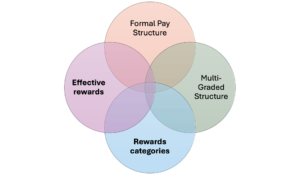
As evidenced in CIPD (2024c), the review of these pay grades are guided by skills, roles assigned, requirements and articulation. The pay progression is relevant and informed by need for the employees transitioning from one level to the other in the organisation. In this regard, the pay structure is inclusive of different grades which are relevant for Eco-Insulate since it contributes to pay determinants being transparent to all.
Informal Pay Structure; Individual Job Grades
This is informal grade with the organisation assigning different jobs a specific grading and aligned pay normally negotiated actively. According to Anshori et al. (2022), an organisation is not required to retain traditional pay structure with employees grouped in similar pay grades but employees’ rewards are informed by markets, input to their organisation and contribution. Considering the structure, Eco-Insulate is in a position of ensuring flexible in presenting and capturing talents in their pay package. Nevertheless, Lavee (2021) note that the weakness of this is potential pay disparity noted as characterised with unfairness. This is when different employees in similar job roles are paid the same which could be due to their bargaining power.
Main Differences; Standardisation and Flexibility
A major factor differentiating these structures include how they are standardised. As evidenced in Decius et al. (2021), pay strategy is well structured particularly in an event pay structure entail staff compensated in a way reasonable to different pay grades. This is as opposed to rewarding the employees differently despite of executing similar job functions.
This is different from individual job grades which are unclear and dependent on how they negotiate for every job identified to be sensible despite inequalities and frustrated employees.
A second difference is the flexibility. The flexibility scope is identified in CIPD (2024a) as individual job grade pay structure as facilitating Eco-Insulate working with an appropriate pay remuneration in a flexible manner. This is meant to attract best talents in line with market expectations.
Considering multi-grade pay structure, Sharma and Sharma (2024) identify it as being rigid as it is appropriate to maintain organisation structure and standards for organisation success relevant to assist them in reducing turnover levels and promoting the business morale scope.
2.2 Contingent rewards impact
Contingent rewards are form of remuneration associated with performance scope or attainment of assigned job functions (CIPD, 2022). Hence, a reward is noted to be contingent when it has been offered upon attainment of set goals. Examples of these entail achieving sales target, project completion and evidencing specific competency. As opposed to fixed pay, the contingent rewards focus on necessity for improving staff effectiveness and output since they are assured of increased pay due to their performance.
Impact on Individual Performance
In Eco-Insulate case, examples entail skills-based remuneration with employee’s higher remuneration informed by acquiring skills appropriate for their functions. A case example is when staff get certificate for successfully installing green energy. They end up receiving promotion for good pay (CIPD, 2015).
The identified reward strategy has a direct impact on personalised outcomes as the staff would put immense efforts for optimising their skills, knowledge and capability (CIPD, 2024d). Considering Eco-Insulate, inclusion of the skilled and non-skilled employees would, the non-skilled would be prompted to acquire better skills to be remunerated as the skilled counterparts. The outcome of this is increase in commitment level hence overall productivity.
Impact on Team Performance
Contingent rewards equally have a positive impact on teams’ performance. The contingent rewards for example are applicable in a strategy for offering incentives to teams for increased performance (CIPD, 2022). In workplace context, its implementation in Eco-Insulate manufacturing teams offering incentives including bonus pay. This is when quarterly performance of insulation materials is achieved and exceeding their levels while achieving quality-level standards.
The strategy of rewards makes sure the employees in a team pull their strength for achieving the objectives successfully attained. This can similarly be essential for neutralising negative cultures of an organisation. This is the case for Eco-Insulate implementing a holistic strategy to address inappropriate practices.
Impact on Organisation Performance
As evidenced in Amhalhal et al. (2022), in an organisation level, contingent rewards including number of years worked remuneration can enhance sustainable performance. A case example is in Eco-Insulate where proposals for non-standardised rewards examples being for further pursing the organisation in a timeline of 5 years. This type of rewards reduces turnover levels and increasing priority on skilled staff. The outcome is mitigating all issues amongst management.
2.3 Merits of Benefits
In an organisation, benefits are defined in CIPD (2024e) as an increased value obtained from an employer offered in the form of total rewards. The difference with rewards is that benefits are directly offered to all and not tagged to performance. The rewards are informed by execution of assigned roles or tasks assigned. Hence, through benefits, Jones and White (2021) note that they increase the scope of staff satisfaction.
Also, with the rewards intended to encourage increased performance and acknowledgement, benefits are a safe-haven and sustainability of staff hence favourable workplace environment.
The examples of benefits include;
Cars offered by organisation– The merits of issuance of organisation cars to particular employees including senior management and sales team ease their working. The different benefits are defined in CIPD (2024e) as relevant for enhancing their movement ease or the ones heading to different business operations provisions.
Considering Eco-Insulate, they have operations in construction sites where they need to travel. Hence, company cars are efficient to travel and execute their functions in a timely basis.
Points cards carrying monetary value– The merit of the point cards include facilitating an opportunity to reward staff for their specific services delivery and devoted to their organisation (CIPD, 2024). Another benefit is employees achieving success in a financial year and eventually exchanged in acquisition of products and services. The form of flexibility harness staff selecting what they prioritise to be significant and motivating.
For Eco-Insulate, turnover could be a challenge hence the loyalty points cards failing in assisting the organisation in encouraging customer loyalty. This is at the same time maintaining customers interest in programs and taking part since they frequently gain appropriate and valued incentive.
Medical Insurance Cover– The merits of this is offering highly valued benefits which have a positive implication in improving healthcare level for staff. According to Findlay et al. (2021), the medical insurance cover assists the staff in feeling that their employers assume their employees care improving their morale and satisfaction. In application of best strategy for Eco-Insulate case, this promotes staff overall satisfaction and retention. This is owing to appreciation and future employers protection successfully. The last merit is health improvement amongst the employees creating healthy teams hence reduced sickness days and increased organisation results.
2.4 Merits of recognition schemes
Adopting the definition of Bosire et al. (2021), the recognition schemes is formally offered to empower individuals in appreciating their performance or evidenced by executing specific functions in an organisation. The success of recognition is to offer improved appreciation which serve the basic principle of offering official-based acknowledgement, issuing prises and rewards. As evidenced in Elrayah and Semlali (2023), the rationale of the identified programs is improving staff motivation, morale level and being keen in workplace as individuals assume a feeling of appreciation.
For Eco-Insulate, the best strategy is where negative issue of organisation culture is enhancing recognition scheme improving staff motivation level/scope.
Non-Cash Awards (Tickets and Vouchers)
This type of reward is realistic and offering chances for creating pleasures or personalised acquisition positively impacting satisfaction level (Bernstein, 2022). For Eco-Insulate organisation context, there is a possibility of thinking on offering staff ticketing for local practices or vouchers for particular outlets selling environment-based products and services. This is linked significantly to organisation culture and prioritised as specialised gestures for rewards strategy.
The merit of this reward is that it manages varying interests promoting perceptions of individualised values and behaviours. The outcome is increased commitment and satisfied.
Day-to-Day Recognition
This type of recognition is noted to be informal and based on frequently acknowledging staff input and contribution level. They are also ranging from the verbal encouragement process, notes written in detail or shout-outs in introduction of members of teams in meetings (CIPD, 2024).
For Eco-Insulate case, the management end up acknowledging little success levels since the process is found encouraging appropriate/positive attitude and behaviours for sustainable excellence performance with time. In line with CIPD (2024a), the merit of tis is managing a negative/inappropriate culture or departmental operations which fails in appreciating their input.
Employees of the Month
Considering this type of reward “employees of the month”, they are relevant for achieving a formalised and recurring recognition. According to CIPD (2023), this note scope of staff having significant/outstanding performance within a stipulated timelines.
For Eco-Insulate case, the recognition offer appropriate and good opposition among staff and making them attempt of working successfully as they are intended.
Considering the process is pursued as an organisation scope, selecting the lucky staff from the past/previous month performers imply successfully publicising of the process. This is at the same time enhancing motivation scope for staff. The process similarly enhance good standards, encouraging individuals in readiness for recognition and evidencing how they are acquired. The system is particularly relevant in regard to recognition lacking or insufficient as formal, standards and prediction is attained.
3.1 Reward environment
Legal factors (Aspect of the Reward Environment)
In an organisation setting the rewards strategies offered are directly impacted by a set of legal aspects. A case example is identified in Ní Laoire et al. (2021) as Equality Legislation. In UK context, the legislations which are prioritised include the UK Equality Act 2010 informing the need for an organisation acting in a fair manner for ensuring they are not discriminating their staff on basis of gender orientation, colour/racial background among other issues.
Considering Eco-Insulate, the identified legal factors would be pressuring to the organisation in developing and initiating an appropriate criteria for determining pay structure. As evidenced in Zallio and Clarkson (2021), this can be inclusive of equal pay for executing similar functions in their organisation.
The entire disparity in issuing the rewards amongst various staff classifications such as skilled and non-skilled is essential and need to be well aligned for avoiding legal injunctions. This could be evidenced to the level in which basic pay rates or specialised/incentives rates are changes in reflecting the difference in staff organisation hierarchy.
Economic Factors (Aspect of Reward Environment)
Please click the following icon to access this assessment in full