Solution
(Solution) 5C001 Calmere House Kirsten’s Ownership
Answer to the Questions
Q1. AC 1.1 Flat Non-Hierarchical Structure; Kirsten’s Ownership and Hierarchical Bureaucratic Structure; Chaffinch Group Ownership
Organisation structure has an impact on communication, decision and employee involvement.
Flat, non-hierarchical structure consists of few levels of management, features open communication, teamwork processes and quick decision-making (EBSCO Information Services, 2021). A hierarchical bureaucratic system has numerous management tiers, better-defined reporting, formalised policies, and uniform procedures (NI business, 2015).
Evaluation:
It was a flat structure that was majorly fitting under the ownership of Kirsten. Calmere House was a small family-oriented and value-based company with a limited number of employees 42 of them, and a powerful culture of trust. Workers were well-educated experts, and the type of consultativity used by Kirsten was based on autonomy and participation in the decision-making process and frequent discussions. This framework endorsed zero turnover, high interaction, teamworking and resident-centred care. The informal procedures fitted in a stable setting that was characterized by intrinsically motivated and committed staff. But it was informal which implied that there were fewer policies and procedures that could pose risks of not complying within a regulated care environment.
The hierarchical bureaucracy of Chaffinch Group brought out uniformity, rigidity and orderliness with formal practices and chain of command, which is effective in a multi-site organisation that requires standardisation and control of compliance. But it fitted Calmere House very poorly. The employees became accustomed to individualism, participation and customised attention. The adoption of a highly centralised organisation brought about cultural misalignment, lack of empowerment and interrupted communication. The autocratic management style had a very negative clash with the set values and the loss of trust. There was no individuality in the resident care as the standardised processes minimised satisfaction and retention.
Therefore, the hierarchical model used imposed its structure, which did not fit the culture and size of the Calmere House, as it contradicted the expectations of the employees and harmed the quality of care and engagement.
Q2: AC 1.2 Chaffinch Group using Rational Approach to Strategy Formulation
Rational approach to strategy formulation offers an organized and evidence-based approach to the identification of needs, formulation of action and better service delivery (VQ solutions LTD, 2025). This strategy could be utilized to reposition Calmere House using this approach to align the expectations of customers with Chaffinch Group.
Goal Setting: The initial level must have quantifiable objectives. Chaffinch Group has already established an objective to occupy 100 percent rooms in 12 months, an objective that is not customer oriented. In the rational sense, objectives would be revised to explicitly cover the needs of residents like customized environments, stable staffing, emotional health and continuity (Fiorina, 2001). Some of the objectives would be to increase resident satisfaction scores, decrease complaints and stabilised staff turnover. With the goal aligned to organisation objectives, any capacity development opportunity is aligned with the employees expectations. Their expectations are aligned in the process development.
Analysis: Far-reaching internal and external analysis is essential. On the inside, Chaffinch Group should investigate the reasons behind the turnover of long-term residents: loss of customised rooms, higher agency worker involvement, lack of decision-making and communication. A low turnover coupled with absenteeism among staff, coupled with dissatisfaction is also a sign of deep cultural embarrassment. Outside, the Group ought to evaluate the quality of the market expectations, the future residents would like to see the personalisation, stability and homelike settings, which Calmere House used to have prior. The application of SWOT and PESTLE tools would be useful in pointing out the mismatch between the standardised and corporate-driven strategy of Chaffinch and the needs of local customers.
Strategy Formulation: According to analysis, some of the options that the Group can come up with include the introduction of personalised room selections, continuity of care through reduction of agency reliance, change of leadership style, and the calibration of policies that reflect the heritage of Calmere House. The strategies must be able to strike the balance between corporate effectiveness and local elasticity.
Strategy Implementation: This must be implemented using communication, staff engagement, and definite action plans. The preparation of Kath and team members should support cooperation, resident-centred practice. Accountability and continuous improvement would be encouraged by monitoring structures i.e. satisfaction surveys and occupancy measure.
Q.3: AC 1.3 External factor; negative impact on residential care industry and external factor; positive impact on residential care industry
The different external forces influence the operation and performance of residential care providers. Knowledge on negative and positive influences helps organisations to act in a strategic manner and ensure that the quality of services is not affected by the unfriendly market conditions.
Negative External Factor: Increasing Operating Costs
One of the key adverse aspects is that the utility and staffing expenses in the whole field of care rise considerably. The cost of energy, especially heating and electricity, has also gone up, and the demands on the regulation to increase compensation of the workforce in the care sector have strained the standards of funds. In the case of Calmere House, it was these increasing costs that led Kirsten to decide to sell given that she was worried that these increased costs would decrease the standards of care offered to residents.
The increased operational expenses diminish the budgetary allocations on individualised services, workforce and infrastructure investment (HFM, 2022). This puts a strain to conform, to reduce expenses and occupancy become profitable in the shortest time possible- which is exactly what Chaffinch Group did. Nonetheless, these cost-cutting measures pose a threat of compromise on quality and deterring potential residents who will favour personalised care.
Positive External Factor: Increasing Demand of Elderly Care.
The shift in the demography towards an ageing population is a positive aspect. Long-term residential care is still required because of the increased life expectancy and the number of people who should live with chronic conditions (Johannes et al. 2022). This provides a big market scope of those providers who are in a position to offer high quality and relationship-oriented care.
This increased demand is an apparent opportunity in the case of Calmere House. Chaffinch Group may also gain new residents with proper strategy by differentiation of personalised services, continuity of care and reputation of the community. The organisation was able to capitalise on this favourable demographic trend by reinstating the home-like environment, as well as, entrenching consistent standard of services. Moreover, patients that are able to match their services with expectations of older patients, including the sense of independence, psychological support and personalised environments, may attain high occupancy rates and financial conditions.
Thus, the residential care providers are challenged by outside pressures, yet demographic trends provide opportunity.
Q4: AC 1.4 Technology used by Chaffinch Group; Impact Calmere House
CIPD (2020) demonstrates that technology can contribute to efficiency, safety, and employee experience considerably, when adopted in a sensitive way.
Care-Management Systems in the Digital World.
Chaffinch Group may introduce electronic care-management software in place of fragmented paper records. This system would enable real time recording of medications, nutrition, activities as well as likes and dislikes of the resident. In the case of Calmere House, where individualised care used to be the main culture defining, digital profiles would aid the staff in offering individualised routines despite the new staff. It would also minimize errors, assist with regulatory compliance and handovers which were previously effective and informal (Agius et al. 2025). The work would be affected in terms of more scheduled operations, improvement of accountability and inter-shift communication.
Electronic Rostering, Workforce-Management Tools.
Another aspect that, in terms of addressing increasing absenteeism and dependence on agency workers, technology may be employed. The electronic rostering systems would divide shifts equally, streamline staffing, and indicate gaps sooner (O’Connell et al. 2024). This would save unnecessary work loads of the remaining workers who now have to take up gaps. Robotic warnings would aid the managers to intervene earlier in life and aid well being and burnout.
With time, the continuity related to staffing can enable the residents to feel comfortable again and minimize the inconveniences caused by the newcomers of the agency.
Families-Communication/Engagement Sites.
Calmere House was losing people who were losing trust and depersonalising. The development of a communication app that helps the families to know the update, care plans, and communicated with the staff would restore the transparency as demonstrated by Elias at al. (2022)The use of the technology will assure the families that individual care will continue to be the priority. To employees, it would ease communication, lessen redundant requests as well as enhance closer ties with family members. Increasing the level of engagement in families enhances emotional wellbeing among residents and thus results in a less standardised refurbishment which would improve the person-centred environment.
With the introduction of digital care systems, working with the most efficient rostering and family-engagement tools, Chaffinch Group can both improve quality and restore trust.
Q5: AC 2.1 Theories and models for organisation and human behaviours
The organisational and human behaviour theories would explain why Calmere House went through organisational cultural disruption, dissatisfaction and service reduction since the takeover by Chaffinch Group. All these models indicate a lack of congruency between employee expectations, leadership behavior and change in the structure.
Organisational Behaviour Theory: Change Model of Lewin
The model developed by Lewin (Three-stage Unfreeze, Change and Refreeze) can help to explain many challenges (Hussai et al.2017). These stages are critical for the successful change process. This is with the involved employees actively working towards achieving their goals. When all the phases are adhered with, they ensure that the organisation behaviour is appropriate and guiding their best practice.
Unfreeze involves the psychological and emotional preparation of people to change. Chaffinch Group failed to unfreeze the existing attitudes, employees just received information via email that the new structures and policies were to be used. Communication with staff was missed and the employees that had been overly involved in the decision-making process with Kirsten were not consulted.
During the Change stage, individuals require assistance, consultation and participation (Ellis, 2023). Rather, Kath was more of an autocratic approach, whereby she would issue out orders without discussion and ignore the issue of employees. The cultural traditions over years such as team spirit, narrative-telling, patient-centred care were suddenly eliminated.
Lastly, Refreeze makes the new working method stable (Hussai et al.2017). Chaffinch Group did not strive to make changes in a positive way. The absence of refreezing of the new culture is shown by high turnover, absenteeism and increasing use of agencies. The organisation was left in a destabilising, long period of transition without any cultural point.
Theory of Human Behaviour Herzberg two-factor Theory
According to Herzberg, there are motivators (achievement, recognition, meaningful work) and hygiene factors (working conditions, supervision, job security) (Nickerson, 2025). Both motivators and hygiene factors at Calmere house deteriorated following the takeover.
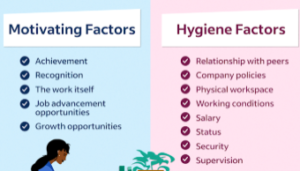
The motivators disappeared because the staff no longer had autonomy, participation in care decision-making and pride in personalised care of the residents, which was their main purpose before. The transformational leadership style by Kath eliminated appreciation and minimized impactful input.
There was a great aggravation of hygiene factors. Turnover and sickness heightened workloads; the continuity was lost with agency employed workers taking the place of those before them; internal communications in the organisation had collapsed; and job security was under threat. Lack of satisfaction was further eroded by poor supervision and strict procedures.
As Herzberg puts it, once the hygiene factors creatures and motivators are eliminated, employees would be demoralised and this results to absenteeism, turnover and poor performance, all evident in the case (Syptak et al, 1999).
Therefore, Lewin and Herzberg demonstrate that the poor leadership and fading motivators that were coupled with cultural disregards generated a big resistance and dissatisfaction. Such behavioural problems are the reason why engagement, quality of stability and care suffered following the takeover.
Q6: AC 2.2 Selection and employee voice impact organisational culture and behaviours
Organisational culture and behaviour are highly influenced by the selection practices and employee voice.
Effects to the Organisational Culture.
Under Kirsten, the selection was collective and value-based. Co-workers were assisted in selecting candidates on personal basis, culture compatibility and adherence to resident-centred care. This strengthened a home like, participative culture, in which being a part of something and having a purpose were core to it.
This was substituted by a transactional, agency-led model of Chaffinch Group. The selection of agency workers was done exclusively using third party screening without any cultural evaluation and participation of the current employees. This change eliminated the collective responsibility in the recruitment that in the past made the teams stronger.
Moreover, the elimination of employee voice, which was manifested in frequent staff meetings, one-on-one check-ins and joint decisions, in a way altered the culture. The employees were not listened to and consulted anymore (CIPD, 2025). Email introduced new policies and Kath was very autocratic and the barriers to dialogue were tightened.
Effects caused on Behaviours in Chaffinch Group/Calmere House.
According to CIPD (2025). Loss of employee voice will have disengaged behaviours. Employees who previously participated in bringing ideas and solving problems collectively developed to be quiet, reserved as well as unwilling to make recommendations. Frustration and loss of control was expressed in a form of increased absenteeism and disturbance. The reduction of commitment even among the remaining employees led to the adoption of the protective behaviours such as working longer hours and covering absences, which became even less as time passed by.
There was behavioural inconsistency owing to the new selection approach. The use of agency staff, which did not understand preferences of the residents, led to low work teams and confusion. The long-term employees indicated that they felt powerless and therefore their morale had dropped so was their discretionary effort and service quality.
In general, the elimination of the participative selection process and the employee voice instead of the integrated culture based on values shifted to a strict, detached culture.
Question 7: AC 2.3 Better managed change from small owner-managed care home to Calmere House
Communication and cultural sensitivity are essential, along with planning in order to be able to change a small, personal, owner-managed home into a large corporate structure in the most effective way (CIPD (2024). Chaffinch Group did not pay much attention to these principles, however, the folowing main actions would have enjoyed great improvements.
Carrying out an Organised Cultural Integration Process.
Chaffinch Group also implemented the hierarchical, standardised..
Please click the following icon to access this assessment in full