(Solution) 5HR01 AC 3.1 Explain the principles of legislation relating to unfair dismissal in respect of capability and misconduct issues
Solution
Capability– In line with the stipulations of Employment Rights Act 1996 (CIPD, 2025d), the capability factor include lack of capacity by employees in executing their functions to satisfactorily levels. This is owing to issues of productivity, ill-health and lower-level qualification. In the merger, these would be manifested with being absent for a long time, consistent failing to achieve goals and lacking relevant skills.
For a dismissal linked to capability with failure of adhering to tenets for fairness, transparency and support-based strategy is classified to be unfairly executed. From the presented guidelines from ACAS codes of practice (ACAS, 2024), employers ought to pursue due diligence holistically and give evidential support allowing reasonableness.
For example, Post-Merging process, dismissal owing to capability can be manifested as unfair if they were not taken through an induction and facilitated with capacity development opportunities for appreciating their new workplace working approaches/demands.
The dismissal need to be at all times be regarded as the final option in organisations. The entire alternate options would need to be put into account including assigning them new roles or even transition to their subsidiaries elsewhere. In the merger, the public sector entity would have their people practice teams assigned with functions of making sure management are fairly executing their operations, documenting entire phases for guaranteeing staff rights and lowering potential legal-based risks areas.
Gross and Ordinary Misconduct– Adopting Raghunandan (2021) definition, an ordinary misconduct is not acceptable and entail breaching of legislations set in an organisation. It is nevertheless not characterised with severity to call for immediately dismissed. An example is when employees are continuously late to work.
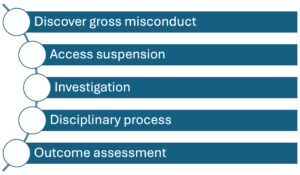
Gross Misconduct is evident in cases…..
Please click the following icon to access this assessment in full