(Solution) 5HR01 Prime L&D Employment relationship management
Solution
Briefing paper Questions
| AC 1.1 Differentiate between employee involvement and employee participation and how they build relationships. Word count: Approximately 400 words |
| Employees involvement and participation
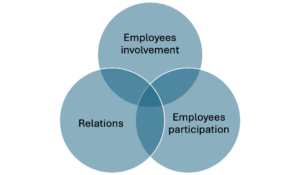
These are concepts which identify the scope in which employees relations are enhanced with a sole intention of improving commitment and also successful organisation operations. In some sources such as CIPD (2024), both concepts are noted as interrelated with similar meanings albeit the scope of employees functions being varying. Employee involvement– This concept evidence the set of strategies under the management encouraging the employees on giving their insights on issues affecting them in their workplace and granting two-way feedback as part of their engagements in a series of discussion. This is different from employees participation since the management holds the overall power in the process. Also, in the merging public organisation, the examples include suggestion schemes and surveys and team meetings regularly implemented. Employees participation– The systematic strategy is used for enabling staff in achieving an active contribution to organisation making decisions. It is different from the employees involvement as both the employees and management have equal responsibility in informing the decision making. According to CIPD (2024a), for merging organisation, the examples of these include collective bargaining strategies, joint consultations and employees boards.
Build strong and positive working relationships (Employee Involvement) An example of employees involvement is the continuous improvement program (CIPD, 2025). This can include innovative practices which are embraced for developing appropriate workplace relations. By using this approach, in the organisation passing through a merger, employees grant their input on initiatives which would improve operation efficiency. The different innovation workshops would be done in collaboration with online suggestion schemes targeting to ensure that the management offer an opportunity to employees to have their input in form of ideas. For the public organisation, an increase in employees inclusion boost how they are engaged since they assume a feeling of appreciation and fully own happenings in their organisation as insiders (CIPD, 2024). Build strong and positive working relationships (Employee Participation) An example of this is the Joint Consultative Committees (JCCs). This is a type which can be used in strengthens workplace relations. In the merging organisation, these would entail inclusion of the employees reps with the organisation to deliberate on the organisation issues and workplace factors and intended changes. This is different from the employees involvement as it is initially stipulated at the start of the contract on the scope of employees inclusion in these areas. Harmonious co-existence is also initiated informed by mutual-based respect for al (Pyman, 2020). To conclude, albeit evident similarities and differences between employees involvement and participation, they are core for successful organisations operations. The rationale of this is informed by working in an environment competitive. |
| AC 1.2 Compare forms of union and non-union employee representation.
Word count: Approximately 400 words |
| Trade Unions
Trade unions works independently on behalf of their employees in regard to rewards, workplace issues and policy. In UK for example, Bertolini and Dukes (2021) note that they operate on the grounds of statutory rights having a right for negotiations which pit employers and employees for collective bargaining and taking part in grievances. For public sector organisation under merger, Unison can be appropriate for enhanced employees voice and protect future of workplace. Post-Merging, trade unions would be important for streamlining overall issues by staff, conflicts mitigation and fair-based engagement in times of organisation change. This include an employee representative and organisation forming a body that is non-unionised (Bertolini & Dukes, 2021). Their core role is advising their organisation on issues which are linked to workplace challenges, two-way feedbacks engagement. The merging organisation can entail focusing on workplace environment, health and safety in new organisation and change. They are inadequate in terms of formal bargaining rights comparative to trade unions. The staff councils are engaged in the role of communication bridging by management and staff. Employees councils guide in guaranteeing staff views inclusion particularly in times of less membership in place and raising challenges neglected in collective agreements. Similarities and Differences The trade unions and employee councils represent types of representation of staff with the target being increased employees voice and fair working. In SME Group (my employer), they initiate an opportunity for employees raising their issues and concurrently supporting their inclusion in core decisions making. Similarly, both harness disputes mitigation and two-way communication amongst the staff and management. Nevertheless, structures and powers are differing. With the trade unions working under the statutory rights for collective bargaining and freedom of progressing to industrial actions, employees councils operate voluntarily without legislations governing their negotiations (CIPD, 2025). This is with unions externally operation, resourced by membership contrary to the staff councils found operating internally and facilitated by employers. Further, the areas of focus by the employees councils include the challenges in work including employees health and wellbeing with unions prioritising on rewards challenges on rewards and contract-based factors. Finally, according to Bertolini and Dukes (2021), with the two supporting an increased morale, in the public sector organisation going through a merger, unions are better positioned to lead the negotiations on behalf of employees and also employers. Also, the employees councils would offer collaborative conversation which prioritise on the interests of different stakeholders in the merger process.
|
| AC 1.3 Evaluate the relationship between employee voice and organisational performance.
Word count: Approximately 400 words |
Please click the following icon to access this assessment in full
Related to: https://rankedprofessionals.com/downloads/solution-cipd-avado-new-5hr01-employment-relationship-management/