(Solution) ADNOC Terms and Conditions CIPS PDC
Table of Contents
3.0 Terms and Conditions (T&Cs) selected for ADNOC.. 5
5.0 Risk of Extension of Time. 11
6.0 Risks of Increased Costs. 14
7.0 Risks of Unethical Practice. 15
7.0 Performance Measures; Monitoring and Management Strategies. 17
9.0 Concept of Battle of the Forms. 19
10.0 Conclusions and Recommendations. 20
Appendix 1: ADNOC T&Cs Selected Summary. 25
Figure 1:Summary of the up-stream, mid-stream and down-stream operations. 4
Figure 2:ADNOC Categories of spend classifications. 5
Figure 3:: Mendelow Matrix Summary in ADNOC.. 6
Figure 4:Contract management cycle. 8
Figure 5:ADNOC Quality Concept. 9
Figure 6:A summary of ADNOC Milestones. 12
Figure 7:4R’s Model Analysis in PS&M.. 14
Figure 8:ADNOC considerations of Ethics in PS&M practices. 16
Table 1:Ruwais LNG Project PPE Risk register. 11
Table 2:An example of KPIs in recent project. 18
1.0 Executive Summary
This project selects a set of Terms and Conditions (T&Cs) to evaluate their relevant to ADNOC different areas of Procurement and Supply Chain Management (PS&M). These areas include risks of quality, risks of extension of time, risks of price overruns and risks of unethical practices. Also, a focus on performance measures and management as part of ADNOC practices have been prioritised. The general terms and conditions are used in ADNOC sourcing categories particularly on Personal Protective Equipment (PPE).
The key findings in this report note that ADNOC there are a set of T&Cs which guide how the concept of risk of quality is managed. The rationale of this is guaranteeing the best quality of the PPEs and other spend categories are sourced. Further, in terms of costs overruns, the T&Cs capture the issues of Force Majeure, performance management, costs budgeted, indemnity, insurance cover and overall managing risks. Similarly, for the findings, they highlight the T&Cs are appropriate for ensuring that an organisation is operating ethically and hence dominating oil and gas industry and leveraging on competitive advantage.
Further, part of this research included an evaluation of Battle of the Forms and their importance to ensure mutual agreement by the vendor and buyer (ADNOC). The common agreement is from managing lack of understanding of differences.
The identified gaps in this report highlight the need for pursuing a set of recommendations for their management. These are;
- Broaden the T&Cs for ensuring that all risks are holistically managed and documented clearly
- Mutually agree with T&Cs for ensuring battle of the forms are eliminated
- Embrace the various KPIs and reporting mechanisms to contract embrace and T&Cs
- Enhance PS&M knowledge and awareness of different T&Cs for successful embrace in contracts implementation
Abbreviations
T&Cs- Terms and Conditions
PPE’s- Personal Protective Equipment
ADNOC- Abu Dhabi National Oil Company
UAE- United Arab Emirates
PS&M- Procurement and Supply Chain Management
KPI’s- Key Performance Indicators
2.0 Introduction
2.1 ADNOC Organisation
Abu Dhabi National Oil Company (ADNOC) is identified as a global leader in production of oil and gas products headquartered in Abu Dhabi since the year 1971, ADNOC has been implementing different up-stream, mid -stream and down-stream practices. Annually, ADNOC is noted to produce upto 4mln oil barrels with natural gas production ranging upto 11.5bln cubic feet’s (ADNOC, 2025a). Apart from their Abu Dhabi headquarters, they also operate various subsidiaries engaged actively to explore, produce, refine and logistics. Hence, as part of economic growth, ADNOC is regarded as the catalyst for Abu Dhabi economic growth as they assist to meet overall UAE needs and support of international energy demands.
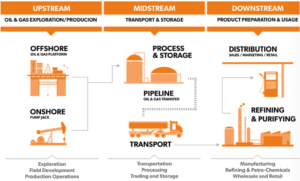
Figure 1:Summary of the up-stream, mid-stream and down-stream operations
Source: Summarised from ADNOC internal documents
Post COVID-19 pandemic, ADNOC has prioritised on enhancing digitisation of their operations while taking immense caution for safety hence sourcing Personal Protective Equipment (PPE) including masks and gloves, sanitizers among others offered to their employees (ADNOC, 2025b). All these investment leads to ADNOC competitiveness, sustainability and alignment with how they diversify their operations in UAE. For ADNOC, in their $5 Billion Net Income for 2024, ADNOC (2025c) report evidence PS&M as budgeting an upward of AED400mln in active practices. The revenues in their PS&M are used to enhance relations with their stakeholders guided by contents of services-level agreements, existing frameworks, procurement strategies and T&Cs harmonisation. These are summarised in appendix 1.
3.0 Terms and Conditions (T&Cs) selected for ADNOC
In this report, the identified T&Cs are entitled “GENERAL CONDITIONS OF PURCHASE” which are relevant for ADNOC different spend areas including PPEs. Hence, these contracts terms and conditions are blanket T&Cs and relevant for general spend areas. Their spend areas are as illustrated herein;

Figure 2:ADNOC Categories of spend classifications
Source: ADNOC internal documentation
From a general context, for identifying the application of the T&Cs in managing risks, Mendelow Matrix Tool is relevant. The Mendelow Matrix is appropriate for identifying the level of influence or power held by stakeholders and also interest of stakeholders (CIPS, 2025).
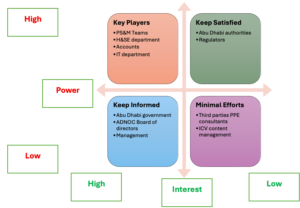
Figure 3:: Mendelow Matrix Summary in ADNOC
Source: CIPS Module Notes Summary
Key Players- For PS&M department, HS&E teams, accounts and IT departments are the major players in the implementation of T&Cs.
Keep Satisfied- For Abu Dhabi authorities and regulators in energy sector in UAE expect to have immense satisfaction with T&Cs. Hence, they must holistically be aligned with UAE laws and policies including ICV policies.
Minimal Efforts- The third parties for PPE consultants and also the ICV content management have minimal efforts as part of the implementation of T&Cs.
Keep Informed– The Abu Dhabi government and ADNOC board of directors and also management teams in the organisation must be aware of the different T&Cs and how they are implemented. As part of recommendations, the knowledge and awareness of the T&Cs would be identified.
To conclude, as illustrated in the following components of contract management cycle, T&Cs are needed to be part of its embrace. Their relevance is in developing and managing the contracts, contracts management, mitigating risks, ethical practices, procurement cycle and policy in place.
Figure 4:Contract management cycle
Source: CIPS Notes
In summary, for the contract management cycle, the different T&Cs guide the most appropriate strategy for engaging all the stakeholders in their sourcing process. This evidence different stakeholders’ relations with conflicts management and practices improved.
4.0 Risk of Poor Quality
In procurement supply chain management area, quality factor is defined by CIPS (2025a) as “organisation capacity for issuing products/services which meet expectations of end-users”. In ADNOC case, quality is identified as double sided and influenced by aspects of quality control and assurance (ADNOC, 2025b).
Figure 5:ADNOC Quality Concept
Source: summarised from (ADNOC, 2025b)
In the ADNOC PS&M operations, the concept of quality is determined in their Key Performance Indicators (KPIs) of defection rates. For instance, in Jones et al. (2023) report, it highlights ADNOC as being ranked 96th in global benchmark of oil and gas out of 100 owing to 90% of defect rates in their management of Carbon dioxide emissions. The selected T&Cs clause 11; section 11.1 note;
Please click the following icon to access this assessment in full
Related;
https://rankedprofessionals.com/downloads/solution-qatarenergylng-developing-contracts-pdc/