(Solution) Avado 7C001- Work and Working Lives in a Changing Business Environment
Solution
Question 4- 1093 Words
Long-term Economic Trend Currently Affecting Saudi Arabia
Economic diversification, as part of the Vision 2030 initiative, is the most important trend transforming Saudi Arabia’s economic framework, fostering sustainable growth, and mitigating the risks associated with oil dependence (Al Naimi, 2021). This trend is significant for several reasons;
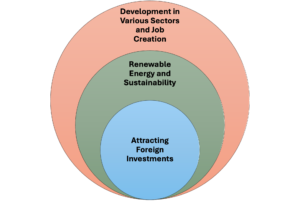
Development in Various Sectors and Job Creation
Saudi Arabia’s economic diversification, led by Vision 2030, has accelerated the development of other sectors other than oil such as tourism, technology, renewable energy, and entertainment. For example, NEOM and Qiddiya are examples of the Kingdom’s vision for new economic hubs (Al Naimi, 2021). These large-scale projects are established not only to support the diversification of the economy but also to create employment to meet the needs of the young population (Houfi, 2021). Saudi Arabia has also introduced some new industries that foster entrepreneurship development, foreign direct investment, and SMEs. Such an approach will enable having a strong and healthy economy that can still perform well even in the midst of unfavorable economic conditions in the world market.
Renewable Energy and Sustainability
Economic diversification has also contributed to the Saudi Green Initiative which is a part of Vision 2030 and which entails reaching net-zero emissions by 2060. The Kingdom is emerging as a global power in the field of green technologies, with significant investments in renewable energy resources, such as solar and wind energy. The country’s investment in the Sakaka Solar Plant and other mega-projects is an example of how Saudi Arabia is planning to meet its energy requirement with reduced carbon intensity (Beutel, 2020). Such measures not only serve as instrumental for climate change mitigation but also grab the attention of international investors who are interested in ESG factors.
Attracting Foreign Investments
The economic diversification policies have enhanced the status of Saudi Arabia as a suitable country for foreign countries to invest in. According to McPherson‐Smith (2021), the strategic goals of the Kingdom related to the development of the infrastructure, the digital economy, and the personnel training enhance the competitiveness of the country in the global markets. Also, there is a Saudi Investment Promotion Authority (SIPA) which seeks to enhance the investment processes and lure more international firms to invest in Saudi Arabia. These efforts are supported by policy changes that provide governance and create a conducive environment to carry out business (Almutairi, 2023). Apart from boosting the economic growth, foreign investments also introduce new technologies and management systems into the country to aid the nation’s diversification of its economy.
Consequently, economic diversification under Vision 2030 is an innovative strategy in the economic development plan of Saudi Arabia. Focusing on sustainable development, promotion of innovation and integration into the world economy, Saudi Arabia is building a strong model for the economy. This trend helps to reduce the reliance on oil and positions Saudi Arabia to be among the leading producers of new industries. With the country striving to achieve Vision 2030, Economic Diversification will continue to play a significant role in the growth, development and stability of the nation.
The Significance of Economic Diversification for the Mining Industry
Significance Now
Economic diversification is highly relevant to the Saudi Arabian mining sector, which is among the pillars of the nation’s diversification strategy. The minerals such as phosphate, gold, and bauxite are readily available hence making mining another economic activity that boosts the GDP (Zmami et al., 2021). Under the vision of 2030 the mining sector was identified as one of the strategic sectors hence the creation of the Saudi Mining Investment Law that promote investment and give a boost to the legal framework. These reforms have offered mining industries the best technologies they require to enhance their performance and existence. Also, the growth of the sector generates employment especially in areas that have little or no employment opportunities hence leading to an equal growth rate (Islam et al., 2024).
Furthermore, mining is considered one of the priority sectors by the government through measures like the National Industrial Development and Logistics Program (Zmami et al., 2021). This program connects the mining industry with other industries such as logistics and manufacturing that would create a strong and positive value chain effect on the economy. Also, there is increased investment in the research and development (R&D) in the mining industry which has a positive impact on innovation (Mohammed et al., 2021). Technological improvements such as remote sensing in exploration, the application of artificial intelligence in exploration, and using efficient mining equipment are reducing the adverse effects on the environment. These have made the mining sector to become the central component of the Saudi Arabian economy diversification strategy.
Significance in the Future
As a result of the diversification of the economy, it is expected that the growth of the mining industry will be on the rise because the Kingdom has embraced sustainability and innovation (Onifade et al., 2024). Future developments are likely to include higher automation levels, the use of artificial intelligence, as well as improved emphasis on environmentally friendly designs which are important for the future. In addition, given its position in the supply of key minerals required for renewable energy technologies, Saudi Arabia is also a key player in the global value chain. According to Abbasi et al. (2021) the mining industry will go a long way in boosting the economic status of the Kingdom and its global standing through product diversification and strategic partnerships.
Furthermore, the importance of mining industry in the future is not only in the economical aspects. As the country joins the global market as a top producer of energy from renewable sources, the mining sector will enable the country to meet the demand for minerals such as lithium and rare earth that are vital in clean energy technologies (Feng et al., 2023). Through sustainable mining investment, the industry will be in a position to meet the set international standards on ESG thus boosting the industries competitiveness in the international market.
In conclusion, the economic diversification in line with Vision 2030 is gradually reshaping the economy of Saudi Arabia and encouraging sustainable development with less concentration on oil. This has important implications for the short and long-term development of the mining sector in terms of technology advancement, job creation, and enhanced competitiveness in the global market. Thus, considering Vision 2030, the mining sector clearly demonstrates how diversification of the economy is important for the future of Saudi Arabia. Thus, the sustainable development, technological innovation, and cooperation with international organisations, the mining sector will remain as one of the important contributors to the diversified economy of the Kingdom.
Question 6- 1079 Words
Public Policy Development and its Impact on Work and Employment
According to Cashore et al. (2021), public policy is the set of principles and measures that governments use to address the needs of society and achieve specific objectives. Digital transformation is one of the most significant modern public policy priorities in Saudi Arabia that is being implemented within the framework of Vision 2030. This policy aims at promoting the economic development agenda, enhance delivery of service in the public sector and foster innovation through the use of digital technologies. The policy includes job generation in new sectors, encouraging business development, and enhancing workforce through digital literacy (Alhubaishy & Aljuhani, 2021). This analysis seeks to evaluate the future implications of the digital transformation policy in Saudi Arabia on work and employment and how it applies to people practice and other sectors.
Impact on Employment
Job Creation and Sectoral Transformation
The first direct implication of the digital transformation policy is job creation in the technological industries (Sarabdeen & Alofaysan, 2023). For instance, sectors like artificial intelligence, cybersecurity, data analytics and e- commerce have been growing due to support from the government. Globaledge (2024) explains that in the year 2022, the ICT sector contributed to the GDP by 7.1% as stated in the report by the Communications and Information Technology Commission (CITC), showing the significance of digital transformation. This growth is coupled with increasing talent needs in the tech industry, which means that there is a need to focus on the right education and training for Digital Transformation.
Moreover, the policy also encourages change across various industries through the adoption of digital technologies into sectors that have not embraced it. For example, precision farming has been adopted in the farming industry while automation and smart technologies is used in the manufacturing industry. These advancements are not only valuable in enhancing efficiency but also in employment where new jobs are being created that require high level of digital literacy (Al-Hajri et al., 2024).
Skill Development
As the economy shifts towards a digital future, it has become crucial to address the increasing demand for a digitally skilled workforce. In response to this, the government has put its resources into education and training with the view of empowering citizens with the necessary digital skills. For instance, the “Digital Skills for All” program has provided training to more than 180 young people in digital competencies including coding, cybersecurity, and cloud computing among others (Dobranja, 2023). This program is relevant with Vision 2030 of the Kingdom of Saudi Arabia to enhance employment rates of its citizens by closing the existing gap in skills. Focusing on skills is also useful for people practices within organisations. This means that HR professionals need to learn new ways of recruiting and training as the skills needed have transformed (Alangari et al., 2022). This entails creating environments that support learning and applying technological innovations in employee training and development.
Remote Work and Flexibility
A new form of work culture
Please click the following icon to access this project in full