(Solution) Avado Level 7 7HR03- Strategic Reward Management
Solution
AC 1.1 Social and Economic Factors Impacting Designing of Reward Strategy (Word Count:1,005 Words)
An organisation has a structured strategy of motivating, attracting and retaining employees by use of financial and non-financial rewards, a reward strategy. Reward strategy denotes the mechanism through which an organisation attracts, motivates and retains its employees using pay, benefits and recognition (CIPD, 2025). The design is influenced by social and economic factors in the present economic environment. This discussion focuses on the social aspect of diversity and inclusion, and the economic aspect of the labour market competition, its definition, effects, constraints, and suggestions. All these factors are as evidenced in the PESTLE model highlighting on their impacts to the organisation rewards management.
Social factor: Diversity and inclusion.
Diversity and inclusion (D&I) are the ability to acknowledge and appreciate individual diversity and to provide all employees (no matter their background, gender, ethnicity, age, or disability) with equal opportunities and treatment. The CIPD (2024) has reported that inclusive reward strategies facilitate fairness, belonging, and equal recognition at the work place.
Impacts
Diversity and inclusion (D&I) signify the establishment of a just and accommodating working environment in which people of diverse backgrounds can equal access to opportunities, acknowledgment, and remunerations. The CIPD (2019) states that an inclusive reward design is a vital component of establishing trust and equity, particularly in workforces in the UK that are becoming more multicultural and multi-generational.
To begin with, diversity influences the way base pay structures are constructed. To overcome gender and ethnicity pay gaps, organisations should be able to guarantee transparency in pay and remuneration of equal work. This will demand periodic review of accounts, impartial job review, and uniformity in the manner pay increase and bonus ratios will be given.
Second, D&I has an impact on benefit design. With different needs, a diverse workforce can appreciate childcare vouchers, flexible work benefits to the younger employees, and pension amplification to older employees. Thus, to achieve flexibility of choice, organisations tend to implement flexible benefits systems (so-called cafeteria-style) (Ayache and Naima, 2014).
Third, Boostworks. (2025) states that inclusion has an effect on recognition and career rewards. The reward systems should make promotions, awards, and growth opportunities available to everyone and not based on unconscious bias, as this would act as a discouragement to the endowed groups.
CIPD (2019a) also asserts that an efficient D&I-grounded reward system improves engagement, employer brand, and retention because employees feel appreciated due to their work. It also enhances problem solving and creativity by providing a variety of views, and this helps to gain competitive advantage. To improve D&I in reward design, Alam and Dharmasena (2020) note that organisations ought to be data-driven in their equity monitoring, through pay audits and workforce analytics to give rise to inequities. Bias will be eliminated by training line managers on inclusive reward decision-making. Also, the incorporation of D&I principles into the organisational culture and communication will make the principles of fairness not just a formal procedure but a daily routine.
Economic Factor: Labour Market Competition
Competition in the labour market can be defined as the level of competition between employers in order to secure and maintain skilled employees. Under the competitive conditions of the contemporary UK market, which are dictated by the increase in the cost of hiring employees, talent deficits, and mobility of talents after the pandemic, the competitor influences the design and positioning of the reward strategies of organisations greatly (CIPD Labour Market Outlook, 2023).
Impacts
Labour market competition is the level of competitiveness that employers have to employ in an industry or a region in relation to talent. In the UK, competition has also been enhanced because of the increasing costs of employment, skills gap, and the mobility of employees (CIPD Labour Market Outlook, 2023). This has a serious implication on the design of reward strategies.
To begin with, pay benchmarking is impacted by competition. Firoj Jamadar and Choudhary (2025) argue that organisations should pay market rates to attract and keep qualified employees. The inability to meet those standards in the industry can lead to the loss of skills or the inability to hire employees, particularly in the technological, healthcare, and engineering industries. Benchmarking tools and regular salary surveys can be used to remain competitive.
Second, it influences performance based rewards. Bonuses, commission-based or profit-sharing plans are also frequently implemented by the employers to stand out and keep the best employees (CIPD, 2022). These incentives facilitate production and lead to matching the personal effort and the organisational goals, building a performance culture.
Third, competition encourages companies to enhance non-financial incentives when they are constrained by budgets that restrict them on raising compensation (Huang, 2023). Flexible working hours, career development, wellbeing programmes and career advancement opportunities all become vital differentiators. These intrinsic rewards are the ones that draw talent in search of purpose, balance and long-term growth.
Completely tuned reaction to the competition in the labour market improves retention, establishes the reputation of employers, and guarantees sustainable talent pipelines. It also fosters innovation and flexibility in that the work force stays engaged and motivated with the use of a wide variety of reward systems. Nonetheless, excessive focus on remuneration to keep up with competition may increase the cost of labour and reduce profit margins particularly among small or government-owned organisations. A total rewards strategy is the best solution to handling labour market pressures because it entails using monetary incentives with non-financial rewards, career development, and support of wellbeing (CIPD, 2022). This strikes a balance in controlling cost and employee motivation. Fairness and trust can also be reinforced through regular market analysis and ensuring that the principles of rewards are communicated transparently so that the pay competitiveness is strategic rather than reactionary.
In summary, the reward strategy design in the UK is also influenced to a great extent by diversity and inclusion as well as labour market competition. Being both transparent and inclusive in pay and market-sensitive and targeted in incentive helps maintain a fair and competitive balance. Powerful analytics, employee engagement and effective communication will make change of rewards a retention, capability and short and long-term sustainability of organisations.
AC 2.1: Importance of Total rewards approach (Word Count:1,002 Words)
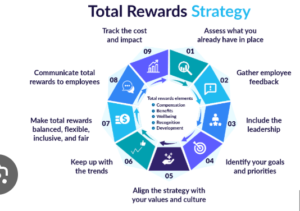
A total rewards strategy is a strategy that entails financial and non-financial benefits to attract, motivate and retain talent. The CIPD (2025a) states that it combines pay, benefits, wellbeing, development, and recognition into one. This question is a critical assessment of how total rewards generate competitive advantage, based on examples of organisations and also examining strengths and weaknesses.
According to the definition of total rewards, CIPD (2025a)
Please click the following icon to access this project in full
Related to: https://rankedprofessionals.com/downloads/solution-new-cipd-level-7-7hr03-strategic-reward-management/