(Solution) Calmere House 5CO01 Assessment ID / CIPD_5CO01_25_01
Solution
Questions
Q1. Evaluate the extent to which the flat non-hierarchical structure was appropriate under Kirsten’s ownership and the extent to which the hierarchical bureaucratic structure is suitable under Chaffinch Group’s ownership. (AC 1.1)
Flat non-hierarchical structure
Kirsten originally operated Calmere House under a flat, non-hierarchical structure that suited the small, distinctive nature of the care home. This approach encouraged transparent communication, staff participation, and quick decision-making. It also reflected Kirsten’s familiar leadership style, which relied on regular one-to-one discussions and staff forums to gather feedback and recognise employee perspectives. Such inclusive practices fostered a strong sense of ownership, accountability, and trust among the workforce (Lombard, 2024). Employees became more committed, collaborative, and confident in delivering care. This environment supported personalised services, strengthened the integrated culture of the home, and helped sustain high retention levels and quality care outcomes built upon the organisation’s founding principles.
Advantages
- The employees engagement in decision-making – A less strict hierarchy allowed employees to engage in organisational decisions, which made them feel more a sense of ownership, motivation and teamwork (CIPD, 2020).
- The design facilitated open dialogue and participation – Policies fostered openness and cooperation, which created trust and enhanced commitment between teams (Taylor and Woodhams, 2022).
Disadvantages
- Operations were overly dependent on one leader – Having all staff report directly to Kirsten created a centralised structure, making the organisation vulnerable (GOV.UK, 2025).
- Lack of defined roles reduced operational efficiency – Without clear job boundaries, tasks were sometimes duplicated and accountability weakened, leading to slower processes
Hierarchical bureaucratic
When Chaffinch Group purchased Calmere House, they were not using a hierarchical bureaucracy, which is a feature of large-scaled organisations. The model has many stages of management, points, and control of the top management. This form of system can bring about uniformity, cohesion of policies and cost-efficiency, but this is incompatible to culture of personal and individualised care which Calmere House was supposed to be known to (Stuckenbruck, 2025). The new structure combined with an autocratic leadership style curtailed the contribution of the staff and sensitive connection with the organisation. This resulted in excluding, disengaging, and high turnover accompanied by absenteeism and worsening the value of care
Advantages
- Enhances team coordination and responsibility – Since reporting relations are clearly detailed, managers will be able to monitor team tasks more efficiently, and employees will understand who to contact, which reinforces the quality of performance monitoring and Accountability (Verduyn, 2024)
- Facilitates compliance and cost management at the different sites – Centralised processes allow easier implementation of policies at the same location and control of budgets in a more cost manner
Disadvantages
- Reduces decision-making and innovation: A highly centralised strategy may slacken the processing of approvals and restrict the innovative solutions of front-line employees
- Ignores personal needs and deflates morale- A strict organisational structure does not allow individualised care as it can reduce employee motivation and lead to poor service delivery.
Reasoned Conclusion
The flat structure in Calmere House was the best to enhance person-centred care, open communication among the staff and empowerment. By comparison, Chaffinch was an organisation where hierarchical structure was placed highly above interaction and personalised care and thus did not suit well in the context of the trust-based and unique culture that had grown within Calmere House and had contributed to maintaining its team spirit.
Q2. Analyse how Chaffinch Group could use a rational approach to strategy formulation to ensure that services provided meet customer needs. (AC 1.2)
Defining an Area to Improve Servicing.
The traditionally known Calmere House has been regarded as a person-centred first-rate care. However, when it comes to Chaffinch Group, occupants and employees report lower levels of fulfilment due to tighter and more rigorous procedures and reduced attention given to an individual. Such a sphere as the enhancement of personalisation of care preparation, which is; modifying the activities, meals, and care agendas according to the preferences of the occupants can therefore be prioritised as the focus of service improvement (CIPD, 2020).
The Rational Approach to the Issue.
The rational approach will enable Chaffinch to apply the tools on the basis of the data, example, SWOT and PESTLE, to find out the core weaknesses (e.g. high turnover, loss of reputation) and outward threats (e.g. elderly populations, cost of living). The examination will provide a systematic foundation of redesigning the system of care arrangement of Calmere House to meet the customer anticipations more.
Analysis of the issue -SWOT and PESTLE Problem Analysis.
The strengths entail funding support by Chaffinch and trained workforce, weaknesses are bureaucratic nature of decisions made, opportunities are care planning via technological invention and threats are increased working cost. PESTLE illustrates demographic changes and the alterations in the rules, which allows Chaffinch to place the services in such a way that it could not lag behind the needs of the residents (David Hayden, 2025).
Objective settings to produce clear goals
According to the analysis, some of the SMART goals that Chaffinch can establish include improving the resident satisfaction marks by 10% annually and the number of grievances related to inflexibility of care plans by 15% in 12 months. Specific goals are measurable, and they are aimed in the correct direction, and the progress can be monitored, which consequently can enable transparency and accountability at organisational level.
Generating a range of ideas and solutions
According to feedback and records , Chaffinch might develop a set of answers, including the introduction of digital care-planning software with occupant best, formation of minor care pods with stable staff teams to enhance continuity in care delivery, and the flexing of the meal and action times (CIPD,2024).
Evaluating the generated ideas.
Using the feasibility scoring and cost-benefit analysis, Chaffinch can strike a balance between the solutions influence on the welfare of residents, the capacity, and cost of each solution. This critical analysis does not make decisions based on convention or intuition, does not create a problem of the expensive wrong choice, but adjusts behaviour to facts.
Picking best ones- decision making
Chaffinch should then choose the most supported evidenced options that are the most likely to succeed such as testing the e-care planning and pods. The choices arrived at must be transparent and based on settled criteria (impact, feasibility, receipt by the stakeholders) and an open communication with all should be made to create ownership.
Implementation the strategy
The implementation must involve a combination of vertical integration, which should be the leadership maintenance, finance, KPIs and policy, and horizontal strategy, which should be teaching front-line workers, interdepartmental working, and providing the feedback channels. In case of electronic care plans, pilot rollout can be used as an example.
Q3. Analyse one external factor that is currently having a negative impact on the residential care industry and one external factor that is currently having a positive impact on the residential care industry. (AC 1.3)
The UK residential care sector is a sensitive industry that is affected by the external issues that influence the delivery of care provision, financial and labour sustainability (Dunkerley, 2022). PESTLE framework gives us an opportunity to analyse them. These two external factors are now seen negatively and in a positive way today.
Negative Factor – Rising Operational Costs
Among the critical external factors that have adversely impacted the residential care industry is the growth in the effective charges especially the utilities and the wages. The rise in care home expenditure due to deflation and energy prices have rendered care homes extremely costly by an astronomical percentage and made tangling and providers have been in a financial crisis (Oner, 2025). Meanwhile, the cost of production is increasing due to the national minimum labour market level of wage surge and the competitive labour market (CIPD, 2025). This is damaging the viability and homes find it difficult to invest in the training, expansion and quality enhancement databases. The second aspect that can be seen in the Calmere House is that the increase in costs caused the employment of agency workers
Positive Factor – Technological Innovation
Assistive and digital technologies are changing the care sector in a positive manner. Electronic care planning platforms, remote monitoring devices, and fall-detection sensors are among the tools that are enhancing the safety of residents and operation efficiency (CIPD, 2013). These innovations minimise administrative workload of the staff, facilitate communication, and empower the care outcomes. In the long run, they are able to reduce hospitalisation costs, costs of medication handling and equipment repairs. In the workforce aspect, digitally skilled professionals are attracted to the technology-enhanced workplaces, enhancing the recruitment and retention opportunities (Oner, 2025). Moreover, sophisticated systems allow more personalised and challenging support of the residents that could increase the levels of satisfaction and promote new admissions. In the case of organisations such Chaffinch Group, the strategic implementation of technology may become a key step towards turning around the falling occupancy levels in Calmere House and restoring its image as a progressive and quality care provider.
Q4. Under Kirsten’s ownership of Calmere House, there was little investment in technology. Chaffinch Group want to change this approach and have decided to implement technology to deliver better patient care and employee experience. Assess how technology could be used by Chaffinch Group and how this would impact work at Calmere House. (AC 1.4)
Taking into consideration both the care provided to patients and the involvement of personnel, the decision to provide the Calmere House with the related technologies may help the Chaffinch Group to achieve impressive outcomes. The application of Human Resource Information System (HRIS) and digital care planning platform can be considered one of the most helpful technologies.
HRIS (Human resource information system).
HRIS can automate HR tasks like audience management, training and presentation history of workforces. But in the case of Calmere house, it is able to decrease the labor in administration and enhance precision in controlling the employee records.
Benefits
- Streamlined onboarding and record-keeping – Automates employee data entry, reducing paperwork and errors (CIPD, 2025).
- Enhanced workforce analytics – Provides real-time insights to support better staffing and planning decisions.
Challenges
- Data security and privacy alarms – Storing sensitive employee information digitally increases the need for robust protection.
- Integration with existing systems – Linking HRIS with current payroll or scheduling tools can be technically complex.
Digital communication platforms
Online communication care systems provide an opportunity to update plans about the care provided to the residents in actual time, monitor prescriptions and report events. This will improve the quality and consistency of care since this is highly essential given the high staff turnover rate and the use of assistance staff in Calmere House.
Benefits
- Strengthens resident safety and care quality – Instant updates to care plans ensure more accurate and consistent service(CIPD, 2025).
- Simplifies compliance and reporting – Digital record-sharing improves regulatory adherence and communication between departments.
Challenges
- Heightened data protection requirements – Strict safeguards are needed to secure sensitive resident information.
- Staff adaptation and training demands – Employees must develop new digital skills to ensure proper documentation and use of systems.
In general, the implementation of these technologies in Calmere House will allow achieving a considerable improvement in efficiency, compliance, and quality of care. Although the first steps might be associated with the resistance of the staff and the issue of data security, the benefit of employee satisfaction, improvement of operational performance and adherence to the strategic objectives of the Chaffinch Group may justify the initial investment.
Q5. Using theories and models which examine organisational and human behaviour, explain why problems have arisen following the takeover of Calmere House by Chaffinch Group. (AC 2.1)
Since Calmere House became part of Chaffinch Group, a number of problems have been identified such as negative attitude by the workforce, staff turnover and decrease in the fulfilment of the residents. These problems could be explained using the organisational theory and human behaviour theory.
Charles Handy’s Model of Organisational Culture
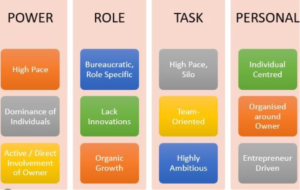
According to Taylor & Woodhams (2022) Charles Handy
Please click the following icon to access this project in full