(Solution) CIPD 5CO01 Calmere House and Chaffinch Group
Solution
Questions
Q1. Evaluate the extent to which the flat non-hierarchical structure was appropriate under Kirsten’s ownership and the extent to which the hierarchical bureaucratic structure is suitable under Chaffinch Group’s ownership. (AC 1.1)
Flat Non-Hierarchical Organisational Structure
This structure has few or no layers of middle management, with most employees reporting directly to the leader. It encourages open communication, close working relationships, and a collaborative culture (AIHR, 2025). Decisions are often made with employee involvement, giving staff greater responsibility and ownership. This type of structure is flexible, people-focused, and works well in smaller organisations.
Advantages and Disadvantages Under Kirsten
The flat structure worked well under Kirsten’s ownership, as direct reporting to Kirsten created an inclusive and supportive atmosphere where staff felt valued. Regular staff meetings, one-to-one check-ins, and shared decision-making encouraged loyalty and trust (CIPD, 2025). Employees had a strong connection to residents and the organisation’s founding values, resulting in high engagement, commitment, and retention. The flat model also encouraged teamwork through shift handovers and collaborative recruitment. However, disadvantages included the reliance on Kirsten’s personal leadership and communication style, which made the business vulnerable if she stepped back. Also, limited formal policies and procedures risked inconsistency in practice, and without clear delegation layers, decision-making might become slower as the business faced growth or more complex challenges.
Reason Why Appropriate
This structure was appropriate because it matched the small size of Calmere House and reinforced its family-centred culture. Employees had strong professional expertise, and being directly involved in decisions boosted morale and commitment. The flat approach created a sense of belonging, which aligned with the goal of providing high-quality, personal care that resonated with both staff and residents.
Hierarchical Bureaucratic Organisational Structure
This structure is built on multiple layers of authority, with clear reporting lines and formalised rules, procedures, and policies. Power is centralised, and decisions flow downward from managers to employees. Kenton (2024) mentions that this approach ensures control, consistency, and standardisation across larger organisations but often reduces flexibility and employee autonomy in favour of efficiency and uniformity.
Advantages and Disadvantages Under Chaffinch Group
Under Chaffinch Group, the hierarchical structure standardised operations and provided control across a much larger care network. Advantages included clearer reporting lines, stronger compliance through established policies, and consistency with group-wide procedures (CIPD, 2022b). It also offered resources for refurbishment and long-term stability. However, disadvantages quickly emerged. Employees were disengaged under the autocratic leadership style, as their input was no longer valued. Layers of management reduced agility and communication, creating distance between staff and decision-makers. The rigid policies ignored the unique culture of Calmere House, leading to dissatisfaction among employees and residents. Staff turnover, absenteeism, and reliance on agency workers undermined quality of care, while residents felt denied of choice and individuality. Ultimately, the bureaucratic model created order but eroded the personal touch that defined Calmere House.
Reason Why Appropriate
This structure is appropriate from Chaffinch Group’s perspective as it allows the company to manage multiple care homes consistently and maintain financial oversight. With established policies, reporting layers, and formal systems, the group can monitor performance and standardise practices. Such a model supports scalability and ensures operational control, even though it reduces local flexibility.
Q2. Analyse how Chaffinch Group could use a rational approach to strategy formulation to ensure that services provided meet customer needs. (AC 1.2)
Service Levels Improvement Area
One key area for improvement is resident satisfaction. While refurbishments modernised rooms, they stripped away individuality and personal choice. Residents previously valued being able to choose decor, which gave them a sense of ownership and comfort. This loss of personalisation has led to dissatisfaction, creating reputational risks and making it harder to attract or retain long-term residents.
Use of Rational Approach
A rational approach would provide a structured way to address resident dissatisfaction by analysing the issue, setting clear goals, and exploring solutions (CIPD, 2025b). By following a step-by-step process, Chaffinch Group could align service improvements with customer expectations, rather than applying generic policies. This ensures decisions are evidence-based and guided by long-term objectives, strengthening both resident loyalty and business performance.
Issue Analysis
The issue can be analysed using a SWOT framework. Strengths include refurbishment resources, while weaknesses lie in rigid policies and loss of resident choice. Opportunities exist in enhancing personalisation to rebuild reputation, while threats include losing more residents to competitors. A clear diagnosis highlights the need to balance standardisation with individuality, directly aligning services with resident preferences (CIPD, 2025c).
Objective Settings
Objectives should aim to reintroduce a sense of personal choice for residents while strengthening trust in the service. A suitable goal could be to boost resident satisfaction levels by 20% within a year by offering customised decor options. Setting clear, measurable targets ensures staff understand priorities, gives management a way to monitor progress, and directly links improvements to what matters most for residents (Sutton, 2025).
Generating Ideas and Solutions
Ideas might include offering residents a choice of approved decor themes, creating a personalisation allowance for small items like curtains or pictures, or running resident focus groups to capture preferences. Solutions could also involve staff training in customer engagement. Generating a range of options ensures that Chaffinch Group has flexible approaches to test and adapt in practice.
Evaluating Generated Ideas
Each idea must be assessed against criteria such as cost, impact on satisfaction, and alignment with company policies. For example, resident focus groups are low-cost but could deliver high impact, while offering full customisation may be impractical. According to Medley (2025), evaluating solutions with these considerations helps Chaffinch Group focus on realistic improvements that balance financial sustainability with enhancing resident experience.
Decision Making
The best option is to allow residents to choose from a limited set of decor themes while also running regular resident forums. This balances personal choice with cost control. Using a rational decision-making approach means the final strategy reflects both business needs and customer expectations, giving the highest chance of restoring satisfaction while avoiding excessive complexity or expense (McCartney, 2023).
Strategy Implementation
Implementation should follow a horizontal approach by involving staff at all levels in the roll-out, ensuring residents and care workers feel included. At the same time, vertical communication is key, with Kath and area managers sharing updates and progress (Soni, 2023). Combining both methods builds alignment between strategy, employees, and residents, helping Chaffinch Group to deliver consistent yet personalised services.
Q3. Analyse one external factor that is currently having a negative impact on the residential care industry and one external factor that is currently having a positive impact on the residential care industry. (AC 1.3)
Negative External Factor: Rising Operating Costs
The steep rise in operating costs, particularly energy, food, and staffing negatively impacts residential care. Across the UK, care homes face higher utility bills due to fluctuating energy markets, while food inflation has also placed additional strain on budgets (Green, 2025). At the same time, workforce shortages have driven up wages, with providers increasingly relying on agency staff who charge premium rates. Together, these pressures erode margins and leave little room for investment in quality improvements. For many operators, this has meant deferring refurbishments or reducing service options, which can harm resident satisfaction and reputation. These cost pressures are not short term. According to Oner (2019), utilities and labour costs will remain high in the coming years. For Calmere House under Chaffinch Group, the combination of rising costs and a less flexible culture creates significant risk. If not managed carefully, it could result in further staff turnover and declining occupancy rates as residents seek alternatives that offer better value for money.
Positive External Factor: Growing Demand for Care Services
Demographic changes are creating sustained growth in demand for residential care. The UK has an ageing population, with more people living longer but also developing complex health needs that require professional care (Stevenson, 2024). Families are increasingly unable to provide this care at home, either because of work commitments or because conditions such as dementia need specialist support. This growing need has created a market opportunity for providers who can combine high standards of care with modern facilities. For care homes, higher demand means the potential for increased occupancy, stronger revenue streams, and the chance to invest in better services. While competition among providers is intensifying, organisations that respond well to resident expectations, such as personalised care or digital engagement, can differentiate themselves and attract long-term residents (CIPD, 2024c). Unlike cost pressures, this trend is long term and highly predictable. For Calmere House, if Chaffinch Group adapts its model to focus on quality and individual choice, the rising demand could be utilised to rebuild its reputation and return occupancy levels to capacity.
Q4. Under Kirsten’s ownership of Calmere House, there was little investment in technology. Chaffinch Group want to change this approach and have decided to implement technology to deliver better patient care and employee experience. Assess how technology could be used by Chaffinch Group and how this would impact work at Calmere House. (AC 1.4)
Technology to Improve Patient Care
Wearable health monitoring devices, such as smart wristband, track residents’ sleep patterns, heart rate, and activity levels in real time. The data would alert staff immediately to any unusual changes, allowing faster response to potential health concerns and helping prevent emergencies before they escalate (Schroer, 2025).
Impact
The use of wearable monitoring technology would significantly enhance patient safety and quality of care. Staff could proactively address medical issues, reducing the risk of hospital admissions and improving residents’ overall wellbeing. Families may also gain reassurance through access to shared updates, which could rebuild trust after recent dissatisfaction. However, the initial investment and ongoing maintenance costs could be high, and not all residents may feel comfortable with continuous monitoring (CIPD, 2025d). Staff would require training to interpret data and respond appropriately, which could temporarily add to workloads. Despite these challenges, the benefits of earlier intervention, improved resident satisfaction, and stronger reputation make this a valuable long-term step for Calmere House.
Technology to Improve Employee Experience
Chaffinch House could implement a Human Resource Information System (HRIS). This system would allow staff to manage schedules, request leave, view payslips, and access training resources online (Vulpen, 2024). It would streamline HR processes, reduce paperwork, and provide employees with more transparency and control over their employment-related information.
Impact
The introduction of an HRIS would create a more modern, efficient, and transparent working environment. Employees could manage routine tasks independently, saving time for both staff and managers (CIPD, 2020). Improved access to training materials and clearer communication channels may also boost morale, engagement, and retention, particularly important given current turnover issues. However, implementing the system requires upfront financial investment and careful integration into daily operations. Some employees may initially struggle with the digital shift, requiring training and support to use the platform effectively. While there are short-term adjustment challenges, the long-term benefits of reduced administrative burden, improved communication, and greater employee empowerment outweigh the risks, supporting cultural change at Calmere House.
Q5. Using theories and models which examine organisational and human behaviour, explain why problems have arisen following the takeover of Calmere House by Chaffinch Group. (AC 2.1)
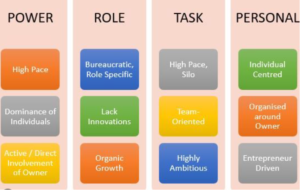
Charles Handy’s model
Please click the following icon to access this project in full