(Solution) CIPD 5HR03 Assessment ID / CIPD_5HR03_24_01
Solution
With reference to the above scenario:
- Explain the principles of reward and its importance to organisational culture and performance management. (AC 1.1)
Key Principles of Reward
Eco-Insulate needs to focus on three principles of reward that will be adopted, such as Total Reward, Consistency and Equity.
Total Reward Approach: According to CIPD (2025), employees do not consider financial rewards as the only important features; nevertheless, a combination of financial (like., salary, bonuses, pensions) with non-financial (such as career development, recognition, flexible working) rewards is valued by the employees.
Consistency: Consistency can be referred to as the employing of reward policies into use in a fair and clear way throughout the organisation so that everyone at work can know how rewards are defined (VQ Solutions, 2023).
Equity: Equity assures employees that they receive comparably well to other employees within the company (internal equity) and shining comparisons with similar positions in the external labour market (external equity) as reported by CIPD (2025a). Collectively, these principles give a guideline to come up with attractive, fair, and sustainable reward strategies.
Impact on Organisational Culture
Other organisational cultural values, such as staff attitude toward Eco- Insulate, would likewise be influenced by these reward principles that will be adopted to change a currently negative organisational culture. Adopting Total Reward, the organisation will be able to transition to the culture of recognition, well-being, and career advancement so that employees can feel more involved and motivated (CIPD, 2025). Consistency of reward practices would decrease attitude towards favouritism, particularly in relation to customised staff schemes to senior personnel, and the requirement to establish trust throughout the workforce. Lastly, Equity would make sure that the employees at the are valued based on their contribution which can minimize turnover and high loyalty.
Impact on Performance Management
The principles of rewards are also important to performance management in Eco-Insulate. Total Reward strategy permits the performance management system to be directly connected with the recognition, career development, and incentives, which reinforce the desired behaviours and results. Consistency makes performance to be measured and reward based on clear standards so that the employees who work diligently and deliver results fairly are confident that their efforts and rewards will be rated equally. Equity feels employees will work in a performance-oriented environment where they think their input and output will be rewarded according to their generated performance thus motivated to work harder (CIPD, 2025a). These principles when incorporated in the performance management would raise a clear view of sight between the individual contribution, organisational objectives, and rewards.
- Assess the contribution of extrinsic and intrinsic rewards to improving employee contribution and sustained organisational performance. (AC 1.2)
Extrinsic Rewards
Extrinsic rewards are material and finances offered by an organisation in order to motivate employees. These, as Pmapstest (2025) indicates are pay, bonuses, pensions, promotions or other material benefits. They do not belong to some intimate sphere of an individual but are directly related to working or being employed as a contractor.
Effectiveness in Improving Contribution:
Extrinsic rewards may be very useful in motivating short-term contribution of employees particularly when the activity is routine or even productivity oriented. Investing in the suitable case of Eco-Insulate to implement a performance related bonus might be one way to motivate both the skilled non skilled workers to ensure more efficiency is achieved as well as the ability to meet production targets (CIPD, 2022). Effective use of extrinsic rewards though could result in the employee having a tunnel-vision when it comes to attaining the rewards but not the wider organisational objectives and demotivation could occur once the reward gets taken away.
Intrinsic Rewards
The intrinsic rewards are psycho-financial gains that employees receive and work at work as job satisfaction, recognition, autonomy, or self-development as demonstrated by Silverman (2024). These are rewards which are associated with the self of the individual as opposed to the external rewards.
Effectiveness in Improving Contribution:
Intrinsic rewards may be especially successful when it comes to achieving engagement, innovations and commitment in the long term. Indicatively, development opportunities and acknowledgment of the contribution of the employees at Eco-Insulate may serve the purpose of making the staff feel appreciated and do their best to surpass expectations (Gibson, 2023). Intrinsic rewards are more likely to establish stronger emotional bonds to work in comparison to extrinsic rewards and result in increased discretional effort and commitment.
Long Term Organisational Performance.
The extrinsic and intrinsic rewards may serve to sustain the long-term performance of Eco-Insulate in terms of reducing the turnover, enhancing productivity, and culture. Extrinsic rewards will enhance a quick reinforcement (immediate) which will aid in attracting and retaining talent within a competitive environment. Although, intrinsic rewards are more long term commitment building rewards as they bring into harmony the values of employees and organisational goals. In the case of Eco-Insulate, it would be most useful to integrate the two methods: we need extrinsic rewards to be able to be fair and be competitive, and we want to be intrinsically rewarded and encourage engagement and innovation.
- Explain the differences between types of grade and pay structures. (AC 2.1)
First Submission:
Formal Pay Structure: Multi-Graded Structure
Multi-graded pay is a system that categorizes jobs into a grade ladder where each grade has a particular set of pay scales (CIPD, 2024). Promotion of employees should be according to grades based on performance, skills or a length of service. This may also bring fairness and transparency at Eco-Insulate since the skilled and non skill employees would be presented clear pay bands. Career development is also easier through such a structure and employees will be more willing to remain as opposed to going elsewhere in search of opportunities.
Informal Pay Structure: Spot Rate.
Spot rate are nonformal arrangements of paying workers a single fixed rate in the job, instead of them fitting into a broader band of pay (Unison, 2023). In the case of Eco-Insulate, it may involve negotiating a certain wage payable to a certain employee and this must be pegged on his merit or the level availability in the market, as opposed to having a defined grading system.
Differences
The following table highlights three key differences:
| Concept | Multi-Graded Structure (Formal) | Spot Rates (Informal) | |
| Fairness & Equity | Encourages equality within the company both in terms of compensation grades; employees perceive fairness throughout all positions (CIPD, 2024). | On the other hand, spot rates may create inequity if workers discover differing pay for similar work. | |
| Transparency | Provides clear progression routes and expectations; also supports Eco-Insulate’s aim to build a positive culture. | In contrary, spot rates lack transparency, leading to confusion and potential mistrust among staff. | |
| Flexibility | More rigid but ensures stability; suited to Eco-Insulate’s need to retain skilled workers. | On the other hand, the spot rates are flexible in responding rapidly to the labour market pressures as applied in recruitment, which is applicable in short-term recruiting. |
New Revised work:
Pay structures are defined as the way organisations handle and organise employee pay. In this discussion, we will cover three pay structures: Multi-Graded Structure, Spot rate, and Broad banded structure, describing their nature, their applicability at Eco-Insulate, and their main difference.
Multi-graded pay is a system that categorizes jobs into a grade ladder where each grade has a particular set of pay scales (CIPD, 2024). Promotion of employees should be according to grades based on performance, skills or a length of service. This may also bring fairness and transparency at Eco-Insulate since the skilled and non skill employees would be presented clear pay bands. Career development is also easier through such a structure and employees will be more willing to remain as opposed to going elsewhere in search of opportunities.
Informal Pay Structure: Spot Rate.
Spot rate are nonformal arrangements of paying workers a single fixed rate in the job, instead of them fitting into a broader band of pay (Unison, 2023). In the case of Eco-Insulate, it may involve negotiating a certain wage payable to a certain employee and this must be pegged on his merit or the level availability in the market, as opposed to having a defined grading system.
Formal Pay Structure: Broad-banded Structure
A broad banded pay structure consolidates multiple grades or pay levels into fewer, wider bands. This approach gives greater flexibility for pay progression within each band and supports cross-functional development (Armstrong, 2010). For Eco-Insulate, broad-banding may help encourage employee versatility and adaptability, especially where roles evolve with company growth. However, it may reduce pay control if managers award pay increases without clear performance guidelines.
Differences
The following table highlights three key differences:
| Concept | Multi-Graded Structure (Formal) | Spot Rates (Informal) | Broad banded Structure (Formal) |
| Fairness & Equity | Encourages equality within the company both in terms of compensation grades; employees perceive fairness throughout all positions (CIPD, 2024). | On the other hand, spot rates may create inequity if workers discover differing pay for similar work. | Offers moderate fairness; equity depends on managerial discretion within wide pay bands. |
| Transparency | Provides clear progression routes and expectations; also supports Eco-Insulate’s aim to build a positive culture. | In the contrary, spot rates lack transparency, leading to confusion and potential mistrust among staff. | Moderate transparency; fewer grades may reduce clarity but encourage open discussions on development. |
| Flexibility | More rigid but ensures stability; suited to Eco-Insulate’s need to retain skilled workers. | On the other hand, the spot rates are flexible in responding rapidly to the labour market pressures as applied in recruitment, which is applicable in short-term recruiting. | It has highly flexible which allows managers to reward performance and skills across broader ranges. |
- Explain how contingent rewards can impact individual, team and organisational performance. (AC 2.2)
Contingent Reward
An example of the rewards which is based on employee performance, skills or contribution is known as a contingent reward. Contrary to fixed pay, contingent rewards are contingent in nature; that is, they are subject to conditions such as competencies, skills, or results (Li et al, 2022). These may be various such as competency related pay, contribution related pay, skill based pay or service/ tenure related pay. In the case of Eco-Insulate, the negative culture and high turnover may be solved by the introduction of contingent rewards that would directly convert rewards towards efforts and outcomes.
Influence on Individual Performance.
At individual level, contingent rewards push the workers to advance their skills and performance. As an example, the implementation of the skill-based pay at the Eco-Insulate operating company would encourage new employees to become technologically skilled in the production of environmentally-friendly insulation (Indeed, 2022). Whenever people realise a tangible positive effect on their lives through their improvement, they tend to learn and be more productive. This does not only enhance individual performance, it also increases motivation and dedication to the company.
Influence on Team Performance
Teamwork can also be enhanced by related rewards as considered to appreciate the contribution of groups. An example of this would be contribution-based compensation based on group output objectives that would induce cooperation among the production teams at Eco-Insulate. Instead of working in isolation, employees would get motivated to help each other, share knowledge and continue meeting the same quality standards. Through this strategy, the existing negativity in the culture might be minimized as a feeling of collective responsibility and shared success is developed.
Influence on Organisational Performance.
Provision of contingent rewards at the organisational level can help align the behaviours of the employees with the strategic goals of the organisation. To illustrate, competency-based compensation based on sustainability abilities might motivate staff to become eco-centric solutions to sustainability that are a focus of the Eco-Insulate mission (CIPD, 2024a). This would, in turn, improve the product innovation, competitiveness in the market, and reputation. Likewise, service/tenure-based compensation might address turnover through loyalty pay as a way of ensuring the maintenance of knowledge. Altogether, the long-term organisational performance can be enhanced by contingent rewards that can compensate the reward according to the skills, contributions, and values that are essential in the success of Eco- Insulate.
- Explain the merits of different types of benefits offered by organisations. (AC 2.3)
Benefit vs Reward
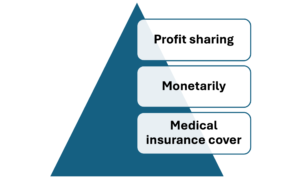
According to CIPD (2024b), a benefit refers to a compensation relating to non-wages paid to employees besides their base wages. More so it is a mentionable difference that whereas a reward is commonly associated with performance or contribution, a benefit is normally provided as a part of the employment package and is not always subjective on the condition that certain outcomes must be attained. Bennies are meant to offer the well-being, security and satisfaction of employees that lacks retention and organisational culture. The merits of benefits include;
Profit Sharing:
One of the benefits is profit sharing in which employees are given a portion of the business profit. In the case of Eco-Insulate, it may make the employees think and behave as stakeholders in an organisation. The virtue of this concept is in the fact that it has to correspond the efforts of the employees to the financial success of the company, which can be witnessed with YesIndeed (2024). In case Eco-Insulate is prosperous, workers are the direct beneficiaries, which makes them more motivated to achieve more and less in terms of waste. This may also change the already developed negative culture into a feeling of mutual goals and accomplishment.
Monetarily-Valued Points Cards:
The other advantage may be that it utilizes monetary valued points cards, where employees can earn points that they can redeem in form of goods, vouchers, or even services. The fact that it can be so is its merit; employees have a chance to select such a kind of rewards that will suit best to their needs. In the case of Eco-Insulate, this may especially be a potentially appealing one to a workforce that is diverse in that both skilled and non-skilled employees will have something potentially beneficial to them. It also enables the commitment to less significant contributions, which gives a consistent encouragement and appreciation of value.
Medical Insurance Cover:
According to O’Brien (2023), one such benefit that helps maintain the health and well-being of employees is medical insurance cover of employees which helps them pay-off the financial burden of attending a hospital. In the case of Eco-Insulate, the value of this advantage is two-fold: the benefit of employee work, stresses and absence have decreased, and it shows that the company has a behavioral model to care about its employees. Healthier employees will increasingly be more productive, and loyal in the long term.
- Explain the merits of different types of recognition schemes offered by organisations. (AC 2.4)
Recognition Scheme
Johnivan (2024) identifies a recognition scheme as a formal or informal programme that recognises and rewards efforts, performance, or behaviours of employees which help in reinforcing the interest of the organisation. Contrary to monetary compensation or bonus payments, a recognition scheme is about appreciation, motivation as well as establishing a positive working environment. In the case of Eco-Insulate which culture has been identified as being negative, it may be necessary to institute a recognition scheme to give the employees a sense of value and belonging. Merits of recognition plans include;
Public Recognition
Public recognition merely entails recognition of employee accomplishments in open areas, including team gatherings, company magazines, or festivals (HiFives, 2023). The first is the merit that it enhances motivation and pride because the employees would feel cherished in the company before their colleagues. The second advantage is that it enhances organisational culture through strengthening positive behaviours and giving rise to role models. In the case of Eco- Insulate, it might be necessary to engage people in favor of building disengagement for creating staff identification with company values.
Non-Cash Awards (Tickets and Vouchers)
Non-cash awards recognise an individual without offering them any direct financial reward, like concert tickets or shopping vouchers. Flexibility is one of them; employees are offered an opportunity to use their personal rewards, which produces a high level of personal satisfaction (Silverman, 2024). Cost users will be considered another advantage because such awards may cost less than cash bonuses yet equally motivating. In the case of Eco-Insulate, a consistent attendance or teamwork reward could be awarded by the use of vouchers to motivate the employees to continue delivering at the same rate and this would not be a valued addition to the payroll as well.
Employee of the Month
Employee of the Month Programme is an award that recognizes and honors the excellent results of one employee every month (CIPD, 2022a). The initial advantage is that it brings about healthy competition whereby the employees strive to perform well in their jobs. The second advantage is that it creates a culture of appreciation since the appreciation act is now a common practice in the workplace. In the case of Eco-Insulate, such a scheme may provide a boost to morale with the benefit of realizing that it pays attention to the hard work and celebrates it, thus lowering turn-over, and reinforcing them on their work.
- Assess the business context of the reward environment. (AC 3.1)
First Submission:
PESTEL analysis is a business strategy employed to understand forces in the external environment of Political, Economic, Social, Technological, Environmental, and Legal forces that impact on organisational decisions, performance and long-term strategy. PESTEL factors are the following in terms of rewrads;
Political Factors
The element of the politeness, specifically the employment legislation, and government policies is important in developing reward strategies. The impact of the UK government policy on minimum wages (National Minimum Wage Act 1998), lessening the requirement of pensions to be automatically enrolled, and actions associated with equality legislation directly affect the way Eco-Insulate will be forced to organize pay and benefits. Swiftly, legislations regarding equality (Equality Act 2010) require that men and women be paid equally for equal amounts of work (ACAS, 2024). The presence of special schemes when working with senior staff at Eco-Insulate may be regarded as disjointed or unjust ever-so-severe, prone to destroy the level of trust or bring up an upsetting question. In order to stay in line and safeguard itself in terms of its image, Eco-Insulate has to implement clear pay schemes, provide equity in perks, and synchronize its motivation strategy with legislation.
Technological Factors
Changes in technology influence the work process and also the system of reward management. Infrared tools and automation can make manufacturing more efficient, but they also put certain stress on employees who have to upgrade in the form of additional skills to stay relevant (Abundance Global, 2024). In the case of Eco-Insulate, these are that reward strategies must have aspects of skill-based compensation or training of the employees to acquire newer technologies needed to incorporate eco-friendly production. Moreover, the use of digital schemes of recognition, flexible benefits, and performance monitoring can be used with the help of technology. Introducing these tools into its system, Eco-Insulate will be able to make its rewarding system more interactive, transparent, and focused, especially to younger employees, who appreciate digital convenience.
Social Factors: Trends in Work Force.
Attitudes towards rewards are influenced by the societal expectation and the labour force demography. As REBA (2024) remarks, the workforce is currently more diverse, as younger workers increasingly need flexibility and appreciation, and older workers need pensions and health benefits, which means Eco-Insulate should develop an inclusive approach to reward purposes. There are also existing trends in the current labour markets that point at the lack of skilled risk manufacturing. In the absence of competitive remuneration, Eco-Insulate has the risk of losing its talented employees to their rivals with more attractive packages. To deal with this Eco-Insulate needs to mix competitive compensation with some intrinsic reward e.g. career development prospects and rewards schemes.
New/Revised work:
Understanding both external and internal business environments is crucial for developing effective reward strategies. PESTEL analysis helps Eco-Insulate evaluate external influences while internal factors ensure alignment with organisational culture and goals. PESTEL analysis is a business strategy employed to understand forces in the external environment of Political, Economic, Social, Technological, Environmental, and Legal forces that impact on organisational decisions, performance and long-term strategy. PESTEL factors are the following in terms of rewards;
Political Factors
The element of the politeness, specifically the employment legislation, and government policies is important in developing reward strategies. The impact of the UK government policy on minimum wages (National Minimum Wage Act 1998), lessening the requirement of pensions to be automatically enrolled, and actions associated with equality legislation directly affect the way Eco-Insulate will be forced to organize pay and benefits. Swiftly, legislations regarding equality (Equality Act 2010) require that men and women be paid equally for equal amounts of work (ACAS, 2024). The presence of special schemes when working with senior staff at Eco-Insulate may be regarded as disjointed or unjust ever-so-severe, prone to destroy the level of trust or bring up an upsetting question. In order to stay in line and safeguard itself in terms of its image, Eco-Insulate has to implement clear pay schemes, provide equity in perks, and synchronize its motivation strategy with legislation.
Technological Factors
Changes in technology influence the work process and also the system of reward management. Infrared tools and automation can make manufacturing more efficient, but they also put certain stress on employees who have to upgrade in the form of additional skills to stay relevant (Abundance Global, 2024). In the case of Eco-Insulate, these are that reward strategies must have aspects of skill-based compensation or training of the employees to acquire newer technologies needed to incorporate eco-friendly production. Moreover, the use of digital schemes of recognition, flexible benefits, and performance monitoring can be used with the help of technology. Introducing these tools into its system, Eco-Insulate will be able to make its rewarding system more interactive, transparent, and focused, especially to younger employees, who appreciate digital convenience.
Social Factors: Trends in Work Force.
Attitudes towards rewards are influenced by the societal expectation and the labour force demography. As REBA (2024) remarks, the workforce is currently more diverse, as younger workers increasingly need flexibility and appreciation, and older workers need pensions and health benefits, which means Eco-Insulate should develop an inclusive approach to reward purposes. There are also existing trends in the current labour markets that point at the lack of skilled risk manufacturing. In the absence of competitive remuneration, Eco-Insulate has the risk of losing its talented employees to their rivals with more attractive packages. To deal with this Eco-Insulate needs to mix competitive compensation with some intrinsic reward e.g. career development prospects and rewards schemes.
Internal Factor: Organisational Culture
Eco-Insulates’s internal culture significantly influences reward strategies. A positive, performance-oriented culture encourages motivation and loyalty. If the culture values teamwork and innovation, rewards must reflect collective achievements, creativity, and recognition. Aligning pay and benefits with company values strengthens employee engagement, retention, and ensures consistency between internal practices and strategic business goals.
In conclusion, combining PESTEL insights with internal cultural considerations enables Eco-Insulate to design fair, competitive, and motivating reward systems that support compliance, innovation, and sustainable employee satisfaction.
- Evaluate the most appropriate ways in which benchmarking data can be gathered and measured to develop insight. (AC 3.2)
Benchmarking and Its significance.
Reward management benchmarking
Please click the following icon to access this project in full