(Solution) CIPD Avado 5HR01 Answer to the Task Questions
Solution
Table of Contents
Answer to the Task Questions. 2
1.1 Employees Involvement and Participation Analysis. 2
1.2 Union and Non-Union Employee Representation. 3
Union Employees Representation. 3
Non-Union Employee Representation. 4
Similarities and Differences. 4
1.3 Employee Voice and Organisational Performance. 5
Arguments Against Relationship. 5
1.4 Better Working Lives; Definitions and Design. 6
Meaning of Better Working Lives. 6
Designing Better Working Lives. 6
2.1 Organisation Conflicts and Misbehaviours. 7
Differences of the Concepts. 8
2.2 Trends in Types of Conflict and Industrial Sanctions. 9
Flexible Work Arrangement Trend. 9
2.3 Third Party Conciliations, Mediations and Arbitration. 10
3.1 Unfair Dismissal; Capability and Misconduct Issues. 11
Capability and misconduct issues. 11
Key Principles of Unfair Dismissal 12
3.2 Employees Grievance Issues. 13
3.3 Grievances handling in Modern Organisations. 14
Grievances handling successfully. 14
Impacts in an event grievances are not effectively handled. 15
Answer to the Task Questions
1.1 Employees Involvement and Participation Analysis
Employees Involvement
This concept is defined as involving decisions which are made by employees in an organisation and initiatives despite final direction/authority given by admin (ACAS, 2021b). Employees are free to grant what they think, pass suggestion and involve in activities plans to influence their daily operations. The involvement assists to build relations since staff and admin are actively engaged, enhance their satisfaction in workplace and trust-based relations initiated.
For example, in public sector organisation under merger, employees would grant their suggestions or discussion forums intended for acquiring information on their views on successful determinants of merging. According to Young (2024), the rationale of prioritising on involvement enhances their inclusion in change, lowered resistance and enhancing collaboration in workplace culture albeit changes in leadership.
Employees Participation
This entail engaging the employees in making core organisation decisions contrary to just listening to what they think. According to Lombard (2024), it transitions past active consultations to granting an opportunity for their participation formally in decision making. The examples of this include part of trade union, joint consultative committee and involved in employee’s representation boards. The outcome of this is enhancing mutual-based trust, accountable and high-level respects amongst the admin and staff. Hence, through enhancing the active participation, the employees increase their potential of support of set objectives of an entity and harmonious relations.
As the merger is being implemented in the case study, work councils and trade unions would be used with a purpose of increasing their impact towards the policies/practices of post-merger. As identified in Indeed (2024), these opportunities offer a feel of inclusion, managing uncertainties and sustainable workplace.
Differences
Both concepts are distinct informed by scope of making decisions, scope of involvement and how they are engaged. Different from employee’s involvement identified as management-based and consultation-based, employees participation grants them a holistic inclusion in making decisions.
Conversely, involvement is basically linked with feedback sourcing by surveying and one-on-one meeting. This is different from participation in that staff are engaged in collective bargaining initiatives and representation for negotiating policy development.
Another difference is that employee’s involvement is informally implemented voluntarily with participation formally pursued such as informally and voluntarily with participation inclusion of formal-based structures including engaging trade unions and advisory teams. Hence, involvement is noticeable from how the employees are offered with engagement opportunity with participation evidenced from employees leveraging on an opportunity to make decisions.
In summary, participation in the case study would be more effective as they are granted more opportunities for taking an active role in core decision making which is long-term based.
1.2 Union and Non-Union Employee Representation
Union Employees Representation
This entail an undertaking of employees having to join a trade union bargaining for them for an improved workplace, rewards and being secure in workplace. The trade unions here are at the middle of organisation/employers and staff for guaranteeing collective bargaining requirements. According to CIPD (2025b), the scope of their involvement is granting legal-based facilitation, advocating fairness and enrolling in industrial activities based on need.
In the case study, being represented by trade unions assures the staff with an opportunity for adherence on strict legislations in place including provision of fairness in contracts implementation towards the benefit of employees. Collective bargaining entails the opportunity granted implying increasing how decisions are made effectively. The scope of representation assists in increasing how employees are confident in pursuing appropriate staff decisions made. This is as merger lead to changes in workplaces.
Non-Union Employee Representation
This is identified to be communication opportunities granted to staff for voicing their issues or taking active part in making decisions with no necessity to enrol to trade unions. In line with Peters (2020), this entail a phenomenon employees forums are internally organised with discussing pitting workplace challenges, presentation for improvements opportunities and interaction with admin.
In the case study, upon merging, employees’ forms are appropriate for managing job securities, restructure and policies in organisations. Through the strategy, open engagement is enhanced amongst the organisation and employees initiating trust-based relations which are transparent.
Similarities and Differences
The unions and non-unions embrace employee’s representation for facilitating employees in expressing their points of view, suggest and issues while participating in core decision making and voices hearing.
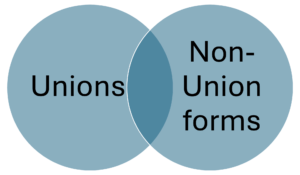
Additionally, according to CIPD (2024), harmony on how in the case study they relate facilitating active engagement amongst the staff and managers and to avoid conflicting parties and have input on their engagement scope.
Another area of difference is in terms of held power and influence. For example, unions are actively supported legally with collective bargaining allowing active negotiations in regard to employment conditions and pursuing industrial actions such as striking and upon emergence of needs.
Conversely, non-union representation power and influence is informed by voluntarily cooperating from managers with no requirements of law inclusion. Additionally, the unions leverage from opportunities for escalating in disputes by formally negotiating and participating in industrial actions. The non-union strategies are implemented in form of open-based engagement and management having willingness in resolving issues in work. According to ACAS (2022), this limit how they influence alignment of employment relations.
1.3 Employee Voice and Organisational Performance
Support Arguments
Through an increased employee’s voice, organisation performance is enhanced through enhancing how they get engaged, innovative and productive. In Broderick (2024), there is higher likelihood for staff commitment and experiencing increased satisfaction in their workplace when feeling their input are incorporated hence lowring overall turnover level.
For the case study, having the input of the staff enhance how effective they are in their operations with employee’s engagement leading to ideas sharing enhancing efficiencies and delivering services. This is collaborated in Busher (2019) noting open-based communication facilitating how they make decisions offering admin with information from leading employees with direct involvement in service es delivery. Also, in the case, making sure employees voice guide identification of issues as they integrate, leaders put into account entire issues prior further escalation.
Finally, in line with Ranjan and Jhaveri (2025), employees voice highlight that by pursuing employees’ forums well positioned and representation strategies enhance how transparent, trust-based relations and collaboration in workplace. Hence, this lead to successful organisation and stable after merger.
Arguments Against Relationship
Despite of relevance of employee’s voice, effectiveness in enhancing organisation performance is not at all times a guarantee. For instance, Wison (2024) highlight evidence of prompt changes with continuously consulting parties reducing efficiency of core decision making and hence inefficient.
Also, in CIPD (2025a), it notes when inappropriately coordinated, employees voice strategies could contribute to increasing conflicting parties as opposed to cohesive relations since varying opinions generate tensed environment amongst staff and leaders/management.
In the context of entities which suffer from weakness in their top leadership, there would be issues with executing the feedback gained from the employees hence frustrated and less engaged teams. Failing in integrating feedback from staff in an appropriate manner lead to staff doubtful of success of their inclusion and start suffering from mistrusts and their morale.
Judgement Made
The voice of staff and performance is a hard relation with gains and issues encountered. While employees voice success contributes to increasing engagement of staff, innovativeness and trustable assists in enhancing how an organisation performs. Nevertheless, inappropriate management and out of control consultations lead to frustrated teams affecting how they control decisions.
For case study, as highlighted by ACAS (2020), working with a well-coordinated employee’s voice such as joint consultation facilitate an appropriately coordinated strategy inclusive of employees input scope with no disruptions of their operation success. Eventually, this is dependent on how the leaders are committed on employee’s voice and capacity for managing feedback meaningfully.
1.4 Better Working Lives; Definitions and Design
Meaning of Better Working Lives……….
Please click the following icon to access this assessment in full