(Solution) CIPD Avado New 5HR01 Employment Relationship Management
Solution
Table of Contents
1.2 Comparing Forms of Union and Non-Union Employee Representation. 3
1.3 Evaluating the Relationship Between Employee Voice and Organisational Performance. 4
1.4 Explaining the Concept of Better Working Lives and How This Can Be Designed. 5
2.1 Distinguishing Between Organisational Conflict and Misbehaviour. 6
2.2 Assessing Emerging Trends in Types of Conflict and Industrial Sanctions. 7
2.3 Distinguishing Between Third-Party Conciliation, Mediation, and Arbitration. 9
3.2 Key Causes of Employee Grievances. 11
3.3 The Importance of Handling Grievances Effectively. 12
Briefing Paper
1.1 Differentiating Employee Involvement and Employee Participation and How They Build Relationships
Employee Involvement and Employee Participation t are both important elements in the creation of healthy workplace relations, yet they operate in different ways. Employee involvement refers to opportunities for individuals to make direct contributions to decisions made in the workplace, typically through means such as staff surveys, staff forums, or suggestion schemes (CIPD, 2025). For example, in the NHS, staff engagement surveys in the public sector allow workers to voice views on organisational culture, leadership, and service quality, ensuring their views contribute towards local and national policies. Direct involvement increases engagement, lifts motivation, and provides a sense of agency for decisions made in the workplace
Employee Participation, on the other hand, is generally more formalized and indirect, particularly in unionized government workplaces. It takes place via representative channels such as trade unions, staff associations, or works councils, who negotiate or consult employers on issues from pay through working environment towards organisational change. UNISON, for instance, generally represents council staff in collective bargaining processes, where staff common interests are represented and negotiated (ACAS, 2021). Involvement thereby provides staff with a louder common voice and equity in decision-making. The employees involvement strategically ensures that they are appropriately positioned in their business sector. This is through ensuring they leverage on competitive advantage and dominate their sector of operations.
Both approaches, though different, are complementary in the shaping of constructive employment relations. Participation provides instant responses for management and facilitates working practice cooperation, while involvement provides staff’s assurance of readily available, legally entrenched mechanisms for logging complaints or influencing organisational policies. Additionally, they foster inclusiveness, strengthen fairness, enlarge the voice of the marginalised, enhance the quality of decisions, and strengthen organisational sustainability in dynamic situations. Both approaches in combination are particularly valuable in the public sector, where accountability, open government, and service quality are key.
If implemented successfully, Participation and involvement generate greater mutual confidence in employees and senior management. Conflict diminishes, communication is improved, and harmony in the workplace is developed as a culture in which employees are listened to and respected. Further, they foster reciprocal responsibility, cultivate enduring communication, attain openness, restrict mistakes in understanding, create greater job contentment, and ultimately build lasting confidence in each organisational level. In a merged firm with a changed leadership structure, both types of representation embedded in practice will consolidate the firm, strengthen employees’ dedication, and favour organisational performance.
1.2 Comparing Forms of Union and Non-Union Employee Representation
Employee representation is a primary mechanism for ensuring staff have a voice and their concerns are listened to seriously.
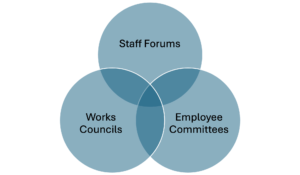
As a system in the public sector, union representation was historically in the lead (CIPD, 2022). Trade unions like the National Education Union (NEU) and the Royal College of Nursing (RCN) negotiate with employers on major issues like workload, pay, and staffing levels. For instance, the NEU lobbied for a lighter teacher workload and adjustment of the curriculum, while the RCN has actively lobbied for safe staffing ratios and more equitable pay arrangements across the NHS. These unions provide employees with a collective voice for bargaining that strengthens their power when they are determining organisational policies and ensuring employment arrangements are fair and transparent.
Comparatively, non-union representation is more commonly seen in private sector workplaces, particularly where trade union density is low (ACAS, 2021). Non-union representation is most likely to feature in the form of staff councils, employee forums, or engagement boards. Instructively, staff voice mechanisms, like consultation groups or web forums are likely to be used by large technical businesses and professional services firms to solicit staff opinion. Such arrangements enable the employees to have a role in making decisions at the workplace concerning the wellbeing programmes, diversity programmes, and the flexible working programmes. Although they may not enjoy the legal protections and collective bargaining privileges of trade unions, non-union forms are usually customised, open and accommodating to the day-to-day requirements of the workforce (CIPD, 2025).
The two types of representation have merits and demerits. Union representation offers a more solid and legal entrenched voice of collective bargaining and is successful in sectors where working conditions have a direct impact on the quality of services like in education and healthcare where conditions directly influence the process of service delivery. Non-union representation can lead to cooperation and creativity, giving employees an opportunity to contribute to organisational change without the formality of joint bargaining. The joint bargaining ensure that the scope of collaboration amongst the different stakeholders is achieved. Since an organisation has many stakeholders, they work together towards achieving their set organisation objectives.
Both approaches are compatible in a Public sector organisations organisational setting. Having union relations in place secures compliance with employment law and labour rights enforcement, while adopting non-union vehicles such as staff forums promotes broader staff engagement. Both are capable of building confidence, open communication, and collaboration in the workplace, facilitating organisational resilience in the face of mass change. A resilient organisation is competitive and manages their business environment issues holistically without compromising their integrity or best practice.
1.3 Evaluating the Relationship Between Employee Voice and Organisational Performance
Employee voice is the way in which staff are empowered to contribute their views, opinions, and concerns, both individually and collectively, on things at work (CIPD, 2025). Effective voice mechanisms in public sector organisations are transformatively linked with organisational improvements in performance. For example, in the NHS, the annual staff survey provides a systematised way in which staff can raise things they are concerned about in regards to workload, availability of resources, and patient safety. Managers and those who set policy use the reports in introducing improvements in patient care and staff wellbeing. Research has demonstrated where staff are listened to, engagement and job satisfaction are greater and staff turnover and absence are lower.
Similarly, staff forums and consultative committees assume prominent influence in HR policy setting in local councils. The management is in a good position to identify problems at the initial stages and formulate policies that consider the interests of both the staff and service users with the staff deliberating workplace issues. The ultimate outcome of it is heightened morale, heightened cooperation and heightened organisational commitment. Notably, it creates a welcoming atmosphere of open communication and transparency in which employees feel that their opinions are taken seriously. ACAS (2024) quotes open communication on employers and staff as the key in the prevention of dispute and fair treatment, which is the core of organisational success maintained.
The employee- organisational performance voice relation is also in the form of measurable outcomes. Companies that respond positively to feedback experience productivity, creativity and service delivery increase. In the case of the public sector, it means improvements in patient outcomes in healthcare, schools, and service delivery in local authority. The failure to pay attention to voice on the part of the employees leads to disengagement, conflict, and reputation.
Voice of employees is not merely a compliance mechanism, but is a strategic resource in the larger sense. When done with proper implementation, it allows organisational learning, facilitates flexibility in organisational change scenarios and allows the alignment of the expectations of employees with the organisational goals. It therefore shows a close connexion between the quality voice arrangements and the performance improvement of the organisation.
1.4 Explaining the Concept of Better Working Lives and How This Can Be Designed
The better working lives idea revolves around enhancing the working life of workers, enhancing their wellbeing, and providing an environment in which workers are prone to professional and personal thriving (CIPD, 2024). On the organisational level of the Public sector organisations, the result of flexible working arrangements, wellbeing, and inclusive human resource policy is better living. They are applied in order to build job satisfaction, stress alleviation and employee turnover, and simultaneously, promote organisational objectives.
One of the ways that can be used to build better working lives is through flexible working……
Please click the following icon to access this assessment in full
Related to:https://rankedprofessionals.com/downloads/solution-cipd-5hr01-briefing-paper/