(Solution) CIPS ROSHN Contract Terms and Conditions
Task
Using a set of your organisations (or one with which you are familiar) terms and conditions, explain how the terms and conditions help the organisation ensure that:
- The risks of poor quality, extension of time, increased costs and unethical practice are managed effectively
- The relevant performance measures are monitored and managed.
Solution
Executive Summary
This report has focused on evaluating ROSHN’s standardized contract terms and conditions. The areas of focus included managing risks related to quality, time extensions, cost increases and unethical practices. Part of this assessment has also involved an evaluation of the terms and conditions importance in enhancing the performance and measuring the overall outcomes. At the end of this report, the battle of the forms evaluation has been pursued.
In regard to the key findings, they evidence that ROSHN’s performance monitoring measures were also assessed. Also, the key findings evidence that ROSHN uses standardised terms and conditions for all procurement contracts regardless of value to ensure consistent risk management across its major real estate development portfolio. The terms appropriately allocate obligations between ROSHN and suppliers to protect project timelines, budgets, and quality standards. Key clauses address technical specifications, payments, penalties, defects liability, and more. Another key findings evidence the need for close performance monitoring against metrics like safety, costs and program data allows issues to be identified and addressed proactively. Lastly on battle of the forms, the key findings note that they prevail due to ROSHN and their potential suppliers having varying terms and conditions.
The analysis uncovered some areas for potential enhancement. Four recommendations were proposed:
1) Establishing clear version control protocols
2) Incorporating liquidated damages for intangible losses from defects
3) Tying supplier payments to productivity metrics
4) Conducting biannual contract reviews across departments. Implementing these recommendations would further strengthen ROSHN’s risk controls and drive continuous governance improvements over documentation and project execution.
Table of Contents
Table of Contents
1.1 Organisation Background. 4
1.2 ROSH Terms and Conditions Selected. 5
2.0 ROSHN Terms and Conditions. 7
2.2 Risk of Extension of Time. 13
2.3 Risks of Increased Costs. 15
2.4 Risks of Unethical Practice. 15
3.0 Performance Measures Monitoring and Management. 16
5.0 Conclusion and Recommendations. 19
Figure 1: Summary of ROSHN Operations 5
Figure 2:Mendelow Stakeholders Analysis. 7
Figure 4: Vulnerability and risk and rewards. 9
Figure 5:Comparison of contacts and warrants. 11
Figure 6:Contract Execution phase. 15
Figure 7:Performance Monitoring and Management 19
Table 1: ROSHN Terms and Conditions 9
1.0 Introduction
1.1 Organisation Background
ROSHN is a real estate development company established by the government of Saudi Arabia in 2020. It was formed as a central part of the Kingdom’s Vision 2030 plan to diversify the economy and develop its housing sector. ROSHN aims to deliver 250,000 housing units across Saudi Arabia by 2030 (ROSHN, 2023). It operates major residential projects in key cities and regions including Riyadh, Jeddah, Al Khobar, Madinah and AlUla. ROSHN utilizes an integrated value chain model to manage all aspects of project delivery from land acquisition to planning, construction and sales (see figure 1). ROSHN uses standardized terms and conditions for all of its procurement contracts regardless of value. This ensures a consistent approach to risk management, performance monitoring and legal compliance across projects.
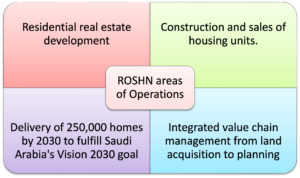
Figure 1: Summary of ROSHN Operations
Source: (ROSHN, 2023)
The terms clearly outline quality standards and timelines that suppliers must adhere to. Non-compliance can result in penalties or contract termination to protect ROSHN’s project schedules and budgets. Suppliers also take full responsibility for increased costs from delays or defects in workmanship. Regular reporting against key performance indicators allows ROSHN to closely track suppliers’ progress (Akkermans et al., 2019). This includes safety, cost, program data, and customer satisfaction metrics. Onsite inspections further help ROSHN proactively address any issues to deliver high-quality homes on time. Ethical conduct is also mandated through the terms. Suppliers must avoid corruption and uphold labour laws to align with Vision 2030 goals of sustainable development (AlArjani et al., 2021). This standardized framework helps ROSHN effectively manage procurement risks as it works to fulfil the country’s critical housing needs.
1.2 ROSH Terms and Conditions Selected
ROSHN utilizes standardized terms and conditions for all of its procurement contracts regardless of contract value or risk level as shown in figure 2. These apply irrespective of contract value or risk level due to the company’s extensive development portfolio (Zhu et al., 2020). This blanket approach helps ensure legal and operational consistency across ROSHN’s extensive residential development portfolio. The selected terms and conditions outline the general commercial and legal parameters governing the supplier-client relationship (See appendix 1). Key sections addressed include contract formation, scope of work, pricing and payment schedules, compliance requirements, obligations of both parties, risk allocation, termination clauses and dispute resolution procedures.
The terms primarily govern sourcing of construction goods, materials and services. It divides risk and authority between ROSHN (Party 1) and its suppliers (Party 2). Figure 2 applies the Mendelow Stakeholders Analysis (CIPS, 2022):
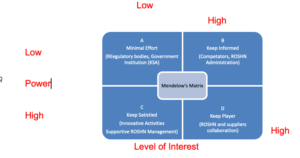
Figure 2: Mendelow Stakeholders Analysis
Source: CIPS Module Notes summary
High power, low interest: Future homeowners and the wider community have low interest in terms but are impacted by quality of delivered homes.
Low power, high influence: ROSHN’s project managers and suppliers work closely to successfully implement terms while influencing each other.
High power, high influence: Suppliers take on significant risks defined in terms. Through collaborative relationships with ROSHN, they can influence scope of work and success.
Low power, low interest: Government agencies set broader regulations but have limited direct influence on contract terms between ROSHN and suppliers. Competitors only indirectly impact terms.
By applying standardised terms consistently, ROSHN maintains control over projects’ schedule, costs and risks. Supplier consultations ensure practical buy-in. Regular performance reviews facilitate transparent risk monitoring aligned with contractual obligations under ROSHN’s standardized terms and conditions.
Additionally, ROSHN utilizes standardized terms and conditions to effectively manage risks across its extensive property development portfolio. To ensure allocated risks in contracts are suitable, ROSHN follows the contract management cycle outlined by CIPS (2022a) (figure 2). This guides ROSHN and suppliers in fairly distributing risks through adherence to contract requirements. Regular engagement and collaboration between ROSHN’s project teams and suppliers aids negotiation of terms that appropriately balance internal and external risks for both parties (Gutierrez et al., 2020). As per the contract management cycle, ROSHN conducts thorough risk assessments and monitoring at each stage. This enables proactive risk mitigation in line with contractual obligations under ROSHN’s standardized terms.
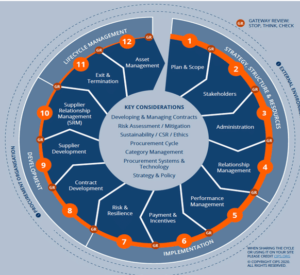
Figure 3: Contract cycle
Source: CIPS (2022a)
2.0 ROSHN Terms and Conditions
ROSHN’s standardized terms and conditions define the relationship between ROSHN, its suppliers, and other stakeholders. It appropriately allocates risks to support successful contract execution across (CIPS, 2022) ROSHN’s housing portfolio. As shown in Figure 4, the relevance of ROSHN’s terms and conditions depends on specification types important for construction contracts. ROSHN’s contracts entail high vulnerability and risks given the extensive development scope. They also represent high relative value and impact on fulfilling Saudi Arabia’s Vision 2030 goals.
High
Vulnerability
Low
Relative Value or Imp High
Source: Summarised from CIPS (2022b)
According to best practices from CIPS (2022b), ROSHN’s terms and conditions follow a performance-based structure. Primary focus is placed on delivering housing units on schedule, within budget and as per pre-defined quality standards. This results-driven approach emphasizes function over process, with suppliers accountable for finished product delivery. Therefore, ROSHN’s standardised approach to terms and conditions facilitates consistent risk management across its expansive real estate portfolio and construction supply chain. This comprehensively addresses contract performance and stakeholder obligations (Chowdhury et al., 2020).
Key sections of ROSHN’s terms and conditions are outlined in Table 1. This includes contract formation protocols, technical specifications, dates for completion milestones, penalties for non-compliance, warranty coverage and dispute resolution, supplementary details on health and safety, pricing schedules and other project-specific procedures.
Table 1: ROSHN Terms and Conditions
Source: ROSHN (2023a)
2.1 Risk of Poor Quality
Quality in contracts refers to goods or services being produced or delivered as explicitly stipulated in terms of design
Please click the following icon to access this project in full
Related: https://rankedprofessionals.com/downloads/solution-cips-organisation-terms-and-conditions-pdc/