(Solution) CIPS ROSHN Syndicate Effective Negotiation
Solution
CAP Front sheet including malpractice checklist V3
Table of Contents
1.1 ROSHN Organisation Background. 6
1.2 Introduction of Category of Spend. 6
2.0 Commercial Negotiation Plan. 7
2.1.2 Stakeholders Analysis. 9
2.1.6 Achieving BATNA in Negotiation. 16
2.1.6 Negotiation Strategies to be used. 17
4.0 Conclusions and Recommendations. 25
Figure 2:Summary of the RACI Matrix. 8
Figure 3:ROSHN Stakeholders Groups. 10
Figure 4:Mendelow Matrix Analysis 11
Figure 5:SWOT Analysis summary. 12
Figure 6:BATNA and ZOPA in vehicles negotiations process 17
Figure 7:Negotiation Strategies. 18
Figure 8:5 Rights of Procurement Model 19
Figure 9:4R’s Model Analysis. 21
Figure 10:3Ps Triple Bottom Line Model 22
Figure 11:Suppliers Preferencing Model 23
Table 2:Summary of the vehicles categories, suppliers and budget 20
This report provides a background of a formal commercial negotiation which has been developed for ROSHN organisation operating in Saudi Arabia (KSA) real estate industry. To achieve the intended aim of this report, the data used has been sourced from information, figures, desk research, external data which guide the negotiation process. The selected category of spend is vehicles. To develop the negotiation plan, different approaches, techniques, theories and concepts have been referenced to analyse and present successful bargaining approach. Further, with different projects being pursued by ROSHN in urban and rural areas, negotiating for good quality vehicles is essential. Hence, over the years, ROSHN demand for different categories of vehicles has been increasing in the past years. As part of negotiation, ROSHN involves experts, basing it to terms and conditions, adequate plan and optmised supply chain and procurement management.
The findings in this report evidence that ROSHN pursues a series of negotiations which are guided by CIPS module models. The phases pursued include preparation, evaluation, proposal, negotiation, settlement and closing. For all these phases, they are resources intensive hence a necessity for pursing a detailed negotiation. Also, the findings in this report evidence the need for involving multiple stakeholders for a successful implementation of the negotiation process. This is essential for managing their competitiveness in their business sector. Part of this report findings also highlight on the need for customising the negotiation plan based on the different stakeholders expectations. This is with optimum success in the negotiation being dependent on how the organisation manage BATNA, MLA and any battle of the forms with good results obtained.
In line with the summary of the findings and conclusions offered, the recommendations include;
- To carry out a detailed planning in their negotiation process to ensure entire stakeholders are engaged with their interests given a priority
- A successful inclusion of technology and innovation to harness process of negotiation plan
- To improve documenting of their operations for optimum involvement of all stakeholders and to manage conflicts of interests in negotiation
- To ensure that customised negotiations are pursued in their different spend categories as opposed to using a single negotiation strategy
1.0 Introduction
1.1 ROSHN Organisation Background
ROSHN is a Real Estate community developer powered by the Public Investment Fund (PIF), which is one of the world’s largest wealth funds, the PIF has the largest investment portfolio. In addition, the PIF focuses on long-term and strategic investment in the Kingdom of Saudi Arabia and around the world. ROSHN real estate company was founded to improve and develop high-quality residential communities for the people of Saudi Arabia.
Since ROSHN is one of the largest real estate development companies in the Kingdom of Saudi Arabia, they are highly committed to supporting the Ministry of Housing, and also National Housing Company (NHC) to reach the rate of home ownership to 70% by 2030 (ROSHN, 2024). One of ROSHN real estate company’s goals is to work with local partners to create jobs for Saudi people. ROSHN will also improve The Quality-of-Life Program. The Quality-of-Life Program was launched in 2018 to improve the quality of life of residents in the Kingdom of Saudi Arabia by becoming homeowners, and also by providing a great community where all residents can find their daily necessities close to their homes, such as gyms, supermarkets, malls, restaurants, and much more.
1.2 Introduction of Category of Spend
One of the key aspects of ensuring that ROSHN’s operations run smoothly is providing its employees who work on-site with vehicles. Since there are no vehicle manufacturers within Saudi Arabia, ROSHN has to rely on suppliers who act as distributors. This highlights the importance of effective negotiations between ROSHN and its suppliers. If ROSHN does not negotiate well, the suppliers will have the upper hand, which could lead to unfavourable terms and conditions. Therefore, it is crucial for ROSHN to apply the best negotiation strategies to ensure that it gets the best possible deal from its suppliers. By doing so, ROSHN can maintain its competitive edge and continue to provide the best services to its clients.
In the vehicles spend category, ROSHN budget approximately SAR50 Million yearly for facilitating their purchasing, leasing and also maintenance.
1.3 Purpose of this Report
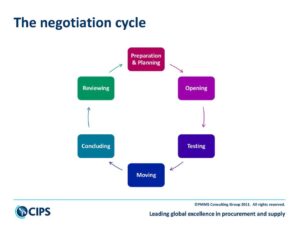
The objectives of this negotiation plan is informed by the fact that a negotiation plan is important for commercial negotiations in order for an organisation to leverage on competitive advantage and dominate their area of practice. The negotiations assists in prioritising on stakeholders interests, managing costs, evaluating quality and hence value for money outcomes (CIPS, 2022). Further, the commercial negotiation is essential for enhancing communication with all stakeholders successfully. In this integrative assessment, the purpose entail coming up with a negotiation plan forming basis for commercial negotiation. This is since a mutual agreement is achieved as part of the negotiation amongst all parties engaged (Mwagike et al., 2022). In figure 2, a summary of the requirements of negotiation plan in alignment with Key Performance Indicators (KPIs) and Service Level Agreements (SLAs) as a core area of negotiation is put into account (Antal & Mitrik, 2020);
Source: Summarised from CIPS Module notes
This integrative assignment would come up with an appropriate negotiation plan for ROSHN organisation. This would be guided by available data, statistics sourced, factual information and CIPS Module Notes and tools.
2.0 Commercial Negotiation Plan
2.1 Preparation & Planning
In this initial phase of negotiation, it include laying ground for the entire process of negotiation by aligning the objectives of negotiation with stakeholders and environment (internal & external). Through this, it becomes possible to achieve the Best Alternative to a Negotiated Agreement (BATNA) as evidenced by CIPS Module notes. The rationale of this is that at the start of the negotiation process, ROSHN does not have a clear understanding of their BATNA or Zone of Possible Agreement (ZOPA). For understanding BATNA and ZOPA, as part of implementation of the negotiation plan, it is essential to identify stakeholders to be accountable and responsible for the various phases pursued in the negotiation process.
2.1.1 RACI Model
RACI model is used in the negotiation plan to detail on the stakeholders responsible for different processes of the negotiation process (NC State University, 2017);
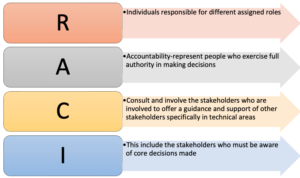
Figure 2:Summary of the RACI Matrix
Source: Summarised from NC State University (2017)
For success of the negotiation plan, the stakeholders involved defining their relationships include;
Responsible- The individuals taking the role of executing various roles are considered in this level. To procure the vehicles, the contract and procurement teams are involved. From the senior management teams, all stakeholders are tasked with distinct functions. For instance, to source for vehicles to be used in commuting in cities, admin and people professionals must be engaged to determine negotiations on the number of vehicles and also capacity.
Accountable- This transcends past decisions required to be made for ensuring inclusivity. For Vehicles sourcing in ROSHN, entire stakeholders need to account for how their operations are implemented. The senior teams in PS&M are involved in negotiation. The inventory planning of the vehicles are engaged to ensure that the negotiation process is successful and aligned with KSA laws (Silva-Aravena et al., 2020). For the vehicles category of spend, management and admin in ROSH must approve to determine the quality level to be negotiated with their suppliers.
Consult- As part of implementing the real estate projects by ROSHN, different consultants are involved. As active players in their business sector, they are involved in enhancing efficiencies in negotiation. The end-users of the real estate projects being pursued by ROSHN would need to be consulted in order to establish the quality of vehicles being offered. With ROSHN primarily using iSourcing in vehicles sourcing, this can entail sourcing timely feedback on improvements.
Inform– In the negotiation, there are stakeholders who would need to be notified and be aware of the process (Omar et al., 2021). As it shall be evidenced from the stakeholders analysis, these are classified as monitoring category. The real estate regulators in Saudi Arabia (KSA), quality assurers of the constructions sites would have to be informed. This is intended to ensure that their operations are aligned with expectations in the KSA real estate sector.
2.1.2 Stakeholders Analysis
In line with RACI Model tool analysis, stakeholders analysis is instrumental. A stakeholder is “an individual/body of persons impacted by implementation of a project/offering products and services in their required format” (CIPS, 2022a). Also, by engaging the different involved stakeholders, negotiation is achieved in a strategic, operational and tactical way with sufficient support and commitment achieve. The different stakeholders for ROSHN are as summarised in the following;
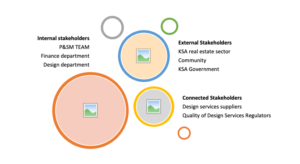
Figure 3:ROSHN Stakeholders Groups
Source: Summarised from CIPS Module Notes
In negotiation process, the stakeholders categories (figure 4) are engaged in influencing supply chain operations and entire negotiation process comprising customers, transport teams and operations due to the nature of vehicles spend category. The different stakeholders elicit a direct implication on negotiation strategy. This is with complex issues managed elicited by globalisation, innovativeness and communication issues.
Taking into account of the vehicles spend category negotiations, the stakeholders have different interests and influence. This influence how they are involved in the negotiation and their handling (CIPS, 2022a);
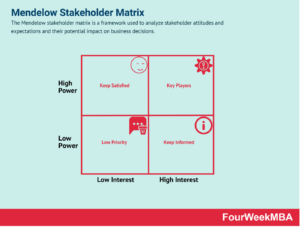
Figure 4:Mendelow Matrix Analysis
Source: CIPS (2022a)
Low Interest; High Power- The Government of KSA since ROSHN is a government institutions and regulators in real estate sector, negotiations for the vehicles have less influence and interest. Their support is only ensuring that ROSH is facilitated and has an appropriate operating environment for successful negotiations.
High Power; Low Interest- The management teams in ROSHN and CEO/Directors have a lot of power in all operations for purchasing of vehicles. In particular, depending on the vehicles to be sourced, they scrutinize the list to ensure there are no wastages and right suppliers are engaged.
High Power; High Interest- The PS&M department in ROSHN has a significant power and interest as they drive negotiations on the vehicles spend category. Also, the real estate clients, KSA admin and employees have a significant influence of type of vehicles purchased hence directly influencing negotiation process.
Low Power; High Interest– The vehicles sourcing involve the different players in the automobiles sector. In the negotiations, their interest is to ensure ROSHN gets the best deal from this process. Also, with real estate projects by ROSHN touching on the communities directly, accessing them would determine negotiations of the vehicles to be sourced.
2.1.3 SWOT Analysis
SWOT analysis in preparation of the negotiation is used to evaluate the internal environment of ROSHN to identify the strengths, weaknesses, opportunities and threats they have at the start of negotiation (CIPS, 2021). To achieve BATNA, communication and managing any idea which conflict is instrumental (Shiele, 2019). A summary of the analysis is as follows;
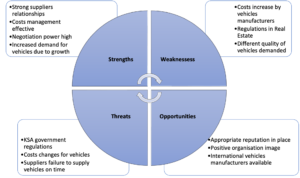
Figure 5:SWOT Analysis summary
Source: Summarised from ROSHN internal documents
To summarise, from the SWOT analysis, it is clear ROSHN operates through sustainable relations with their vehicles suppliers. To succeed in the negotiation, professionals such as legal professionals, vehicles experts and IT experts would need to be involved to easily achieve ZOPA. The existing opportunities entail appropriate negotiation in place, good brand image, reputation and leveraging on competitive advantage. The threats identified would potentially delay the negotiation process, but they would be prioritised and considered.
2.1.4 STEEPLED Analysis
This tool is identified in CIPS Notes as appropriate in scanning external environment for identifying implication of different factors influencing the vehicles negotiation process in ROSHN (CIPS, 2021a). The analysis is as shown in the following;
Source: Summarised from CIPS (2021a)
2.1.5 Porters 5 Forces
Since we do not have manufacturing for vehicles in the kingdom of Saudi Arabia that means that the price is higher than the other countries who have manufacturing for vehicles. Also, there are shortages in global supply chain. Definitely that affect companies like ROSHN by spending large amounts of money to secure ROSHN employees so that ROSHN can do their work on the site. Also, recently there is an increase in global shipping cost as it shows in the below chart. I still remember when I met with some suppliers to ask them to provide us vehicles for ROSHN employees on site, and they said that we cannot promise to provide these vehicles because they do not have any available vehicles in stock. Additionally, in the kingdom of Saudi Arabia, we have agents and distributors only. All of the suppliers of vehicles work with an “old-fashioned” mindset in terms of buying and selling, which leads to difficulties when trying to publish the tendering for vehicles on our platform. They do not know how to use it and they tell me that if you want us to participate, send it only by email, which will cause us to delay in meeting service-level agreements with the end users. This also makes it difficult for us to archive our documents.
Container-ship charter rates
Container-ship charter rates
Porter’s 5 Forces play an important role in the bargaining power of suppliers, with many factors such as time, session, local supplier or international. In addition, the volume of work, and reputation of the company or supplier. On the other hand, these forces also have an important role in the bargaining power of customers. Furthermore, there is competition among existing competitors as well as threats of substitute products and threats of new entrants to the market.
Bargaining power of suppliers:
I believe that providing vehicles for ROSHN employees on site allows suppliers to have strong power for a few reasons. First, in the kingdom of Saudi Arabia, we only have agents and distributors for selling vehicles. Also, buying vehicles has a high demand, especially with the new mega projects taking place, such as NEOM, ROSHN, the Red Sea Development Company, to name a few. This causes the suppliers to have greater demand and power. Second, quite often in Saudi Arabia, there is only one agent for these types of vehicles which requires us to buy from them. If we go to the distributor’s location, they will ask the agent to provide these vehicles, so the power still lies with suppliers for this service. Finally, on occasion the suppliers do not participate with big companies like ROSHN , because big companies tend to have many requirements for them to become approved suppliers.
Bargaining power of customers:
I believe that ROSHN has a strong power which makes the suppliers enticed to participate in any related tender to their area because of some key reasons. First, ROSHN is owned by the Public Investment Fund which is one of the biggest investment funds in the world. Second, ROSHN has a great reputation on the market, so that pushes suppliers to try hard to win one of our projects. Finally, the chairman of the board of directors of ROSHN is the crown prince Mohammed bin Salman, which means all suppliers will be happy to obtain one of our projects as it will allow them to put it in their proposal when they apply for any tender in other companies. This gives most companies the confidence to trust the approved suppliers from ROSHN.
Competition among existing competitors:
Recently many major projects have begun in Saudi Arabia, leading to high competition to have the best suppliers in the market. In addition, the demand is currently higher than supply, especially in regard to Saudi Vision 2030.
Threat of substitute products and threat of new entrants:
I think this has already happened, as I mentioned above. Often, we must ensure our payments to the suppliers are done on time to keep them as partners, because the threat of new entrants is high, and each company is trying to be the best to make a strategic partner with the suppliers.
2.1.6 Achieving BATNA in Negotiation
For success in this preparation/planning stage of negotiation, objective setting is essential. This involve coming up with expected Best Alternative to Negotiated Agreement (BATNA) which is an alternative for MIL providing an organisation with a chance for bargaining their place in negotiation (CIPS, 2021b). For ROSHN organisation case, coming up with BATNA would entail;
- Identifying and highlighting entire alternatives at the start of negotiation including identification of best practice when the negotiation has failed
- Valuing the alternatives identified- this is pursued through identifying value and worth value of all alternatives
- Using information- This evidence entire alternatives quoted values with best strategy including getting the options of optimum value
- Calculation of low-valued option- this is primarily implemented after the entire BATNA process is a success
Taking into account of the negotiations for vehicles by ROSHN, their PS&M teams would need to possess the awareness of the entire expectations and appreciate need to achieve BATNA and as such source power and confidence in negotiation. The ZOPA (Zone of Alternative Agreement) is essential considering it is found overlapping vendors and end-users who settle negotiation issues. This is also an alternative to buyer settlement range essential for the buyer;
Figure 6:BATNA and ZOPA in vehicles negotiations process
Source: CIPS Modules Notes
2.1.6 Negotiation Strategies to be used
Further, in preparation/planning for the negotiation process, identifying approaches to be used is essential. The different approaches guide how persuasive the parties are with their vendors/providers and rest of identified stakeholders. The various approaches are informed by level of intuition and influence as illustrated in the following;
Figure 7:Negotiation Strategies
Source: Summarised from CIPS Module Notes
Bargaining- For majority of negotiations, this is popularly used in ROSHN. The tradeable which would be put into account would be put into account would guide conversations with all issues identified to come up with a mutual agreement. High intuition and low influence are essential for ROSHN to negotiate for vehicles which have mechanical support after being purchased. Also, considering ROSHN contracts are impacted by Battle of the forms often, this could be managed by bargaining the terms and conditions at the start of the negotiation. This is particularly the issue of cost overruns and Force Majeure which are common occurrences today.
Emotion- This is evidenced when the parties involved in the negotiations interact. As part of the negotiation, the negotiators can express negative emotions by manifesting a sense of resentment or expecting favorable treatment. In ROSHN case, to manage emotions in negotiations, in coming up with uniforms for all drivers in the organisation, they required the uniforms to be similar and within specified quality levels. This meant having to terminate a previous contractor who had failed to meet these specifications of uniforms quality. There was however a 60 day’s notice in line with ROSHN terms and conditions for terminating a contract. With compromise not an alternative, the best practice was to use emotional approach to convince the supplier with a win-win arrived at.
Compromise- This is outright approach which involve taking an alternative option in negotiation (Yazdani et al., 2018). For ROSHN, this is not used as they always pursue a holistic preparation prior the negotiation process.
Logic– Negotiation process can be pursued informed by factual information and data. With a high-level influence, it is used in ROSHN to ensure they use numbers, facts and texts which guide decision making process. A case example is the recent shift from Land rover to Toyota vehicles for offloading capabilities owing to the data on costs of maintenance and longevity of using the vehicles in different terrains.
2.2 Opening
Please click the following icon to access this assessment in full
Related;https://rankedprofessionals.com/downloads/solution-roshn-negotiation-in-procurement-and-supply-pin/