(Solution) Driving Value and Managing Expenditure Assignment PDV
Solution
Executive Summary
This assignment analyses the procurement and supply chain management of Kraft paper cement bags at Qassim Cement Company (QCC), a strategically critical input that directly impacts packaging quality, operational continuity, and customer satisfaction. These bags are essential for protecting and transporting cement, and their performance influences brand perception, operational efficiency, and compliance with sustainability standards. The paper bags are sourced through a global supply chain involving Tier 3 pulp producers, Tier 2 converters, and Tier 1 bag manufacturers. In this context, procurement must create Value for Money (VfM) by balancing quality, cost, and reliability.
The report key findings indicate that QCC applies strategic procurement tools such as the Kraljic Matrix, Total Cost of Ownership (TCO), and supplier performance monitoring to ensure Value for Money (VfM). This includes balancing cost, quality, reliability, and sustainability through indexed pricing, long-term partnerships, and Just-in-Time inventory practices.
Another key finding is that the market is expanding due to increased infrastructure projects and a global shift toward sustainable packaging. Despite external risks, such as supply chain disruptions and regulatory changes, QCC maintains procurement resilience by aligning stakeholder priorities, managing risks proactively, and leveraging supplier flexibility. The result is a procurement model that supports efficiency, risk mitigation, and long-term value creation.
From these key findings, the following recommendations are proposed:
- Implement dual sourcing for Kraft paper bags by identifying and onboarding at least two additional regionally diversified suppliers, to reduce overreliance on single-source regions
- Adopt digital supply chain forecasting tools integrated with RISI index tracking, to improve procurement planning accuracy.
- Pilot open-book costing with its Tier 1 suppliers to increase pricing transparency and build trust.
Table of Contents
1.1 Company Overview: Qassim Cement Company. 5
1.2 Selected Product Category. 6
2.0 Key Players in the Market. 7
2.1 Stakeholder Importance and Impact. 8
3.3 Alternatives and Substitutes. 16
3.4 Porter’s Five Forces Analysis. 18
4.0 Value for Money (VfM) in Paper Bag Procurement. 20
4.1 The Kraljic Matrix for Kraft Paper Bags. 20
4.2 Total Cost of Ownership (TCO) Components for Paper Cement Bags in a Cement Plant. 21
5.0 The Role of Procurement in Adding Value to Paper Bags. 23
6.0 Overview of Cost Management Approaches. 23
7.0 Achieving Savings for QCC.. 24
8.0 Conclusion and Recommendations. 25
Appendix 1: MENA Cement Market Outlook. 31
Appendix 2: QCC Company Financial Performance. 32
Appendix 3: Global pulp producers dominating the cement market. 33
Figure 1: Types of Cement Produced by QCC.. 5
Figure 2: QCC’s Supply Chain for Kraft Virgin Paper Bag. 6
Figure 3: The Mendelow’s Matrix. 10
Figure 5: Projected Growth in the Global Cement Packaging Market. 13
Figure 6: Saudi Arabia Cement Market Growth. 14
Figure 7: The Five Rights of Procurement. 14
Figure 8: Porter’s Five Forces Analysis. 18
Figure 9: SWOT Analysis for QCC.. 19
Figure 10: The Kraljic Matrix. 20
Figure 11: The Total Cost of Ownership Analysis for QCC.. 21
Table 1: A summary of Key Players in the QCC Kraft Virgin Paper Bags Market. 9
Table 2: QCC stakeholders Categories. 10
Table 3: A summary of the RACI Matrix for QCC.. 13
Table 4: STEEPLED Analysis for QCC.. 19
Table 5: A summary of Total Cost of Ownership (TCO) Components for QCC.. 25
1.0 Introduction
1.1 Company Overview: Qassim Cement Company
Qassim Cement Company (QCC) is a publicly listed company established in 1976. It is a leading cement manufacturer in the Kingdom of Saudi Arabia (QCC, 2025). Qassim Cement supports the Kingdom’s vision 2030, infrastructure, development, and industrial projects by producing four types of high-quality cement shown in Figure 1 below;
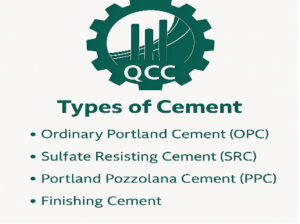
Figure 1: Types of Cement Produced by QCC
Source: QCC (2025)
The company also committed to operational efficiency and implementing sustainable practices across its supply chain to ensure continued operations and meet the needs of customers and the local market, enhancing its performance as illustrated in appendix 2.
1.2 Selected Product Category
The chosen product category is the 50kg cement packaging paper bag (Kraft sack), a key input to the QCC supply chain. These cement sacks help store and transport cement safely and ultimately affect product quality, customer satisfaction and QCC’s market reputation. The bags are made from virgin Kraft paper sourced worldwide in the pulp and run through a multi-tiered supply chain including raw material extraction, final manufacturing and delivery (See Figure 2). Their procurement involves strategic supplier agreements and use of models such as the Kraljic Matrix and Total Cost of Ownership (TCO). Focusing on the entire lifecycle of the paper bag, this analysis evaluates supplier performance and cost management initiatives and suggests ways of increasing efficiency and sustainability while meeting the expectations of key stakeholders for the business.
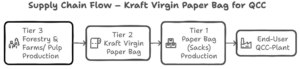
Figure 2: QCC’s Supply Chain for Kraft Virgin Paper Bag
Source: Summarized from QCC (2025)
As illustrated in Figure 2, Kraft pulp is primarily sourced from sustainably managed forests in regions such as Russia, Canada, Northern Europe, and Sweden. The colder climates in these areas produce dense, durable wood fibers that contribute to the superior strength, tear resistance, and durability required for industrial-grade cement packaging (World Paper Mill, 2025).
Qassim Cement Company uses paper bags that hold the highest technical standards. For use in the automated packaging plant, these bags are two-ply 90mm, of specific sizes (60 x 50 x 11 cm), and have a standard capacity of 50 km (Sharma, 2023). The supplier guarantees the quality of the bags during automated packaging, handling, and transportation through the customer’s trucks, for all types of products in Figure 1.
2.0 Key Players in the Market
The supply chain for Kraft virgin paper bags in the cement sector consists of a multi-tiered ecosystem of organizations contributing at various value chain stages (Grabenweger, 2019). These can be grouped into three primary categories:
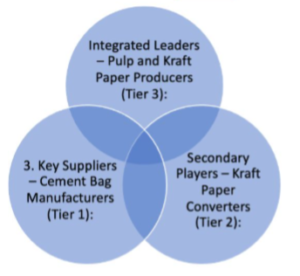
Figure 3: Key Players in the Market
Source: Grabenweger (2019)
From the above illustration, they can be explained as follows;
- (Tier 3)-Fully integrated, managing operations from sustainable forestry to pulp production and Kraft paper manufacturing. The table below shows that their end-to-end control ensures supply consistency, cost competitiveness, and quality assurance for the crucial suppliers.
2. (Tier 2)-These companies specialize in converting externally sourced pulp into raw Kraft paper. While they do not operate integrated pulp mills, they play a crucial role in regional supply by offering flexibility, cost efficiency, and being the leading supplier and offering faster delivery times:
3. (Tier 1)-These manufacturers convert Kraft paper into industrial-grade sacks tailored to cement packaging specifications. Their capabilities range from basic bag fabrication to value-added features like moisture resistance and custom printing.
Table 1: A summary of Key Players in the QCC Kraft Virgin Paper Bags Market
|
Suppliers | (Tier 3) | (Tier 2) | (Tier 1) | ||
| Leaders | Mondi Group (U.K) | ü | ü | ü | ||
| Billerud AB (Sweden) |
ü |
ü | ||||
| Stora Enso (Finland) | ü | ü | ||||
| Segezha Group (Russia) | ü | ü | ||||
| Smurfit Kappa Group (Ireland) | ü | ü | ||||
| Domtar Corporation (Canada) | ü | ü | ||||
| Secondary | Natron-Hayat (Bosnia and Herzegovina) | ü | ||||
| Chan Industries (China) | ü | |||||
| Century Pulp and Paper (CPP) (India) | ü | |||||
| Key Suppliers | CPI (Cement Products Industry Co.) – Saudi Arabia | ü | ||||
| Yanbu Cement Factory (In-house conversion) | ü | |||||
| NAPCO (National Paper Company) – Saudi Arabia | ü | |||||
| Sharjah Cement Factory – UAE | ü | |||||
| Kuwait Paper Mill – Kuwait | ü |
As shown in the table, the key suppliers are in tier 1 because their capabilities range from basic bag fabrication to value-added features like moisture resistance and custom printing, hence saving immense costs.
2.1 Stakeholder Importance and Impact
According to CIPS (2022), a stakeholder is a person or group of people who have an interest in a company’s success, often financial. Stakeholders in the QCC procurement process can be divided into three main categories, either internal, external, or connected. These are explained in table 2;
Table 2: QCC stakeholders Categories
Source: QCC (2025)
| Stakeholder | Power | Interest | Type | Attitude | Position / Recommended Action | ||
| Suppliers (Tiers 1–3): (Forestry, Pulp Producers, Paper Bag Manufacturers) | High | High | External | Advocate (+) | Manage closely, monitor markets, secure agreements | ||
| End-Users (Customers) | High | High | External | Advocate (+) | Maintain regular communication, adjust to needs | ||
| Procurement Team (QCC) | Internal | Advocate (+) |
|
||||
| Technical / Operations Team (QCC Plants) | High | High | Internal | Advocate (+) | Manage Closely, aligning on specifications, stock levels and quality | ||
| Finance Dept. (QCC) | High | Medium | Internal | Indifferent |
|
||
| Logistics Providers: (Transport, customs, forwarder, Customs Broker) | High | Lew | Connected | Indifferent | Consistent and ongoing monitoring – making sure shipments arrive on schedule without delays. | ||
| Regulatory Authorities (Environmental & Industrial Standards) | High | Lew | External | Indifferent | Close management, ensuring environmental and industrial compliance |
To analyze QCC’s stakeholder importance and impact, we can use Mendelow’s matrix and the RACI Matrix;
2.1.1 Mendelow’s matrix
This is a strategic tool used to analyze stakeholders based on their power level and interest in a project or organization (Cuofano, 2024). For QCC, this is illustrated in Figure 4;………….
Please click the following icon to access this assessment in full