(Solution) ICS Learn 5HR02 3.2 Approaches to Retaining People
Solution
The retention of warehouse supervise in a highly competitive labour market requires diverse approaches to ensure engagement, satisfaction, and long-term commitment. Below is a contrast of four key retention methods: realistic job previews, induction, job enrichment, and rewards.
Retention Approaches Comparison
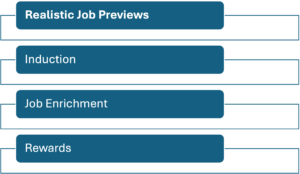
| Retention Approach | Similarities | Differences |
| Realistic Job Previews– This strategy presents possible workers with an honest picture of the job, encompassing both good and destructive elements, thereby enabling them to make an educated choice (Van Vulpen, 2020). It helps to lower early turnover and straightens expectations.
|
• Both realistic job previews and induction seek to provide fresh recruits a clear knowledge of the position and company.
• Both methods seek to align expectations to prevent early turnover. |
• Realistic job previews are done at the time of recruitment, whereas induction is done after the hiring of the employee.
• Realistic job previews focus on giving candidates an upfront understanding of the role, while induction covers broader organisational culture and logistics. |
| Induction– A planned onboarding process whereby new hires are exposed to corporate regulations, culture, and work positions (CIPD, 2024). It covers first training and assistance meant to enable the staff member fit into the firm.
|
• Realistic job previews and induction both try to clear misconceptions about the work and organisation.
• Both processes involve a clear overview of the job expectations and organisational culture. |
• Induction involves hands-on training and integration into the company, whereas realistic job previews are generally more about setting expectations during recruitment.
• Induction continues after hire, whereas job previews are part of the recruitment phase. |
| Job Enrichment– Involves restructuring jobs to add more responsibility, diversity, and potential for personal development. This increases job satisfaction, participation, and motivation, making the job more satisfying. | • Both job enrichment and rewards aim to increase employee motivation and reduce turnover by making the work more engaging.
• Both focus on enhancing the job experience to retain talent. |
• Job enrichment involves altering the nature of the job itself, offering long-term changes.
• Rewards are usually short-term incentives or benefits, focusing on external motivation through compensation or recognition. |
| Rewards– Offering various forms of compensation (salary increases, bonuses, benefits) and recognition (praise, awards) to encourage performance and retain staff (AIHR, 2024). Rewards can be both financial and non-financial. | • Both rewards and induction focus on retaining employees by improving their satisfaction.
• Both approaches aim to acknowledge the efforts and contributions of employees. |
• Rewards provide short-term motivation, such as financial bonuses or recognition, while induction focuses on the long-term integration and support of new employees.
• Rewards are typically external incentives, whereas induction focuses more on internal support mechanisms like training and cultural integration. |
These retention methods share similar objectives—employee satisfaction and turnover decrease—but differ in practice and timing. Induction and realistic job previews share the objective of establishing clear expectations,……..
Please click the following icon to access this assessment in full