(Solution) Level 5 Associate Diploma CIPD 5C001
Solution
1.1 Divisional and Matrix Structure Evaluation
Divisional Organisation Structure
For this structure, as opposed to segmenting the employees based on their job functions, products/markets geographic background are used (Jerab & Mabrouk, 2023). The different divisions in the organisations work independently in delivery of products and services to their customers. According to CIPD (2021), this is by being independent with their resources for operations.
Advantages and Disadvantages
A major advantage of divisional organisation structure is that high-level specialisation is in place. A case example is the accounts or HR departments with employees specialised to execute their functions. The specialisation is identified in Study.com (2024) as improving overall efficiency of their operations in their business environment. A customer-centric products and services are also delivered by the specialised teams.
Also, Gutterman (2023) identify a divisional organisation structure as being defined with a significant accountability and transparency. With the division’s operating under their own management, holding them into account is easier.
For disadvantages, a successful implementation of a divisional structure is cost intensive. According to Indeed (2024), despite of the independence of different functions, a central corporate division is required to oversee the rest. This cumulatively led to an increased cost of operation. Further, with the different departments operating independently, they operate their own strategy leading to a silo mentality. The outcome of this is reluctance in working in collaboration.
Underpinning Reason– The reasons why an organisation can select to use this structure is when they intend to invest optimum efforts to develop and support a particular and individual product. Also, Jerab and Mabrouk (2023) note that this is more appropriate for large organisation offering a broad portfolio of products and services to specific market.
Matrix Organisation Structure
This is defined in CIPD Forum (2024) as a type of structure with teams reporting to different leaders. Also, this structure means that resources from a project could be distributed to a different product while maintaining their specialisation. According to Saunila et al. (2023), this is by being in a position of eliminating he traditional hierarchy.
Advantages and Disadvantages
This structure is characterised by sufficient collaboration amongst skilled employees in various departments (Brukwe, 2022). The outcome of this is allowing organisation capitalising on available resources as opposed to sourcing for expertise and recruitment of project teams members externally.
The disadvantages include slow decision-making process (Nannoolal, 2015). This is since the entire players in the matrix would need to be continuously consulted before making critical decisions.
Underpinning Reason– This is best used in organisation which need strict management from the top. This is with various specialisations being mandated to work in collaboration for the overall good of the organisation.
Comparison to my organisation structure
In Park Inn Organisation, a matrix structure is operational. The organisation structure is as illustrated in the following;
Figure 1: Park Inn organisation Structure
Source: Park Inn internal document
As illustrated in figure 1, all the department’s report to the General Manager (GM) at the top of the matrix. This is with the different departments working in collaboration to achieve the Park Inn goal of being the best destination for different tourists.
1.2 Organisation strategy ensuring Products/Services meet customer needs
As defined in CIPD (2024), an organisation strategy represent direction and guided for an effective execution of set goals. In Park Inn organisation, strategy is used for guiding how the management allocate resources for their achievement.
Example of Strategy– One of Park Inn organisation strategy is delivery of vibrant and friendly hospitality experience customised to their modern travellers. This is with a focus on expansion of global footprint by strategically repositioning and market- specified development.
A second organisation strategy involve focusing on delivery of stress-free experiences, good food, and upbeat environments. This is while cleverly using coloration, contemporary designs and personalised services delivery for lifting guests’ moods for happy stay in Park Inn.
Direct links of identified strategy
The identified strategies directly link with Park Inn goals. According to Dawson (2020), this entail achieving sustainable operations, leveraging on competitive advantage and value addition. By delivering vibrant and friendly hospitality experience, they would target more modern travellers who are a majority in the hospitality sector. Also, the stress-free experiences and good food and upbeat environments are part of achieving vision 2030 in Saudi Arabia of being the leading tourist destination in the entire Middle East and internationally.
Meeting Customer Needs
The identified strategy of delivery of vibrant and friendly hospitality experience customised to the modern travellers guarantees the organisation reaching out to best group of customers (Stone et all., 2022). Their operations in the hospitality industry guarantees the modern travellers of best services and support which is not available with their competitors in the hospitality industry.
Part of their strategic repositioning and market-specific developments lead to more customisation of their products and services. This is with the customers retained for a long period in the organisation. The hospitality services offered are of high quality and meeting their expectations.
External Context
For the identified strategies, there are external factors influencing their successful implementation. A case example is what Alharthy et al. (2017) identify as economy fluctuation affecting availability of resources for offering friendly hospitality experiences. This is with delivering the experiences and good food impacting the customers operations.
Also, the increased development of technology also directly impacts on the organisation pressures in personalising services delivery by enhancing the mood of their guests for a happy stay in at Park Inn. Further, as evidenced in Heracleous (2020), lack of appropriate relations with different parties would hinder how the modern customers are attracted and develop new strategies for their operations.
For the identified organisation strategies, they are intended for ensuring Park Inn organisation is initiating their goals and objectives amidst innovativeness and leveraging on competitive advantage. The outcome of this is maintaining their relevance and good customer relations in the highly changing hospitality industry. This is with their global footprint expanded by strategic repositioning and market specific developments in the hospitality sector (Alharthy et al., 2017).
1.3 Interest rates, inflation and external factor
Interest rates
Adopting the definition of Di Giovanni and Shambaugh (2019) interest rates represent amount charged over and above principal amount by a lender from borrower. For a receiver, an individual depositing money to a bank or financial institution, income is earned based on time value of money identified as interest obtained by a depositor. In Saudi Arabia (KSA) context, CEIC Data (2024) identify interest rates to be at 5.62% pa in October 2024 as opposed to 5.82% pa in past month. In UK, the interest rates are rated to be 4.75% with a focus of reducing it to 4.5%.
Priority– Operating in Saudi Arabia, an organisation such as Park in priority need to be setting financial targets. With the interest rates in a decline in KSA, the organisation needs to blend foresight, adaptable and data-based decision making for ensuring they leverage on available opportunities. According to Dery and Serletis (2021), as opposed to allowing interest rates control an organisation, setting financial targets would mean being proactive in paving way for achieving financial stability and growth.
Inflation Rates
According to CIPD (2023), inflation rates represent increased prices within a specified period of time. Hence, it is used as broad measure of cost of living in a nation. In KSA, the inflation rates have surged to 2% in November 2024 from 1.90% in October 2024 (Trading Economics, 2024). This is as opposed to the 2.6% in November 2024 an increase from 2.3% in past month (Statista, 2024). For Park In, operating in the hotel industry, an increase in prices in restaurants and hotels category has increased by 1.5%. This is owing to 5.9% increase in costs for hotel and furnished apartment services (Ageli, 2022).
Priority– Owing to the identified inflation rates, Park In organisation priority is to promote operation efficiencies by investing on cost-control measures and investing in modernised technologies for streamlining their operations. For instance, Bareith et al. (2024) note that by investing in artificial intelligence, they would reduce costs incurred in repositioning to become premium value conversation space. This would increase their attractiveness to young, value-conscious travellers by providing “brighter basics”.
Government policy and legal regulation
In a business environment, government regulations are core for protection of public sector from any ineffective business practices. According to CIPD (2024), this is for advancing protection to employees, consumers and broader business environment. In Saudi Arabia, a major government policy impacting Park In operations is Saudisation (Global, 2024). This is a regulation which has been set for ensuring majority of the jobs are occupied by Saudi Nationals.
Priority– The priority for Park In would be reorganisation of their operations. According to UC Berkeley (2024), this is a practice of permanent and major change to organisation hierarchy leading to permanent and substantial change in functioning of a job position in an organisation.
1.4 Scale of Technology; Impacts
AI Predictive Analytics in Talent Acquisition Area
This is a technology used in streamlining the resourcing strategy in an organisation (Paramita et al., 2024). It is used through analysis of detailed data for candidates for identifying top talents. The effectiveness of this technology is evidenced by ability of using employment history, CV and psychological tests for identifying people with a high potential of fitting specific job roles.
Advantages– The pro of this technology is lowering time used in shortlisting potential applicants, evident bias and improved opportunity of resourcing highly qualified individuals.
Disadvantages– When not appropriately used, it led to over-looking talents characterised with soft skills/non-typical candidates failing in fitting set patters for a specific job role. Also, it is costly to implement in talent acquisition.
Impact on Workplace– In Park In case, the use of predictive analysis in talent acquisition assists to select and recruit employees with best qualifications hence a lowered possibility of recruiting inappropriate employees (CIPD, 2024a). Also, the application of the tool is relevant for sourcing skilled individuals for particular job roles.
AI Empowered Virtual Training Assistants
As part of online learning strategy, this type of AI is used in offering on-demand learning facilitation, accessing different capacity development materials, simulation and real-time based feedback (Chavali et al., 2024). The effectiveness of the assistants is assuming Natural Language Processing for ensuring users are posing areas of concern and recommending most appropriate learning strategy.
Advantages– In process of learning, an employee is assured of holistic inclusion in the learning process. Also, in line with their expectations, all employees are accommodated hence flexibility (CIPD, 2024a).
Disadvantages– Over-reliance on the virtual training assistants lead to undermining of interactiveness and collaboration in learning. Also, it is not possible to fully mimic human beings in learning process.
Impact on Workplace– For Park In, using this technology could lead to redesigning of their capacity development initiatives. This is while enhancing flexibility of employee’s involvement in learning irrespective of their locations.
2.1 Charles Handy’s model and David Rock’s SCARF Theory
Charles Handy
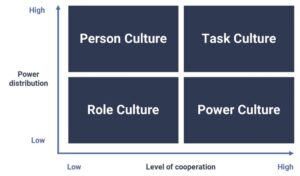
This is a theory which identify the organisation culture as being in forms of person, task, role or power cultures (Pinnington, 2021). This is as illustrated in the following;
Figure 1: Charles Handy Model
Source: Abdala et al. (2021)
The key features include;
Power Culture– Process adopted to make a decision is prompt considering power is in hands of few people. The weakness includes over-dependence on the leaders as opposed to a decentralised practice (do Carmo Silva & Gomes, 2023).
Role Culture– With an organisation classified into different roles, career, job ranking and scope of control inform on the organisation culture.
Task Culture– This includes working groups established in order to enhance decisions, handle issues encountered in specific roles execution. The strengths of this include collaboration, flexibility and creativity.
Person Culture– This type of culture is defined by enhancing an individual development with an organisation facilitating their efficiency. It is best used in specialised areas including consultancies.
For people practice professionals, this model is applicable for evaluating organisation strengths and weakness for understanding organisation culture (Cacciattolo, 2024). For instance, in Park In, using role culture would mean different functions are assigned to specific employees. This enhances efficiency in their operations as opposed to having power culture.
David Rock’s SCARF Model
In line with this model, an organisation behaviour is characterised by different factors influencing motivation, decision-making and collaboration (Kolemba, 2016). These factors include status, certainty, autonomy, relatedness and fairness. This is as illustrated in the following;
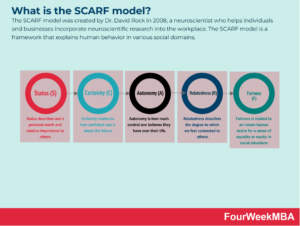
Figure 2: SCARF Model
Source: Mamedova et al. (2023)
Status- A human behaviour can be characterised by identifying an individual personal worth and relative relevance to others in an organisation.
Certainty- Employees behave with confidence for their future operations.
Autonomy- Human behaviours are characterised by scope of their control with their lives.
Relatedness- This evidence the scope of an employee behaviour inclusive of feeling connected well with the rest.
Fairness– This is defined as innate human expectations/desire for a sense of equality in different social situations employees operate from.
The impact of this model for the people practice professionals is to shape organisation behaviours by improving engagement and fostering an effective leadership. According to CIPD (2024a), this is for utilising different aspects of work inclusive of team management, day to day interactions, leadership, facilitation and recruitment. The outcome of this is development of rewarding workplace experiences with particular leverage on their integration in agile environments. This would enhance certainty in their operations in the hotel industry.
2.2 Employee selection and development impact
Employee Selection Impact on Organisation culture
As defined in CIPD (2024b), organisation culture identifies “how things are done here”. An effective employee’s selection has an influence on an organisation culture by shaping their value, norm and working environment. In Park In organisation, selecting highly qualified employees enhance organisation culture since it is associated with excellence, creative and embracing innovativeness.
Impact and Benefits
Cultural Fitness– By operating strategic selection, it is possible for an organisation to be…….
Please click the following link to access this assessment in full
Related to:https://rankedprofessionals.com/downloads/solution-cipd-brandfield-5c001-assessment/