(Solution) MBA MGT506 HRM
Solution
Table of Contents
2.0 Company Selection & Background: Savola Group. 2
3.1 Talent Acquisition and Workforce Planning. 3
3.2 Learning and Development 3
3.4 Compensation and Benefits 4
3.5 Management of Culture and Employee Engagement. 4
3.6 HR’s Role in Organizational Change, Innovation, and Growth. 5
4.0 HR Challenges & Gaps at Savola Group. 5
4.1 People Engagement and Cross-subsidiary Synergy. 5
4.2 Obsolete or Low-frequency Training and Development. 6
4.3 Fatigue of Change & Resistance to Restructuring. 6
4.4 Performance Management consistency and feedback Loops. 6
4.5 Finding the balance between Scale and Localisation and Cultural Diversity. 6
5.0 Recommendations & Solutions. 7
5.1 Enhancing Employee Engagement 7
5.2 Modernizing Learning and Development 7
5.3 Managing Change and Reducing Resistance. 7
5.4 Strengthening Performance Management 8
5.5 Promoting Localization and Cultural Diversity. 8
1.0 Introduction
The present project focuses on the Human Resource Management (HRM) practice of Savola Group, a large food and retail conglomerate in the GCC and MENA countries. Since its foundation in 1979, Savola has not only expanded a small oil refining firm based in Jeddah but is now a multinational company with a philosophy of Value Built on Values. The project examines the alignment of HR strategies with its corporate objectives at Savola which focus on talent management, innovation and sustainable growth. It also studies the role of HR in change in an organization, determines current issues faced and the recommendations that can be taken to enhance the contribution of HR to the future of the competitiveness and success of Savola.
2.0 Company Selection & Background: Savola Group
Savola Group was established in 1979 in Jeddah in the Kingdom of Saudi Arabia as a small business that dealt with the importation and refinement of vegetable oils in the local market. Having an initial capital of SAR 40 million and approximately 200 employees, the initial vision of the company was obvious to be the largest strategic investment group in Middle East and create sustainable value among shareholders (Savola Group, 2025). More than 40 years on, Savola has developed into one of the biggest and most esteemed food and retailing conglomerates in the Gulf Cooperation Council (GCC) area, working under the business idea of Value Built on Values.
The operations carried out by Savola are mainly structured into two major segments namely Savola Foods and Savola Retail. Savola Foods produces and sells necessities foodstuffs including edible oil, sugar, pasta, as well as ghee in over 30 nations within the Middle East, North Africa, and Central Asia. It has a retail business, Panda Retail Company, which is among the biggest grocery stores chain in Saudi Arabia. Today, Savola has more than 22,000 employees and has a high presence in the region with subsidiaries and operations in Saudi Arabia, Egypt, Algeria, Sudan, and the Levant (Savola, 2019). The firm has been able to sustain a competitive position in the market despite strong forces in the market due to its emphasis on innovation, ethical leadership, and sustainable business practices. The HR strategy of Savola focuses on developing employees, diversity, and corporate alignment, making human capital remain a key driver of business expansion and success over the long term in the changing GCC market.
3.0 Strategic Alignment.
HRM supports Savola’s Strategic Goals in various ways. The ability of Savola Group to emerge as a foremost food and retailing conglomerate in the GCC and MENA region is profoundly entrenched in the fact that its Human Resource Management (HRM) operations are strategically aligned with the corporate goals. HR in Savola is also at the forefront of generating talent, innovation, and ethical leadership to create sustainable business development. HRM practices are as follows.
3.1 Talent Acquisition and Workforce Planning.
Long term strategic objectives of Savola to be the regional leader in food and retail will be based on the process of hiring and keeping the best talents who can deliver the innovation and operational excellence. This entails the systematic attraction, screening and placement of talented employees to suit present and forthcoming organizational demands in accordance with strategic objectives (Hayden, 2023). Its HR department takes a proactive workforce planning strategy, which identifies upcoming skill requirements with the plans of the business expansion (Savola, 2019). By using both local and global hiring policies, Savola is able to secure a wide pool of skilled and expert employees who are knowledgeable about the regional market. The ability of the company to recruit employees that share its core values integrity, passion, and commitment also ensures that there is a continuity and cultural alignment in its line operations which are ethical.
3.2 Learning and Development
Savola has been strategic in its quest to achieve operational excellence and innovation by the way of continuous learning and building of capabilities. This practice constitutes on-going programs and initiatives that advance the knowledge, skills and capabilities of employees in order to ensure individual development and organizational performance as demonstrated by CIPD (2025). The HR department carries out organized development schemes which enhance leadership, technical skills as well as cross functional cooperation. Savola has a development program which is in-house developed, providing customized training modules based on the strategic priority of the company- which include efficiency, customer focus, and digital transformation (Savola, 2025a).
3.3 Performance Management
This involves having a carefully designed process in goal setting, performance and outcome assessment as a way of integrating employee efforts with business goals (CIPD, 2025a). The performance management system of Savola is interconnected with such strategic objectives as accountability, innovation, and profitability. The performance model used in the company is results-based, and it integrates the goals of individuals with the bigger company KPIs (Savola CG Manual, 2025). Employees are not only measured in terms of results, but also the compliance with the ethical and cultural values of Savola at work, so that performance excellence is not only in balance with integrity.
3.4 Compensation and Benefits
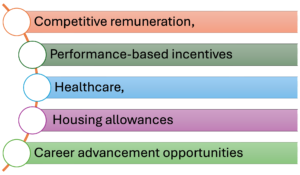
CIPD. (2025b) indicates that it is a Comprehensive financial and non-financial rewards aimed at motivating, retaining, and fairly rewarding the performance and organizational input of the employees. As part of the vision of becoming a choice of employer in the GCC, Savola compensation and benefits strategy creates fairness, competitiveness, and motivation (Savola.com, 2025). The HR department also compares salaries and other benefits with the regional standards to maintain the best talent and attract the best. The total rewards scheme of Savola is comprised of competitive remuneration, performance-based incentives, healthcare, housing allowances and career advancement opportunities.
3.5 Management of Culture and Employee Engagement.
This practice involves policies encouraging dedication, inspiration, and adherence to company values to facilitate a positive, inclusive, and productive working environment culture (Harris, 2024). The promise in the Savola brand, Value Built on Values, is expressed in the idea that the company aims at building a powerful inclusive corporate culture (Savola World, 2025). HR encourages participation by embracing open communication, empowering employees, and community building. The company will carry out frequent engagement surveys to know how the workforce feels and respond to new needs. In summary, the HRM practices at Savola Group are strategically aligned in areas like recruitment, development, performance management, compensation and engagement processes to support its business objectives. Investment in people and culture makes HR agile, innovative, and ethically-oriented leaders.
3.6 HR’s Role in Organizational Change, Innovation, and Growth
The Savola Group Human Resources (HR) is transformative as it enables organizational change, promotes innovation, and sustainable growth.According to Hubbart (2023), the term organizational change can be defined as the method of reorganizing the strategies, operations or culture to meet the internal or external changes in the business environment. Approaches to organizational change Since its inception in 1979, Savola Group has experienced several bouts of organizational change, particularly in expanding to the retail sector by acquiring Azizia Panda United in 1998 and share distribution of 34.52% of Almarai to its shareholders in 2024 ( Overview, 2025). In addition, innovation is the process of developing or embracing new ideas, processes, or products that help to increase the efficiency, competitiveness, and customer satisfaction (IMD, 2025). Innovation in Savola is facilitated by the HR department that promotes creative problem solving and continuous improvement by promoting learning culture. Furthermore, definition Organizational growth can be defined as the increase in size, market share, revenues, or capabilities of a company due to the strategic investments of a company and workforce development. The HR department of Savola is core in assisting the expansion of its regional operations. As of 2025, more than 30 countries have over 16,000 employees, consolidated revenues are more than SAR 29 billion (Savola.com, 2025a). HR will help to achieve this expansion through formulating scalable recruitment, leadership succession, and localized workforce policies, which can be extended to other markets like Egypt, Algeria, and Sudan.
4.0 HR Challenges & Gaps at Savola Group
4.1 People Engagement and Cross-subsidiary Synergy.
A problem with engagement: in the Savola Group Sustainability Report 2018,
Please click the following icon to access this assessment in full
Related to: https://rankedprofessionals.com/downloads/solution-mba-mgt506-human-resource-management-2/