(Solution) New Brief 5CO01 – Organisational performance and culture in practice
Solution
1.1 Advantages and disadvantages of Organisationion Structure; reasons underpinning the structure
Functional- A functional organisation structures departments by specialised functions and expertise, with clear lines of authority and permanent assignment of employees to functional roles as evidenced by Vaughan (2022).
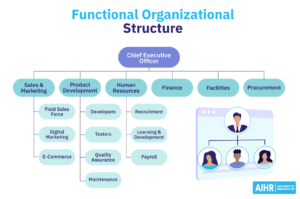
My organisation which is Saudi Aramco is an example of a functional organisation. As the national oil company of Saudi Arabia, it is organised according to functions such as exploration, production, refining, transportation, marketing and petrochemicals. Each major division focuses on its own specialised task and value-adding process. This structure provides clear reporting lines and maximum efficiency within each specialised discipline.
Matrix- Asana (2023) point out that, a matrix structure may be better suited for large, complex projects that require cross-functional collaboration. In a matrix organisation, project teams are assembled from different functional departments and specialists are temporarily assigned to projects. This is an organisation structure which is used in General Electric Company (GE). This is an international organisation offering different categories of products and services to multiple customer categories. There is dual authority as employees report both to their functional manager and project manager. Communication is multi-directional rather than top-down. This can foster innovation as diverse perspectives are brought together to solve problems. However, it can be less clear-cut than a functional structure and requires strong coordination to avoid conflicts between project needs and functional goals.
Evaluation (Advantages and Disadvantages)
The functional structure at Saudi Aramco provides many advantages in efficiency and specialisation. Employees develop deep expertise in their focused domains. However, it may stifle collaboration and innovation.
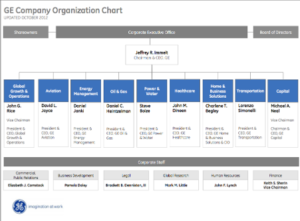
On the other hand, the matrix model in General Electric (GE) company fosters cross-disciplinary interaction and flexible resourcing of projects. Yet dual lines of authority can lead to conflicts if not managed carefully. Mixed teams may struggle with unclear responsibilities. Strong coordination is needed to balance functional and project goals. Both have merits, depending on an organisation’s needs.
Collectively, both organisations structures are suitable. For Saudi Aramco, the functional structure promotes maximum efficiency in extracting, refining and transporting oil across separate large-scale operations requiring deep functional specialisation. A matrix structure facilitates complex multi-disciplinary projects that cut across departmental boundaries, allowing flexible resourcing and fostering innovation through diversity of perspectives ( NiBusiness, 2017).
1.2 Connections between organisation’s strategy; products or services, and customers
Organisational strategy
Organisational strategy refers to the approach and direction an organisation takes to achieve its long-term aims. According to Bengfort (2023), It is influenced by external factors like competitive rivalry (per Porter’s Five Forces model), which is why understanding the industry landscape is crucial. Porter’s Five Forces model relates to organisational strategy formulation as it provides insights into industry competitors, potential new entrants, substitute products, supplier power and buyer power – important external factors strategies must account for (Mindtools, 2023). Strategy ties directly into the organisation’s strategic goals and objectives – the specific, measurable targets it sets to realize its vision. These provide guidance, focus efforts and allow assessment of progress. Clearly defined strategies and goals are essential for organisations to thrive, as they help allocate resources effectively and navigate industry pressures and disruptions to gain competitive advantage into the future.
Organisation Revenues– Considering an organisation strategy, it is supposed to improve organisations revenues generation. This is through maximisation of their short and long-term sales ability. The rationale of this is that acquisition of revenues is essential to succeed in accruing value, aligning their strategy, organisation structure, structure, individuals roles and their processes. For Saudi Aramco case, this is attained through an embrace of aspects of Value, Rarity, Imitability and Organised. The outcome of this include Saudi Aramco strategy being customised towards profit increase and dominating their market.
Organisation Products- A company’s strategic goals and objectives provide the long-term direction for what products and service it will deliver to customers. F.Dieffenbacher (2023) point out that the goals shape the vision for the product portfolio and customer value propositions. Individual product objectives then support the achievement of these higher level aims. Having alignment ensures that R&D, marketing and operations are all developing and improving the right solutions for consumers in line with strategy. This focus and connectivity is vital for competitive differentiation and market success and helps the organisation efficiently allocate resources towards products that will resonate with target audiences. Strong goal and objective setting helps products evolve effectively over time to meet strategic ambitions.
Organisation services- Just like with products, a company’s strategic goals and objectives guide the development and delivery of its services. The goals provide direction for what customer needs the organisation aims to fulfill through services as evidenced by United Nations (2023). Individual service objectives then directly support accomplishing the overarching aims. This ensures that service design, operations and innovation efforts are strategically aligned. Having this link is crucial for a company to efficiently channel its resources into offerings that meet strategic priorities and create value for customers. It allows services to evolve in a way that augments the business’ positioning and competitive differentiation over time. Clear goals help drive consistent progress across the service portfolio.
Organisation Customers- Strategic goals and objectives shape the customer segment an organisation aims to serve by clarifying the target audience’s needs and pain points addressed (UK Customer Experience Excellence report 2022). Customer objectives then cascade this focus to ensure customers receive personalised value at each touchpoint. This vital connection allows allocating resources toward acquiring and retaining customers central to strategic ambitions, strengthening the partnership for mutual growth.
1.3 External factors and trends impacting organisations in identifying current organisation priorities
Factors Impacting My organisation
PESTEL analysis is a framework for scanning the external macro environment that may impact a company (CIPD, 2023). It covers Political, Economic, Sociological, Technological, Environmental and Legal factors.
Factors
Political: Changes in OPEC production quotas could negatively impact profits in the short term if Saudi Arabia is forced to decrease oil output. However, long term quotas may stabilise oil prices and support sustainable energy projects positively. It has long-term impacts.
Economic: Global recession fears and reduced energy demand from China could lower oil prices from reduced consumption in the short term. Yet transition to renewables may boost long term investments and partnerships in technologies like hydrogen production. Tighter environmental regulations worldwide also spur investments in less polluting alternatives. It has long impacts.
Trend
Economic- Growing sustainability conscious investing is a long term trend that may negatively impact Aramco’s oil business. Many funds now exclude fossil fuel companies due to climate change risks. However, partnering with ESG investors on renewables and carbon reduction projects could attract sustainable investment in the short term. It demonstrates efforts to transition, while ensuring long term investment in the energy transition. This mitigates reputation damages and future-proofs the business model for a low carbon economy. Embracing low carbon solutions now has long term economic benefits.
Priorities
- Expansion into renewable technology development through strategic partnerships and investments. This would involve expanding operations beyond oil and into growth areas (IMD, 2022).
- Restructuring investment portfolios to gradually shift funding from oil production to renewable projects over the long-term. This addresses transition risks while stabilising short-term profits.
- Limited controlled contraction of oil output coupled with expanding green hydrogen, carbon capture and other clean tech solutions to address production quota issues. Restructuring operations to phase out fossil fuels slowly.
1.4 Assessment of scale of technology within organisations and impacting work
Technology use within organisations has increased massively with digital transformation of operations as evidenced by CIPD (2022). Cloud infrastructure and AI are optimising production and remote operations efficiently. Widespread use of sensors, IoT and automation has improved safety and productivity while reducing costs substantially. However, over-reliance on technology exposes the business to significant cyber security risks (Moore, 2023). Technology projects also demand huge capital expenditures and workforce retraining. While technology boosts performance, it introduces new challenges around security, costs and employee reskilling that must be carefully managed.
2 examples of technology used by Aramco Organisation professionals include;
Reservoir Engineering Technology: Reservoir engineers use supercomputing platforms and complex simulation software to analyse subsurface data from wells. 3D and 4D seismic mapping technology helps assess untapped reservoirs. This sophisticated modelling technology optimizes extraction to maximize oil recovery.
Industrial Automation: Automated pipelines, engines and machinery minimize human intervention at oil facilities and reduce safety risks. Industrial internet of things sensors remotely monitors assets for performance and maintenance needs. Drones with thermal cameras and gas detectors autonomously inspect infrastructure like refineries. This digital automation improves efficiency while maintaining production continuity.
Impacts on workers
Reservoir modelling technology allows engineers to perform complex analysis and simulations virtually from any location. This enhances productivity and flexibility as evidenced by Mohaghegh (2011). However, it may reduce on-site jobs over time and impact wellbeing for those in demanding modelling roles. On the other hand, Industrial automation optimises operations with remote monitoring but replaces some manual roles. This could negatively impact jobs and wellbeing. However, it also improves safety for on-site workers and empowers maintenance staff with predictive data. Freed up time may allow hands-on problem-solvers to focus more on creative troubleshooting, innovation of processes and development of new services like carbon capture technologies.
Impacts on Working Practices
Reservoir modelling technology allows engineers to work remotely and collaborate virtually in real-time with global teams. This provides flexibility but may blur the lines between work and personal life. It also shifts practices from purely observational to heavy computer-based analysis and simulation work.
Industrial automation shifts some on-site maintenance and monitoring roles to remote operations. Workers now supervise multiple plants simultaneously using data analytics (INDUSTLABS 2023). While this improves oversight, it reduces mobility and human interaction. Manual tasks are replaced by IoT-enabled machinery controlled off-site. Working practices transition from hands-on to digital process supervision requiring new technical skills focused on software, programming and preventative maintenance.
2.1 Organisational Culture and Human Theories
Theory of Organisation culture
Edgar Schein model
Please click the following link to access this assessment in full