(Solution) PDC organisation terms and conditions (T&Cs) in procurement and supply management (PS&M)
Solution
Executive Summary
In this assignment, it intend to analyse XXX organisation terms and conditions (T&Cs) in procurement and supply management (PS&M). This is in terms of the contract guiding in management of risks on Quality, Time extension, Costs overruns and unethical tendencies. Similarly, in this report, performance measures and management of organisation operations has been considered. With XXX being Saudi Arabia (KSA) public sector organisation, achieving the organisation objectives requires strategic T&Cs in their contracts. These T&Cs are relevangt for XXX in their different spend categories. This is for successfully managing all the incurred risks in execution of their contracts.
The key findings in this assignment identify that XXX organisation spend category are characterised with different risks which are captured in their T&Cs. This guarantee success in managing the risks. Another risk is that the T&Cs are impacted with issues lined with Force Majeure, performne management, quality factors, costs, insurance cover and indemnity. Cumulatively, the findings identify that the T&Cs are to the advantage of XXX protecting their interests while ensuring suppliers and other stakeholders relations are appropriate. Part of the findings equally identify XXX as dominating their market and leveraging on competitive advantage.
In regard to the Battle of the Forms, this report findings highlight they entail differences in the contracts T&Cs of the buyers and suppliers. An agreement from the initial phase of the contract guarantee success in managing all the contracts. This is what influence successful performance management and monitoring.
In this report, gaps have been identified with their resolution best achieved following the following recommendations;
- Diversifying the T&Cs to be aligned with the different contracts being implemented
- Mutually agree with T&Cs from the start for avoiding any battle of the forms
- Embrace of KPIs and contracts reporting mechanisms for understanding of the contracts
- Embrace of modernised technology as part of contract management
- Increase awareness by PS&M for enhancing embrace of the T&Cs
1.0 Introduction
1.1 Organisation Background
In this report, the organisation of focus is XXX. This is an organisation which has been established in 2010 with a capital of 100 million SAR and is an arm of the Saudi government, which executes public-private partnerships. It aims at economic promotion, augmentation of human resources, and augmentation of business infrastructures, and provision of economic stability. Using dedicated subsidiaries, XXXXX provides strategic mobility, workforce enabling, smart cities, and digital transformation solutions (see figure 1).
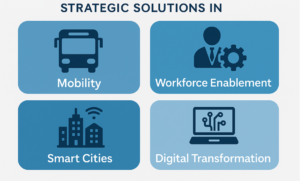
Figure 1:Company XXXXX strategic solutions (Sources from company documents)
In summary, the model delivers integrated solutions through four pillars: strategic mobility enhances transport and logistics; workforce enabling boosts employee productivity; smart cities improve urban living through technology; and digital transformation modernizes operations with AI, automation, and cloud-based innovations. For success of all the identified areas, PS&M ought to be appropriately positioned for ensuring sourcing of their different spend categories. This is with value for money outcomes successfully achieved.
1.2 Identified Terms and Conditions
The contract T&Cs template has been presented in Appendix 1 of this assessment. These T&Cs are relevant and in general for various projects which are executed by XXX. There are different projects pursued in areas of mobility, smart cities, workforce enablement and digital transformation. The T&Cs are relevant for the different risks for appropriate distribution with absolute power being first party (XXX) with projects managers/vendors being the other party.
For identifying relevance of the selected T&Cs, the impact of contract to different stakeholders can be put into account. In CIPS (2022), this is appropriately pursued by use of Mendelow Matrix Stakeholders Analysis. This is illustrated in the following;
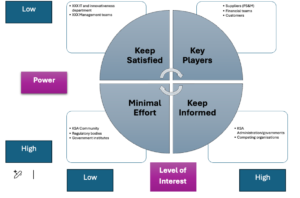
Figure 2: Mendelow Matrix Analysis Summary
Source: Summarised from XXX Internal documents
High Power; Low Interest– Considering they have low in interests and risks faced, communities in KSA and government do not actively get involved in T&Cs embrace. With this category including majority of the end-users of XXX services, they are directly impacted by these T&Cs.
Low Power; High Influence– Considering suppliers and the PS&M, risks is enormous as evidenced in their T&Cs. Hence, they are found influencing successful practices in line with their T&Cs. This relationship is informed by collaborating, consulting with experts actively.
Low Power; Low Interest– For the different competing firms against XXX and also the admin in KSA, they are influencing development of T&Cs initiated. Owing to their direct relations with XXX business practice, existing legislations influence T&Cs implementation.
Additionally, considering XXX contracts development, to manage evident risks, Contract Management Cycle is relevant to define T&Cs. In line with CIPS (2022a), the relevance of this is to guide supply chain managers and buyers (XXX) towards risks distribution sligned with contracts demands. This is while relevant negotiations and changes a priority. In the following contract cycle, risk management is in line with PS&M considerations of risks (internally & externally in their business environment);
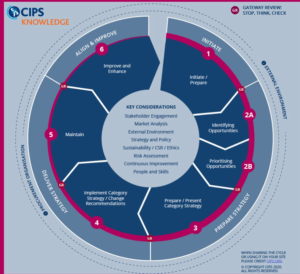
Figure 3: Contracts Management Cycle
Source: CIPS Module notes
1.3 XXX Terms and Conditions
For the selected T&C, they are used in XXX PS&M operations and contracts management in executing projects as part of their vision. Using the CIPS Module Notes Model of vulnerability and risks and relative value/impact analysis, the T&Cs importance and relevance is informed by core contracts specifications;
Figure 4: Vulnerability and Risks; Relative Values and Impacts
Source: Summarised from CIPS Module Notes
Considering the T&Cs of the contracts, its structuring is in a way the structure is performance oriented. They ensure they manage how vulnerable and risky the process is with relative value and impact prioritised. In line with COFC (2022), contracts performance classification prioritises on performance scope, incurred costs and implementation process of the contract. The outcome is informed by T&Cs which touch on functionality and incurred costs.
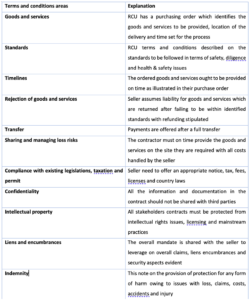
Further, having functional factor important, it is found deviating from requirements of testing done or pre-delivery essential before implementing the real contract. These T&Cs could be summarised in the following;
Table 1: XXX T&Cs Summary
Source: XXX T&Cs Template document
2.0 Risk of Poor Quality
Quality in contracts management is identified as “both the process and technical expectations attained in products and services/projects implementation”. The definition by Groot et al. (2021) implies the products and services conform to the contract expectations. Considering the T&Cs used in the XXX projects execution, these expectations are in regard to how valid, acceptable, capacities and laws.
From the T&Cs template, they note;
The identified T&Cs cannot be categorised as a warranty considering it lack relevance by granting an injured stakeholder with remedies classified as damage. This is classified as a condition as it detail importance of a contract by putting into account of the terms of contracts;
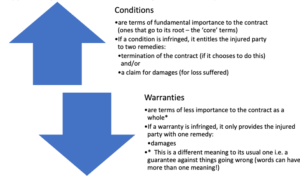
Figure 5: Conditions and Warranties in Contracts Differences
Source: Summarised from CIPS Module Notes
With the T&Cs being essential for a successful management of quality of the projects implemented, risk register is relevant to monitor and analyse the risks. In CIPS (2021) risk of quality impact how a contract is implemented.
A recent project by XXX involved installation of technology systems for monitoring operations in the city to advance their operations. For the project, risk register was relevant for evaluating risks of the contract implementation;
Table 2: Recent XXX organisation project Risk Register
Source: XXX Internal Documents
| Risk ID# | Raised Dates | Description | Risk Impacts | How Severe | Owner | Action to Mitigate |
| A | 10th July | Lack of an elaborate contract definition | High | Medium | PS&M teams | Ensuring entire PS&M teams are well harmonised in regard to T&Cs |
| B | 20th August | Contract unclear in definition and outcomes | Medium | Low | Contracts dev manager
PS&M |
Entire stakeholders involved from the initial phase of contracts implementation |
| C | 4th September | Lack of clear enumeration of the timeline of contract execution | Low | High | Contractors
Suppliers |
Appropriate schedule put in place where quality expectations are identified |
| D | 5th October | Service quality levels and Key Performance Indicators (KPIs) not elaborate | High | Medium | PS&M teams
Contract manager |
Guaranteeing KPIs clear highlight with assigned functions evidenced |
In summary, for the risk register, it is clear the T&Cs do not address all the issues in the contract implementation holistically. The T&Cs need to be broadened to different projects pursued. The part of the T&Cs which highlight the risk of quality is;
Therefore, it is important to build on the T&Cs to guarantee all stakeholders contentment with their embrace in the different areas of project implementation. This would be further in alignment with KSA legislations including Saudisation.
3.0 Risk of Extension of Time…………..
Please click the following icon to access this assessment in full
Related to: https://rankedprofessionals.com/downloads/solution-cips-organisation-terms-and-conditions-pdc/