(Solution) PwC’s Academy 5HR02 Talent Management and Workforce planning
Solution
Table of Contents
1.1: Strategic Positioning in Competitive Labour Markets. 7
Understanding Competitive Labour Markets. 7
Being an Employer of Choice. 7
Improving Employer Branding. 8
1.2: Impact of Changing Labour Market Conditions on Resourcing Decisions. 8
Tight vs Loose Labour Markets. 8
Changing Workforce Demographics. 8
2.1: Analyse the Impact of Effective Workforce Planning. 9
Definition of Workforce Planning. 9
Impact of Effective Workforce Planning at ParcelCare. 9
2.2: Evaluate the Techniques Used to Support the Process of Workforce Planning. 10
Work Study and the Delphi Technique. 10
Recommendation for ParcelCare. 11
2.3: Evaluating Recruitment and Selection Methods Effectively. 11
Recruitment Method 1: Employee Referrals. 11
Recruitment Method 2: Recruitment Agencies. 12
Selection Method 1: Psychometric Testing. 12
Selection Method 2: Work Sample Tests. 12
Recommendation for ParcelCare. 12
3.1 Understanding Employee Retention and Turnover Drivers. 12
Avoidable vs. Unavoidable Turnover 12
Push Factors for Leaving ParcelCare. 13
Pull Factors Attracting Employees Elsewhere. 13
3.2 Comparing Different Approaches to Retaining People. 14
3.3: The Impact of Dysfunctional Employee Turnover 15
What is Dysfunctional Turnover?. 15
4.1: Assessing Suitable Contractual Arrangements for Workforce Needs. 16
4.2: The Benefits of Effective Onboarding. 17
Answer to Questions
1.1: Strategic Positioning in Competitive Labour Markets
Understanding Competitive Labour Markets
A competitive labour market can be defined as the situation in which a number of employers are competing over a scarce source of talent (CIPD, 2023). It is determined by the skill shortages, geographical positioning, the level of wages and working conditions. In the case of ParcelCare and other employers, this creates the challenge of how to differentiate themselves and to recruit the best employees whilst also trying to retain the ones they have in a market where their rivals are providing more and more compelling packages.
Competitor Analysis
As a way of staying competitive, ParcelCare will have to conduct frequent competitor analysis to determine what the other firms operating in the parcel delivery and logistics industry are offering. This involves checking on competitor compensation systems, benefits, conditions of work, flexibility and training provisions. The knowledge of these factors will enable ParcelCare to benchmark its own services and find gaps. As an illustration, when the competitors provide hybrid working or sign-on bonuses to drivers, ParcelCare should ask whether it is possible to introduce similar incentives sustainably. Through this, an organisation will be in a position to retain its competitiveness and prevent the loss of personnel to competitors.
Being an Employer of Choice
The concept of being an employer of choice implies that potential and current staff members consider the organization as one of the best places to work in. It gains this status by being highly dedicated to the wellbeing of the employees, their career advancement and work-life balance. With investments into mental health resources, equitable remuneration policies, flexible working practices and transparent development systems, ParcelCare can become an employer of choice. Providing meaningful work and a positive culture is the strategy to attract and retain talent in the current market as noted by Jacobs (2021). Inclusive and values-driven culture will enable ParcelCare to boost its attractiveness among jobseekers.
Improving Employer Branding
The proposition of employer branding defines the way that the company is viewed as an employer and consists of the reputation, culture and values (CIPD, 2023). ParcelCare needs to invest in promoting its good culture working place and success stories on different platforms such as the company website, social media, and recruitment websites. Highlighting employee testimonials, diversity programs and community services would help improve its image to the outside world. A good employer brand will not only ensure that high quality applicants apply to the organisation but it will also save the organisation money in the long run that would have been used in the recruitment processes as applicants would seek the organisation on their own.
1.2: Impact of Changing Labour Market Conditions on Resourcing Decisions
Tight vs Loose Labour Markets
A tight labour market can be defined as the situation when the number of job seekers is lower than the number of job vacancies, and employers cannot find the appropriate people to hire (CIPD, 2021). In this case, ParcelCare might find it difficult to staff, particularly drivers and warehouse workers, and it might need to offer higher pay packets, better working environment, and more effort on recruitment marketing. On the other hand, when the labour market is not tight, that is, when the number of candidates exceeds the number of jobs, ParcelCare will have more options and potentially decrease recruitment expenses. But it might also have to provide fair and transparent selection practices in order to sustain its reputation as an employer, and to prevent discrimination suits.
Changing Workforce Demographics
The experience as well as institutional knowledge that is held by some older workers may be lost suddenly as a result of the change in the demographics of the workforce at ParcelCare, especially with the decreasing number of the old workers as a result of early retirement or poor health. To address this, the organisation ought to adjust its recruitment practices by implementing return-to-work programs as well as advertising specifically to older employees (ILO, 2022). It can also develop part-time or flexible jobs to accommodate longer work lives. Such strategies will help not only to enhance retention but also to guarantee knowledge transfer via mentoring or training older workers, contributing to the long-term sustainability of the workforce.
Rise in Flexible Working
The rising need of flexible working arrangement demands that ParcelCare has to reconsider its working practice and policies. The inability to offer such flexibility might lead to an increase in turnover and the inability to attract new talent (Statista, 2023). Employee satisfaction and engagement can be increased by introducing hybrid work to administrative positions, more flexible shift schedules to operational employees, and job sharing options. These changes would be included in an updated retention plan and would make ParcelCare an employer that is inclusive and progressive (CIPD, 2025).
Local Hiring Legislation
Local hiring legislation could limit ParcelCare access to its historic source of labour, especially where migrant workers have historically been employed to operatePerhaps the greatest impact on ParcelCare is legislation on local hiring which could potentially cut off its access to traditional labour supply especially in locations where migrants have been employed to operate ParcelCare, in its turn, will have to reconsider its long-term planning by training local talent with the help of apprenticeships, school leaver programmes, as well as local job centre collaboration. As noted by CIPD (2024), further, the recruitment strategies will need to change to focus on regional job markets better, and internal development programmes might be required to develop talent internally.
2.1: Analyse the Impact of Effective Workforce Planning
Definition of Workforce Planning
Workforce planning refers to the strategic approach by which an organisation makes sure that it has the number of people, with the appropriate skills, in the right jobs, at the right time in order to meet its objectives (CIPD, 2023). It entails examining the existing capabilities of the workforce, predicting future requirements of the workforce, determining the gaps, and finding ways of bridging them. The CIPD (2023) mentions that workforce planning helps to balance short-term operational and long-term strategic priorities, governed by the alignment of people strategy with business objectives.
Impact of Effective Workforce Planning at ParcelCare
If ParcelCare has a successful workforce planning, the company can attain several positive impacts. To start with, it will be in a position to make more accurate future staff requirement forecasts and, therefore, pre-recruit and prepare staff beforehand instead of responding to shortfalls. Through such forward-looking planning, there is ongoing provision of service that is very crucial in the logistics sector whose delays or mistakes wreck reputation as well as generate distrust in clients.
Additionally, through the future skill needs identification, ParcelCare can make investments in training and development initiatives that reskill the existing workforce, hence enhancing internal mobility as well as retention. Proper planning also removes overstaffing or understaffing, hence keeping labor costs in check as well as enhancing effectiveness (CIPD, 2023). Furthermore, it ensures there is a compatible workforce for future technology or operations changes, enabling innovation and flexibility within a dynamic market.
Without forecasting and labor planning, ParcelCare may experience misalignment between demand and supply of labor. For instance, shortage of delivery drivers during peak season would cause missed sales, missed delivery, and unhappy customers. Conversely, overestimation of requirements would result in unnecessary salary expenditure and lower rates of productivity. Moreover, the inability to forecast skill shortages can hinder the implementation of new systems or services, leading to slow advancement and burdening existing workers.
2.2: Evaluate the Techniques Used to Support the Process of Workforce Planning
Work Study and the Delphi Technique
Two commonly employed techniques that assist in workforce planning are Work Study and the Delphi Technique.
Work Study is a technique that systematically analyzes work processes in order to enhance efficiency and identify the optimal number of personnel needed to carry out tasks (Joseph Konnully, 2015). Work Study contains two aspects: method study (reviewing the way that work is done) and work measurement (quantifying how long a task must be accomplished). The approach identifies redundancies in work processes, time wastage, and ineffective usage of resources (Slideshare, 2023).
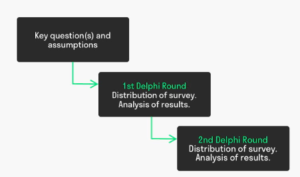
The Delphi Technique is a methodical method of forecasting which generates opinion from a group of experts by using questionnaires given consecutively. The answers are returned anonymously, compiled, and given out in a sequence of rounds, leading experts to adjust their opinions on the basis of feedback from groups (Project Smart, 2023).
Evaluation of Each Tool
Work Study is very appropriate to working conditions like ParcelCare because it provides quantifiable data for application in making decisions about staff numbers and process improvement. It can guarantee efficiency and can tell us where automation or training is required. Its disadvantages are that it is time-consuming and can disrupt current production. Work Study focuses more on the present situation than on considering future needs, so is less suitable for strategic planning.
The Delphi Technique offers a strategic advantage, particularly in rapidly changing industries. It provides access to expert judgment and is useful in establishing future trends and long-term manpower requirements. It is also best suited for applications with uncertainty where previous facts may not be a good predictor of what may be required in the future. The process, nevertheless, can be slow and requires extensive coordination. Additionally, its quality is dependent on participants’ skill and process facilitation (Project Smart, 2023).
Recommendation for ParcelCare
Although both techniques are valuable, Work Study would be most valuable for ParcelCare short-term as it can make things run more smoothly and objectively calculate work force capacity against existing delivery operations. However, for strategic planning over the long term, the Delphi Technique may be more valuable by projecting future labour requirements as a response to future industry and technological patterns. Better still, the two methods could be merged to create a comprehensive overall workforce planning approach, Work Study ensuring efficiency in operation and the Delphi Technique informing the future direction of workforce development.
2.3: Evaluating Recruitment and Selection Methods Effectively
Recruitment Method 1: Employee Referrals
Employee referral programs make existing employees refer qualified individuals to fill vacant positions. The main advantage of this approach is that there is a high probability that candidates will become a more effective cultural fit and already be aware of company values, which can enhance retention and facilitation of faster integration. This may be a cost-saving opportunity in case of ParcelCare that experiences recruitment and retention issues, improving trust and time-to-fill. Nevertheless, the key weakness is the possibility of the lack of diversity since employees can suggest people with similar backgrounds or views which can inhibit innovation (CIPD, 2022).
Recruitment Method 2: Recruitment Agencies
External recruitment agencies will help ParcelCare to cast a broader net on the talent pool, and promptly fill positions, particularly those that are specialist or those with high turnover. Agencies are usually able to access passive candidates and can carry out initial screening exercises which saves ParcelCare time. This approach can however be expensive and could lead to recruitment of candidates who will not be committed in the long run unless a good assessment of the organisational fit is done. Also, it is necessary that ParcelCare makes agency partners aware of their values and work expectations (CIPD, 2022).
Selection Method 1: Psychometric Testing
Psychometric assessments evaluate candidates’ personality traits, cognitive abilities, and motivations. These tests are useful for predicting job performance and team compatibility. For ParcelCare, this could help ensure new hires align with the organisation’s fast-paced and customer-focused environment. However, tests must be properly validated and interpreted by trained professionals. They may also disadvantage candidates unfamiliar with such assessments or who experience test anxiety (Cook, 2016).
Selection Method 2: Work Sample Tests
Work sample tests assess a candidate’s ability to perform tasks directly related to the job, such as planning delivery routes or responding to customer queries. This method offers a realistic view of candidate competence and reduces the risk of poor hiring decisions (Cappelli, 2019). For ParcelCare, it ensures practical readiness and can enhance workforce effectiveness. However, designing valid and job-relevant tasks can be time-consuming, and this method may not suit all roles (CIPD, 2021).
Recommendation for ParcelCare
Employee referrals would be the most appropriate recruitment channel to use by ParcelCare because they strengthen cultural alignment and improve turnover minimisation. Work sample tests would be most useful to select the candidates, especially in operational positions, as they would be ready to start working immediately and the training would be minimal.
3.1 Understanding Employee Retention and Turnover Drivers
Avoidable vs. Unavoidable Turnover
It is possible to classify employee turnover as avoidable and unavoidable. Avoidable turnover is the resignation or dismissal, which can possibly be averted by making organisational changes. These can be illustrated by low morale, poor leadership or lack of growth opportunities as the reason of departure (CIPD, 2021). Unavoidable turnover, in its turn, is caused by the factors that are mostly beyond the control of the employer, including retirement, moving to another location, or the personal health problems. In the case of ParcelCare, it is essential to understand this difference – avoidable turnover can be minimised to cut recruitment expenses and to retain institutional knowledge, whereas unavoidable turnover should be anticipated in advance to maintain continuity.
Push Factors for Leaving ParcelCare
A lack of career development opportunities is one of the major push factors that may motivate members of staff to quit ParcelCare. Without well-defined routes of movement, employees can become stagnated and thus desire to move up somewhere else. That is particularly applicable to the sphere of logistics where monotonous work may become a job satisfaction barrier unless accompanied by upskilling and mobility opportunities (Vulpen, 2016). Poor managerial relationship is another push factor. Trust and morale can be destroyed by a culture of micro-management, no recognition or reward, or unreliable communication. Research indicates that one of the leading causes of employee resignation is bad leadership, and it might have an adverse impact on the general workplace environment (Sapia.ai, 2024).
Pull Factors Attracting Employees Elsewhere
Pull factors usually entice the employees with external attractions. One of the main pull factors is high salary or improved benefits provided by the competitor. A competitive labour market allows employers to entice employees feeling under remunerated at ParcelCare with advertisements of more appealing financial offers (Norbury, 2019). Flexible working arrangements another great pull factor. As employee demands shift, especially after the pandemic, people are focusing on work-life balance. Organisations which encourage hybrid working, compressed hours or remote positions usually have an advantage when it comes to recruiting and retaining staff. As a company that has always worked based on fixed shift patterns, ParcelCare is at risk of losing talent to the employers that will accommodate these changing preferences (Vulpen, 2016).
This knowledge can enable HR at ParcelCare to manage the internal push factors and still be competitive enough against external pull factors. Talent management and frequent interaction can assist in keeping good employees and minimize turmoil created by turnovers.
3.2 Comparing Different Approaches to Retaining People
| Retention Approach (briefly explained) | Similarities | Differences |
Please click the following icon to access this assessment in full