(Solution) QatarEnergyLNG Developing Contracts- PDC
Solution
Executive Summary
In this assessment, the focus is on Module 3; “Developing contracts in Procurement and Supply” to evaluate terms and conditions in QatarEnergy LNG and impact on procurement and supply management (PS&M). The selected terms and conditions (T&Cs) are general and used in various spend categories in the organisation. The evaluation focus on how the T&Cs assists to manage poor quality risk, extension of time, increased costs and unethical issues. Also, the performance measures monitoring strategy and management referencing on the terms and conditions have been noted and analysed. Also, the battle of the forms concept has been evaluated. With QatarEnergy LNG having their T&Cs, their different suppliers equally operate with their own terms and conditions. The key findings in this report have been informed by collected data from different CIPS Module Notes and also models and tools. This report main findings note that QatarEnergy LNG T&Cs are appropriate and relevant for implementing the procurement and supply chain management process. Also, from the stakeholder’s analysis, the T&Cs are appropriate for ensuring that their relationships are appropriate and successful. Further, the findings evidence the T&Cs as relevant in enhancing success in ethical sourcing and timely delivery of products and services on demand. This is while at the same time managing performance issues owing to differences in positioning of the suppliers and the organisation. For the battle of the forms, this report findings highlight on their existence. By referencing to a specific case law, appropriate strategies for their management have been identified.
From the gaps and limitations identified in this report, a set of recommendations have been suggested including;
- Expansion of the current T&Cs to include more focus and content
- Improving suppliers’ relations for clear harmonisation of T&Cs for avoiding battle of the forms
- To accommodate legislations including local content legislation in UAE for legalisation of the T&Cs
- Benchmark T&Cs of their different suppliers for harmonising performance
- To create awareness amongst the Procurement and Supply Management teams for success in implementing all the T&Cs
Acronyms
T&C- Terms and Conditions
UAE- United Arabs Emirates
Kraljic Matrix Analysis
Source: (CIPS, 2025)
Leverage- With low supply risk and high profit impact, these are logistics, employees uniforms and technology to optimise local and international upstream operations, downstream operations expansion and positioning in low carbon business (CIPS, 2025). Their T&Cs highlight these areas in issuing tenders, costs management and substitutes in place.
Strategic- Having high supply risks and profit impact, the relations of all stakeholders is critical. This is while balancing the relations in T&Cs to guarantee successful risks management.
Bottleneck- This category is characterised with high supply risks and low profit impact and include categories such as Information Technology (IT) systems, vehicles for the organisation and catering services. T&Cs are set in a manner in which Force Majeure impacting the success of procurement identified.
Non-Critical (Routine) items– The low supply risk and profit impact inform the T&Cs only facilitating the contracts implementation. These items such as communication gadgets in onshore and offshore, staff identify, and badges are only negotiated on scope of costs management and their access.
In summary, in line with Kraljic Matrix analysis findings, the T&Cs are critical in ensuring risks management in their various risk areas as part of procurement and supply chain management.
3.0 Importance of the Terms and Conditions (T&Cs) in QatarEnergy LNG
3.1 Managing Risks of Poor Quality
Adopting the definition of CIPS (2025a), quality represent “technical and non-technical features fully adhered to in the products/services sourced conforming with needs”. In different spend categories, quality factor is captured in areas of workload assigned, operations resolution, and continuous quality monitoring. To manage risk of quality, the T&Cs note;
Hence, the T&Cs in regard to risk of quality are a warranty and not a condition (HTAY, Y2023). In this case, for a supplier, failure to ensure that the products and services are in line with required quality could be a ground of contract termination. A summary of warranty and conditions are as illustrated in the following;
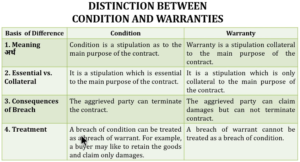
Table 1:Differences of the Conditions and Warranties in T&Cs
Source: Summarised from CIPS (2025b)
To monitor the different risks, a recent sourcing strategy of one out of the 17 ultra-modern LNG Carriers valued at 14.2 billion Qatari Riyals, a risk register was used (Handayani & Rabihah, 2022). This is to identify the likelihood of occurring and risk impact owing to the quality factor;
Table 2:Risk Register for quality factor in ultra-modern LNG sourcing
Source: Internal QatarEnergy LNG documents
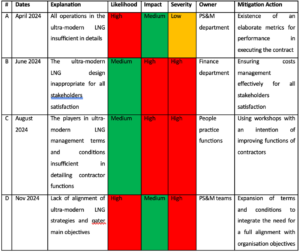
In conclusion, the risk register in table 2 detail on the risks encountered in the implementation of the ultra-modern LNG construction process in North Field East and North Field South LNG expansion projects (QatarEnergy, 2025). As part of this report recommendation, terms and conditions are required to be broad to accommodate risks management needs. For managing the issues encountered in maintaining quality, the terms and conditions also note;
With the terms and conditions noting on the existing Qatari regulations, part of this project would include recommending best strategy in integrating Qatar laws as part of their operations. Also, by partnering with the rest of the organisation departments, need for encumbrance management and full compliance would be achieved successfully.
3.2 Risk of Extension of Time
Time extension in contracts management is identified as “meeting set timelines in execution of a contract” (CIPS, 2025c). The time us used in evaluating, reviewing and managing the entire contract with success. There are normally costs tied with breaching of contract T&Cs handled by the supplier or the buyer (QatarEnergy LNG). Apart from risk of contract termination, fines or non-cash pay are advanced. Their T&Cs note that;
As identified in the T&Cs, to avoid the risk of time extension, upto 2% of the overall price weekly is charged for failing in delivering goods in their set timeline. For instance,
which had been tasked with implementation of an industrial project was not completed on time and only 75% was completed. This was despite the delay being as a result of increased cost of initial contract with $2.4 billion from pandemic-linked issues, change orders and bill schedules and differences with owners (Reuters, 2024). QatarEnergy LNG has requested 20% of the initial contract price to be paid for the delays.
Also, the QatarEnergy LNG T&Cs are identified as insufficient in terms of integrating all the Force Majeure needs. The industrial project with Zachry failed to be implemented on time and only 75% has been done owing to COVID-19 pandemic. According to CIPS (2025d) the Force Majeure is “excluding or limiting liability clause after issues past an organisation direct control/management”. The examples are earthquakes, eruption/tsunamic with COVID-19 such pandemic not included in the provisions. This is part of this report recommendation where a review of their T&Cs need to be pursued as the T&Cs require settlement of all dues irrespective of events;
The review of the T&Cs would need to put into account the provisions of the Law no (22) of 2004 on promulgation of the Civil Code (Bantekas, 2023). This would improve the relevance and scope of the T&Cs to achieve their intended purpose.
3.3 Risk of Increased Costs
As part of contract management cycle,
Please click the following icon to access this assessment in full
Related to;https://rankedprofessionals.com/downloads/solution-cips-roshn-contract-terms-and-conditions/