(Solution) ROSHN APGCM Global Commercial Strategy
Solution
Executive Summary
In this business report, an analysis of ROSHN Global Commercial Strategy has been provided. This report analyse the relationship of strategy with Procurement and Supply Chain Management (PS&M) and resource management. ROSHN operating in KSA have their strategic objective of achieving operation success in achieving Vision 2030. This is in their sustainability in development, owning homes and diversifying KSA economy. The scope of this business report is to analyse relationship of strategy and corporate, business and functional structure, supply chain analysis methods, resource management and financial management implication on resilient operations and value creation.
The key findings in this business report highlight that ROSHN hierarchy and collaboration in their corporate structure, specialisation of business portfolio and function departments. These enhance how they coordinate, manage risks and allocate resources consistently. The key findings are informed by different tools used including Balanced Scorecard which evidence linking of operation performances with strategic objectives. The findings in SWOT analysis note the strengths as including finance facilitation and supply chain networks with weaknesses, opportunities and threats impacting supply chain resilience. The findings from STEEPLED analysis is relevant for analysis identifying environment and social-economic factors impacting sourcing and delivering projects. This is with Porter’s 5 Forces relevant for informing competitive position and suppliers management approaches.
The key findings on the resources management including skilled human management, information systems, digital systems including financial modelling assisting efficiencies. This is with reduced delays and optimising projects delivery. The financial strategies which include cost strategies, reducing costs and managing risks assists in achieving supply chain resilience, profits and increased value creation.
From the identified gaps, various recommendations have been identified which include;
- Diversifying the suppliers relationships for improved resilience, dependency on risks management and continuous projects delivery
- Embracing predictive analytics for real-time insights
- Incorporating advanced MIS having digitised cost tracking systems for transparent, on-time decisions made
- Expansion of successful awareness of PS&M for efficient projects deliveries and sourcing
1.0 Introduction and Background
1.1 ROSHN Organisation Background
ROSHN Group is classified as a leader in Saudi Arabia (KSA) multi-asset class real estate developer (ROSHN, 2025). It operates as a Public Investment Fund (PIF) organisation mandated to guide achievement of the Saudi Vision 2030. To achieve this vision, the organisation work on transformation of urban landscape characterised with human-centric, fully integrated developments elevating connection and improving quality of life. Specifically, ROSHN Group intend to develop a higher of 400,000 residential units, Northern Riyadh-based SEDRA development exceeding SAR 19 billion (Argaam, 2025). Approximately 71% of their 2024 contracts are given to the domestic organisations with local development investing approximately SAR2Billion. This is in their different projects as illustrated in the following;

Figure 1: Summary of ROSHN Group Ongoing Projects
Source: Summarised from ROSHN (2025a)
In summary, in this illustration, it evident ROSHN operates multiple projects of immense scale with diversity and inclusion prioritised. The different projects are possible owing to ROSHN large-scale scope of networking, appropriate resources management/application and managing resources appropriately. Hence, this inform need for analysis of their commercial strategy. This is in context of supply chain analysis, resources management and costs-based decisions made.
1.2 Scope of Business Report
The scope of this business report is to analyse ROSHN global commercial strategy. This is by strongly emphasising on how strategic practice in the organisation is translated to successful procurement and supply chain management (PS&M).
This business report is classified into 4 major sections guiding the identification of capability and sustainable commercial performance. This starts with reviewing the strategy and corporate relationship, business and the functional structures of an organisation. This is while at the same time examining the scope in which aligning the different levels impacts quality of making decisions and commercial- based results.
Also, this business report pursue an evaluation of the supply chain analysis methods. This is through the embrace of data, risks management and performance indicators which support strategically planning.
Part of this report entail discussing on best practice in managing resources identified to be inclusive of individuals (people), technologies (IT) and asserts for developing and implementing the strategy. lastly, costs and financial factors analysis for supporting resilient supply chain has been carried out. This guide the final recommendations for ROSHN commercial strategy development.
2.0 Relationship of Strategy and Corporate, Business and Functional Structures
2.1 Analysis of Strategy and Corporate Structure
in ROSHN, strategy and corporate structure is defined by their core objective of achieving 70% of house ownership amongst KSA population with guidance of Vision 2030. This is achieved through sustainable growth, expanding KSA infrastructure and incorporating different amenities. Achieving this is identified in ROSHN (2024b) to demand existence of a corporate framework accommodating investments done for many years.
A hierarchical structure is evident in their corporate structure with collaboration with Public Investment Fund (PIF) which is the leadership organisation overseeing their prioritisation in areas of economy development, increasing homes ownership and living standards. The collaboration of all these department inform the decisions made;
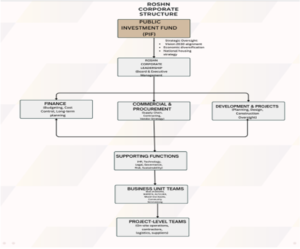
Figure 2: ROSHN Corporate Structure
Source: Summarised from ROSHN (2024) notes
The corporate structure offers ROSHN with an opportunity of transitioning their strategic practice with investments, governance initiative and managing risks process. The different corporate departments (financial, PS&M, Commerce and infrastructure development) are guided by mutual strategic objective. This lead to a uniform standardisation and distributing resources while appraising performance.
From a general context, the corporate structure grants formalised opportunities, source of authorities and coordinating execution of strategies. This is with corporate strategy influencing structure changes for accommodating ROSHN increasing investments as they achieve the Vision 2030. With location in Jeddah, Medinah, Riyadh and Dammam, they enhance their success in geographical and multi-sectorial growth.
2.2 Strategy and Business Structure
Adopting Tiffany (2025) definition, a business structure inform the manner an organisation plan their different functional units and projects for achieving their strategic objectives. This is by specifying report structure, assigned roles and inter-relations.
In ROSHN, organisation structure is stratified on enormous development portfolios and projects facilitating success in the organisation strategy to expand in the entire country. For instance, their operations in projects including ALFULWA, SEDRA and WAREFA manages sourcing, management and development programs in their regions for ensuring its implementation is aligned with the corporate investments and governance strategies. The identified portfolios are noted in PIF (2024) as granting project stratification enhancing operations hence facilitating uniformed productivity and resources use.
A summary of the organisation structure impact on different projects include;
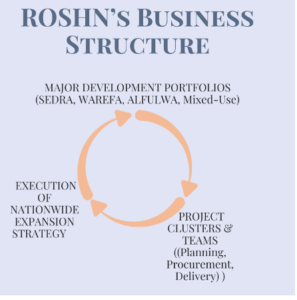
Figure 3: Summary of ROSHN Business Structure and Investments
Source: PIF (2025) internal documents
The illustration evidence major portfolios of ROSHN operations which are associated with project stratification for delivering detailed operations in their various projects in KSA.
Also, in line with ROSHN (2024a), a uniform business strategy is in place with different portfolios and operation teams coordinating planning, sourcing/procurement and deliveries aligning strategic objectives to commercial and development outcomes.
2.3 Strategy relationship with functional structures
The functional structures entail clustering an organisation into different departments of various specialisation. According to Danha (2025), the specialists could be finances, PS&M, logistic, people practices and research and development. In ROSHN, the professional functions are essential for aligning their strategic objectives with daily operations assisting in developing KSA community projects. The PS&M professionals for example assists in ensuring sourcing and contracts management are cost effective, best qualities and ethically.
Conversely, financial experts assists to strategically plan budget, forecasting and controlling investments. According to Overvest (2025), this is while research and development managing knowledge development on specific categories of investment.
All the functional structures are interlinked with organisation strategy of achieving 70% of houses ownership amongst KSA citizens by making mutual decisions, managing risks and allocating needed resources.
3.0 Supply Chain Analysis Methods
The rationale of using different tools and techniques in global supply chain analysis is for an efficient, resilient and strategically aligned objectives. In ROSHN case, they embrace diversity in regard to area of practice, supply chain and contracts development. Therefore, analysis of supply chain is the major driver of on-time contracts execution, managing costs overruns, and managing quality.
3.1 Benchmarking
Through benchmarking approach, Jurevicius (2025) identify it as guiding the supply hain analysis by comparative analysis of all processes, productivity and industrial standards or successful organisations.
In ROSHN, benchmarking can be done internally focusing on their various projects and externally focusing on other players in real estate such as Aldar, Amlak International and Dar Al Arkan (ROSHN, 2025a). The outcome of benchmarking is identified in CIPS (2025) as guiding ROSHN in appreciating performance factors, operation efficiency and quantifying sourcing, logistic and managing contracts. The limitation of this analysis tool is that it is cost intensive to implement and also the involved experts lacking knowledge of pursuing benchmarking.
3.2 Balanced Scorecard (BSC)
This is a tool relevant for strategic performance analysis relevant for assessing organisations performance in their supply chain. According to Hayes (2024), this is by focusing on factors of Finances, Clients, Internal Processes and Learning and Growth.
The relevance of Balanced Scorecard (BSC) is detailed and efficient as its focus is not only finance-based but incorporate operations and strategic objectives. By prioritising on these factors, ROSHN successfully achieves their long-term based objectives;
Figure 4: Balanced Scorecard model components
Source: Summarised from CIPS Module Notes
The rationale of using the Balanced Scorecard in ROSHN is to grant an appropriate framework for tracking how the supply chain perform. The performance metrics are finances, customer-based, internal processes, and learning and development. This link the organisation process in areas of PS&M efficiencies, managing contractors relations and delivering projects. This is guided by ROSHN strategic objective of achieving 70% of house ownership in KSA.
3.3 SWOT Analysis
This is used as strategic framework for evaluating of strengths, weaknesses, opportunities and threats in an entity. Referencing on this tool assist in developing what to improve, streamlined practices and pursuing strategies for managing challenges in PS&M in ROSHN as a best practice;
Figure 5: Summary of SWOT Analysis
Source: Summarised from ROSHN Internal documents
To conclude ROSHN SWOT analysis, their supply chain including significant financial resources, suppliers network broad locally/internationally and experienced experts in delivery of enormous projects/investments.
For weaknesses, they include heavily relying on. large suppliers and complex logistics of their operations. This is while having opportunities in innovativeness, creativity, sustainable development and market development. They are negatively affected by threats of regulations changing, geo-politics and competitiveness.
It imply ROSHN could successful prioritise on their strengths and opportunities while addressing weak areas and threats for ensuring resilience in supply chain network, efficiencies and strategic.
3.4 STEEPLED Analysis
The rationale of embracing STEEPLED analysis is to guide ROSHN in appreciating potential risks and chances in external business environment, facilitate proactiveness in planning guided by active decisions made. This is with overall operations well aligned with objectives in the detailed supply chain internationally;
Table 1: ROSHN STEEPLED Analysis Summary
Source: Summarised from ROSHN Internal documents
To summarise STEEPLED analysis, the outcomes impact ROSHN supply chain management and delivering their operations in different context.
For social and demographic factors, these impact demand for houses and community projects with efficient and coordinated practices enhancing technologies embrace. KSA government offer sustainability in business environment hence success in their business of housing. This is with Saudi Green Initiatives influencing how they ethically operate. The identified factors offer guidance for ROSHN in risks management, leveraging on offered opportunity and maintaining resilience in supply chain network, managing costs and aligning strategy with KSA Vision 2030.
3.4 Porter’s 5 Forces Analysis
This is a technique which is used strategically in analysis of competitiveness of a sector in a particular sector. The factors considered include the suppliers and buyer power, competitive rivalry and threats of substitutes (Gratton, 2023). The outcome of this include analysis of dynamics of an industry, risks prediction and initiating approaches for improving how they compete and leverage on profitability;
Figure 6: Porter’s 5 Forces Analysis Tool
Source: Sourced from CIPS Module Notes
Bargaining Power of Suppliers- The different materials used in construction, sourced IT systems and services influence the costs and timely provision. ROSHN embrace diversity in procurement and effective contracts management.
Bargaining Power of Customers- KSA administration and regulators impact costs, quality and sourcing projects for construction approved. The houses owners do not have immense power leverage.
Competitive Rivalry- The different competitors for ROSHN are put into account for ensuring that best practice is initiated in the organisation. Collaboration with different suppliers enhance creativity, quality in their operations and cost-efficient projects execution.
Threat of Substitutes– Many housing projects are in place with small developers emerging impacting market share. Hence, ROSHN is supposed to be differentiating themselves and integrating and mastering the different community needs.
New Entrants– Construction of houses to achieve 70% of houses ownership is a capital-intensive investment. This is while complying with existing legislations and contracts development. Hence, ROSHN all time strategy is investing on efficiencies and creativity for maintaining competitiveness.
4.0 Resources Management
A successful management of resources is essential for transformation of an organisation strategy for successful operations. This definition by Avron (2024) imply having in place enormous, many regions strategies demanding people, information and technology and finances all for successful alignment of supply chain and development roles. These are aligned with organisation core objectives.
4.1 People as a Significant Resource
Please click the following icon to access this assessment in full