(Solution) Sourcing approaches in NHS Supply Chain
Solution
Executive Summary
This report evaluates the sourcing approaches utilised by NHS Supply Chain (NHS SC) within selected Personal Protective Equipment (PPE) and consumables categories. The analysis considers how procurement strategies fit with suppliers’ market conditions, product criticality, and operational requirements.
The assignment is specifically on the Medical Consumables category of spend including high-volume and critical-use items such as visors, gauntlet gloves, clinical waste bags and polymer aprons. Each is selected with the tailored sourcing approach employed by NHS Supply Chain. A single sourcing approach was applied for visors under Lot 6 of the Personal Protective Equipment and Medical Consumables Framework through mini competition by awarding Globus as the sole supplier to realise economies of scale and to achieve pandemic preparedness targets. For gauntlet gloves under the Medical Examination Gloves Framework, sole sourcing was used after production limitations and supplier withdrawals necessitated a range extension with Globus to ensure continuity of supply in this bottleneck product. To increase resilience and avoid Far East supply risks, clinical waste bags were secured from dual sourcing strategy with two UK based manufacturers. Lastly, polymer aprons are procured by means of multiple sourcing, ensuring flexibility and competitive pricing from three approved suppliers.
The report will evaluate different sourcing approaches and determine the most suitable sourcing approach for the NHS operations in the Medical Consumables spend category. Further, supplier appraisal checklist for the Medical Consumables category of spend is developed through a strategic reference of the NHS Portfolio, and the use of best practice tools such as SWOT Analysis, Kraljic analysis, Business Hierarchy of Needs and Carter’s 10C’s Model.
From the findings in this report, the following recommendations have been proposed:
- Align sourcing models to the specific category of spend, considering product importance and supplier availability
- Develop inclusive procurement policies reflecting the needs of clinical, operational, and supply stakeholders
- Simplify procurement processes to enhance clarity and engagement across the supply chain
Table of Contents
2.0 Category of Spend Selection and Positioning. 4
2.1 Category of Spend Selection. 4
2.2 Spend Positioning in NHS SC. 5
2.3 Models Used for Strategic Spend Positioning. 5
2.3.1 The Kraljic Matrix Analysis. 5
2.3.4 Business Hierarchy of Need. 10
4.0 Supplier Appraisal of Medical Consumables category of Spend. 15
Figure 1: The Kraljic Matrix Analysis. 6
Figure 2:SWOT Analysis for NHS SC. 8
Figure 3: The Porter’s Five Forces Model 9
Figure 4: Business Hierarchy of Need Model 10
Figure 5: A summary of NHS SC’s Dual Sourcing Approach. 13
Figure 6: A summary of NHS SC’s Multiple Sourcing Approach. 14
Figure 7: Carter’s 10C’s Model of supplier evaluation. 15
Table 1: A summary of NHS SC Roles. 3
Table 2: Summary of NHS SC’s Category of Spend. 5
1.0 Introduction
NHS Supply Chain has an important role in delivering clinically assured, value driven products and services to NHS trusts in England. The organisation operates in a highly regulated and budget sensitive health care environment, processing over 4.5 million orders a year 7,000 suppliers (NHS Supply Chain, 2025). The organisation’s roles are summarised in the table below:
| Role | Description |
| Product and Service Procurement | Sources, purchases, and supplies clinically assured, value-driven products and services to NHS trusts. |
| Supplier Management | Manages a network of over 7,000 suppliers to ensure availability and reliability of critical products. |
| Order Processing | Handles over 4.5 million orders annually across a highly regulated and budget-sensitive environment. |
| Framework Agreement Management | Runs national framework agreements ensuring compliance, value for money, and operational resilience. |
| Emergency Preparedness | Maintains stockpiles and sourcing strategies for pandemic and health emergency responses. |
Table 1: A summary of NHS SC Roles
Source: NHS Supply Chain (2025)
Taking into account that healthcare delivery in the UK is an essential service, NHS Supply Chain has developed a structured pricing and procurement strategy, which is based on resilience, transparency and delivering value for money. One notable initiative under this framework is the organisation’s sustainability and social value commitments, which include ethical sourcing, reduced carbon emissions and supplier diversity in alignment with national health priorities (NHS Supply Chain, 2025). NHS Supply Chain’s approach provides sourcing decisions within the strategic and operational frameworks, as part of the value-based healthcare objectives and government policy directives. The rationale is to safeguard consistent supply for critical-use products, ensuring operational readiness and patient safety across the NHS.
2.0 Category of Spend Selection and Positioning
2.1 Category of Spend Selection
The selected category of spend is the Medical Consumables category, encompassing a wide range of high-volume, critical-use items essential for frontline healthcare delivery. The selected products (visors, gauntlet gloves, clinical waste bags, and polymer aprons) represent varying levels of complexity, supply risk, and clinical importance, which inform the tailored sourcing strategies used.
| Category of Spend |
|
Estimated Annual Volume (Eaches) | Sourcing Strategy | Suppliers | ||
| Medical Consumables | Single-use Visors (22cm) | 44,098,672 |
|
Globus (awarded) | ||
| Medical Consumables | Gauntlet Gloves | 300,000 |
|
Globus | ||
| Medical Consumables | Clinical Waste Bags | 25,000,000 | Dual Sourcing | Berry BPI Ltd, GV Health Ltd | ||
| Medical Consumables | High-Volume Standard Polymer Aprons | 851,000,000 | Multiple Sourcing | GV Health Ltd, Opalion Plastics Ltd, Polystar Plastics Ltd |
Table 2: Summary of NHS SC’s Category of Spend
The selection of the right sourcing strategy is imperative for maintaining supply resilience, mitigating risks and meeting clinical demands for each of the above mentioned medical consumable in the NHS Supply Chain (Apeh et al., 2024). As shown in table 2, tailored approaches from sole to multiple sourcing are applied depending on product criticality, supply risk, and supplier capabilities. Such strategic alignment will provide continuity, cost efficiency and pandemic preparedness. Best practice tools such as the Kraljic Matrix and Carter’s 10C’s are used by NHS SC to evaluate the supply positioning, supplier performance and procurement risk in line with NHS’s operational priorities and patient care needs.
2.2 Spend Positioning in NHS SC
The spend positioning in NHS SC is a strategic approach by which each product type can be categorised according to its importance, supply risk, and its potential impact on the ability to deliver patient care in the organisation. Patel (2022) mentions that this helps to optimise supplier management and prevents risks. This also ensures supply continuity for NHS SC and the clinical needs of the healthcare staff during the high-pressure moments such as pandemics.
2.3 Models Used for Strategic Spend Positioning
2.3.1 The Kraljic Matrix Analysis
CIPS (2025) defines the Kraljic Matrix as a strategic procurement and supply chain management tool that classifies suppliers based on supply risk and profit impact. Its purpose is to assist organisations to locate opportunities for optimising their supply chain as well as efficiently manage risks (Overvest, 2025). For NHS SC, categorising different categories of spend enables a focus on strategic sourcing tactics to mitigate risk and maximise value.
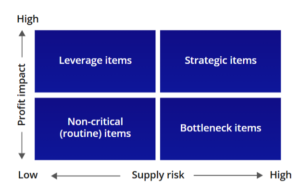
Figure 1: The Kraljic Matrix Analysis
Source: CIPS (2025)
Leverage Items: Here, supply is abundant and there are many suppliers which causes low supply risk and high profit impact (Webb, 2024). In NHS SC, an example is the visors procured for healthcare staff. These items are essential for safety, and having several suppliers ensures competitive pricing. NHS SC can negotiate well with these suppliers in order to receive value for money and maintain a stable supply chain.
Strategic Items: These are items that are typically procured because they are critical and naturally scarce, and as such, they present high supply risk and high profit impact (Ideson, 2025). An example in NHS SC is the Gauntlet gloves, which are used in specific medical procedures. These products are critical, with a limited number of suppliers that can meet NHS SC strict healthcare requirements, and therefore NHS SC relies on sole sourcing for these (NHS Supply Chain, 2025). Strong, confidential relationships with suppliers are essential to reduce supply chain risks for long term supply continuity.
Bottleneck Items: These items have medium to high supply risk and low profit impact. Clinical waste bags fall into this category for NHS SC (Bhasin, 2019). Though necessary for waste management, they suffer from medium to high supply risk due to the limited number of suppliers and global logistics challenges. These risks are mitigated by using the dual sourcing approach whereby NHS SC has a backup supplier in the event of disruptions. According to Zhao et al. (2019), better stakeholder relationships are recommended to reduce the negative effects of supply chain vulnerabilities as a means to improve resilience.
Non-Critical (Routine) Items: These are products and services with low supply risk and low profit impact, with easy access to multiple suppliers and market substitutes (Denis, 2022). A prime example in the case of NHS SC is polymer aprons. These items are non-critical in terms of supply chain disruption as they are readily available from several suppliers. Here, multiple sourcing strategy is used which ensures that NHS SC gets consistent supply and competitive pricing. Embracing technology can further improve communication and collaboration with stakeholders, ensuring the procurement process continues to be smooth and efficient (Segun-Ajao, 2024).
2.3.2 SWOT Analysis
SWOT analysis is a strategic tool which allows for an evaluation of the strengths, weaknesses, opportunities and threats in the given market (Peterdy, 2024). This model can be used in the case of sourcing on the medical consumables of NHS SC as a means of gaining insights on supplier landscape and the market competition.
| Strengths
· Strong partnerships with key suppliers such as Globus, Berry BPI Ltd, and GV Health Ltd. · Established relationships and purchasing power allow for favourable terms. · Ability to negotiate competitive pricing due to volume purchasing. |
· Dependency on sole or limited suppliers for critical items like Gauntlet gloves. · Limited supplier base can lead to reduced flexibility in sourcing. · Potential risk of supply disruptions if there are few suppliers. |
||
| Opportunities
· Explore new suppliers to diversify the supplier base · Leverage technological advancements to streamline procurement processes. · Potential for cost-effective procurement by reducing supplier dependency. |
Threats
· Global supply chain disruptions and geopolitical instability. · Emergence of new market entrants could increase competition. · Rising costs and market volatility affecting price stability.
|
Figure 2:SWOT Analysis for NHS SC
Source: Peterdy (2024)
Thus, based on the SWOT analysis, the existing strong relationships with multiple suppliers would inform the sourcing approaches for NHS SC’s medical consumables. A multiple sourcing strategy would be adopted in cases where many suppliers would be available for items such as visors in order to gain competitive pricing and supply resilience (Mehrjerdi & Shafiee, 2021). However, for critical items like Gauntlet gloves, NHS SC may maintain a sole sourcing approach with the limited supplier availability. Based on the identified risks such as supply chain disruptions and reliance on a few suppliers, Katsaliaki et al. (2021) recommends exploring new suppliers to mitigate these risks as well as embracing technology to optimise procurement processes.
2.3.3 Porter’s Five Forces
Another model which would help NHS SC understand the number of suppliers and the level of competition in the marketplace
Please click the following icon to access this assessment in full
Related: https://rankedprofessionals.com/downloads/solution-sourcing-essentials-pse/