(Solution) CIPD New Assessment ID / CIPD_5CO01_25_01 Organisational Performance and Culture in Practice
Solution
1.1
Divisional Organisation Structure
This structure involves an organisation being organised in terms of their products and services. According to Gaspary et al. (2020), this is as opposed to the use of person specification and job descriptions. The structure is illustrated in the following;
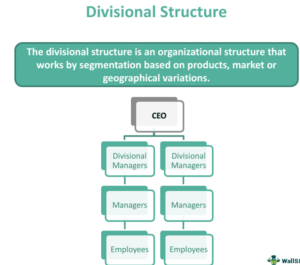
Figure 1: Divisional Organisation Structure
Source: Gaspary et al. (2020)
Considering MNGHA (organisation I am familiar with in Saudi Arabia) operates through the divisional organisation structure. There are divisions including radiography, medicine, clinical medicine, outpatient, inpatient and pharmaceuticals.
The advantages of divisional organisation structure include;
Highly flexible– With multiple departments in place, the organisation is highly flexible in executing its functions. This is with multiple customers engaged.
Innovative and creativity– In MNGHA, operating in modern healthcare setting demand them being innovative and creative which is attained by embracing the divisional structure.
The disadvantages include;
Reduced collaboration– In divisional organisations structure, employees end up being confined to their divisions. This affects their scope of interaction and working in active collaboration.
Role’s duplication– The organisation is actively involved in ensuring that the different departments independently operate playing the roles available in others. The outcome of this is duplicated functions.
In divisional organisation structure, underpinning rationale for their use is management of a broad organisation which require a lot of operations. A large-scale organisation work best when there are multiple departments in place. For MNGHA, this would mean that they improve their healthcare services provision with all the divisions working in collaboration.
Matrix Organisation Structure
This is a type of organisation with organisation having a leadership at the top leading the rest of the organisation departments. An example of the structure is illustrated in the following;
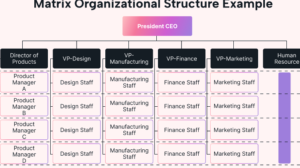
Figure 1: Example of Matrix Organisation Structure
Source: Al- Swidi et al. (2021)
The various strengths of this structure are;
Teamwork encouraged– In implementation of this structure, people possessing varying skills and knowledge come together in workplace. For example, Saudi Aramco using this structure is characterised by cross-functional operations and collaboration levels increased for optimum organisation gains.
Flexibility and adaptability increased– In this type of organisation structure, it grants opportunities for adjusting appropriately on basis of workplace dynamics and work environment interaction. The flexibility lead to successful resources use with all the departments appropriately financed without discrimination.
The weaknesses/disadvantages include;
Confusion in roles execution– With leaders in place in the different departments, the employees can be confused on the leader they need to report to. This could lead to a sense of being confused (Hunt & Madhavaram, 2020).
Priority conflicts– As part of embrace of the matrix organisation structure, employees could be competing owing to existence of varying capabilities and knowledge. The outcome of this is dispute emergence in resources embrace, meeting timelines and accommodating all interests.
The underpinning rationale for embrace of the structure entail coordination of various organisation discipline/areas of operations. A case example is Saudi Aramco which is a Saudi Arabia oil and gas industry organisation. With their operations both onshore and offshore, they work towards engaging different disciplines such as engineering, program management and oil and gas refineries.
1.2
In MNGHA organisation (organisation I am familiar with in Saudi Arabia) their set strategy entail making sure that they offer highly quality services to their customers. Their customers entail the KSA veterans and their families.
Link to Strategic Goals and Objectives
Broadly, an organisation strategy is essential for guiding a holistic analysis for appreciating both internal and external business sector factors to note their impact in an entity. According to Tawse and Tabesh (2020), having an elaborate organisation strategy imply the organisation recognising challenges including inflation, surging interest rates, competition and demand and supply issues. An organisation strategy must hence be guided by existence of distinct organisation needs expectations. For MNGHA organisation, sufficient resources availability is important for achievement of their Vision 2030 set in Saudi Arabia. For the organisation, this is by supporting he veterans in KSA and internationally in the Middle East. Also, they prioritise on employee’s value proposition with an intention of enhancing loyalty of employees. The best recommendation is provided for implementing different capacity development strategies.
Strategic Goals and Products/Services
Economic Environment– Taking into account of UK economy, the 2.78% economic growth evidence opportunities for organisations to leverage on. Similarly, for KSA (my home country), the economic growth and development offer immense opportunities for organisations to offer specific products and services. For an organisation such as MNGHA, they prioritise on factors of supplier’s power, industrial rivalry and market competitiveness. For MNGHA organisation context, giving quality veterans facilitation and maintaining competitiveness in KSA healthcare industry is a major advantage. Therefore, appreciation of the veterans in KSA demands make sure they are successful in offering high-level quality services.
Customer Satisfaction – In an organisation such as MNGHA which I am familiar with, offering high-level quality services to their customers guarantee them success in their operations. This is in regard to veterans’ expectations being prioritised with custom-made services guaranteed. Further, a high-level customer satisfaction is an opportunity of guaranteeing the management teams that their overall operational costs have been prioritised enhancing a successful organisation practice. For differentiating veterans support and different services categories in the veteran sector needs. For instance, the current international and regional aggression of KSA which could lead to an increased demand for wars.
1.3
The different external factors are informed by the PESTLE Model analysis tool (CIPD, 2024). This identifies how the external factors impact the organisation strategy.
Interest Rates
This is defined in CIPD (2024a) as the costs which are charged to advanced finances or savings made in financial institutions. They are informed by the economic wellbeing of a country and the amount of revenues advanced or saved. A case example is CIPD (2024b) identifying the UK interest rates as having declined Post COVID-19 pandemic with lower interests advanced to their investors.
The phenomenon is evident in KSA and UK where CIPD (2024i) identify these interests’ rates as oscillating from 5.9% to 7.8% every month. As such, the interest rates change impact on profitability gained in the different financial institutions and the investments made in the financial market. Hence, the interest rates of a country affect profits gained and dominance in their business sector. For overall supply chain network, this directly impact on products and services costs.
Priority– Owing to the increasing interest rates, an organisation including MNGHA could focus on expanding due to the existence of interest rates. Through an expansion of their practice, CIPD (2024b), identify this to lead to government advancing financial support and safeguarded from legal injunction. This lead to a leverage on competitive advantage and dominating their business environment where they have based on operations.
The disadvantage of the use of the model include inflation increasing due to challenges. These challenges could not have been clearly noticeable.
Inflation
According to Karki et al. (2020), the external environment is directly impacted by how much is spent to procure groceries and day to day living standards. Considering MNGHA case, based in KSA, the inflation rate has been increasing with approximately 3%. The outcome of this has been the available resources for their operation including recruitment of qualified employees and managing operations in their business environment.
Priority– In economies such as UK and KSA where their inflation rates are on the rise, they would initiate a contracting policy as a priority. According to CIPD (2024c), contracting policy entail prioritising only on the most critical operations and avoiding operations/activities which are costly and draining their financial resources. ‘
The negative of this priority is that inflation rates are continuously changing due to other factors beyond an organisation control. As such, continuously putting in place strategies for managing inflation would be challenging.
Social Factors
Today, there has been a significant alteration of labour dynamics, population changes and emerging stratification of modern society. This is found influencing labour market dynamics (Miess & Gold, 2021). For example, in UK and KSA, a common trend has been a significantly ageing population. This is while at the same time having an increased Gen Z and Millennials venturing into the labour market. The influence of this is availability of skills demand with qualifications prioritise. According to CIPD (2024c), this social factor similarly influence how cultural practices are enhanced. The rationale of this is to attract significantly qualified staff.
Priority– Considering the different noted social factors, restructuring strategy is supposed to be a priority and investment in resourcing strategies. The drawback of this is identified in Nikolaou (2021) as disrupting the organisation operation structure. This is in terms of their investment with staff having an improved performance in area of operations. Similarly, immense time is used in restructuring process.
1.4
AI-Powered Chatbots
Impact to Organisation- These chatbots are identified as assisting people practice professionals in reducing their workload. This is by facilitating a holistic support to the employees with continuous answering to set questions and clarifications. These are on rewards, leave and other issues. The chatbots are used in reducing the overall workload of the employees and how they are satisfied in their operations. Also, these are relevant resourcing tools for narrowing the candidate’s recruitment qualification informed by past qualifications and competencies.
Benefits– These entail a high-level efficiency, lower people professional’s workload and improved staff experiences. This is by successful facilitation by the management.
Risks– The application of chatbots could lack the capacity of handling challenging or complex questions. This lead to employees lacking adequate satisfaction with their use. Over-relying on the chatbots lower human factor in people professionals.
Impact on Working Practices- By embracing AI-powered chatbots, they significantly lower the intense paperwork required to be done. This is for attending to various challenges involving the employees and entity needs. With itn3rfacing evident amongst the various systems, supporting organisation data embrace and fostering responsive level of the organisation is instrumental.
Benefits– The AI-powered chatbots assists to dedicate immense time for core roles, foster innovativeness and strategically execute their functions. An improvement in managing of the data promote effective decision making.
Risks– The staff could assume a feeling of disconnect owing to lacking individualised interactions. Further, the technical challenges and errors made by chatbots embrace could be disruptive to work operations and eroding trust-levels.
Collaborative Project Management Software
Impact to Organisation– This is an AI tool which involve team-based communication, managing assigned roles and to track work systems. According to Panem Developer (2024), this is important for assisting the management and admin to coordinate actively in execution of their operations.
Benefits– Transparent operations are harnessed, all employees being accountable and performance increased This is with appropriate allocation of resources therefore appropriate workplace results.
Risks– The AI software implementation is very costly with likelihood of the employees resisting the change process owing to the challenges potential encountered. Also, security issues emerge owing to project data sensitivity available in various digital-based platforms.
Impact to Work Practices
By the application of real-time based data sharing, collaboration and proactively resolving organisation challenges, work practices are appropriately aligned to their needs. It becomes easier for people in facilitating cross-functional roles, communication strategies and fostering innovativeness as zero barriers are in place to differentiate various teams.
Benefits– Enhancing a well coordinated and communication amongst various teams facilitate prompt implementation of projects. Also, innovativeness is enhanced by sharing different ideas and real-time sourcing of quality feedback.
Risks– Highly relying on the AI software is hindrance to individualised interactions and relations amongst the various teas. The staff could be experiencing stress surge to adapt the system with inadequate capacity development.
Through a strategic leverage on different AI tools and technologies, MNGHA organisation could be in a position of enhancing operation efficiencies and initiate dynamic workplaces. This is at the same time having to address risks linked with detailed implementation.
2.1
Charles Handy Model
The theory is evidenced by the fact that motivated employees in an organisation influence appropriateness of the culture in terms of practices, behaviours and values embraced.
The features are;
Power- In Handy (2022), this feature detail on the scope in which the entire power is manifested by several people tasked with critical execution of organisation decisions. Their subjects or followers strictly adhere to their guidelines.
Task- This type is available in the organisation I am familiar with MNGHA. It is characterised by people tasked with specific tasks implementation. According to Sokolovic et al. (2022), they need to be possessing proficiency, qualified and effective in roles implementation.
Person- In this culture type, employees have the mandate of being the brand of their organisation. As identified in Handy (2022), employees are noted to be critical resource of a specific organisation. Considering MNGHA organisation, this is unpopular since preference is on teams as opposed to personal.
Role– For this culture, depending on the knowledge and skills possessed by the employees, they are tasked with mandate of executing specific job roles. For MNGHA case, they initiate main decisions making directly affecting their practice.
In conclusion, the relevance of this theory in organisation culture is to inform various cultures in place in an organisation. The different cultures evidence players relationship to gain collaboration actively. In MNGHA for instance, the task culture is manifested which is noted to be task culture type with relevance informed by business sector demands.
David Rock’s SCARF Model
This is a human behaviour theory which is guided by the fact that employee’s status, positioning, autonomy, relations and perceptions for fairness influence behaviours.
The features of the model entail;
Status- For appropriateness of behaviours, status inform on how to be appreciated, competencies needed, acceptable and admired functions implementation in assigned functions.
Certainty- In psychology, predictability and managing confidence scope is core to manifest appropriate human behaviours.
Autonomous- Human behaviours are characterised by having the freedom to execute their roles. This is with no micromanaging by leadership. This lead to high input for personal development needs.
Relatedness- There is a necessity for ensuring mutually accepted and eliminate a feel of isolation and loneliness. This impact employees’ relations with entire organisation.
Fairness– To gain maximum behavioural practices, entities ought to possess a feeling of fair recognition and priority on their interests.
In conclusion, the relevance of embrace of the model is to highlight the human behaviours. The relevance of this is appreciating various human behaviours characterising employees’ operations in their workplace. The effective decision-making ought to inform success in achieving personalised expectation by eliminating threats and challenges which inform success of organisation practice.
2.2
Employee Selection Impact on Organisation Culture
By embrace of various norms and employees value to an organisation, selection of employees is important leading to 50% increased performance. According to Cherian et al. (2021), culture appropriateness is to guide employees selection to assume various job functions. For negatives, employee’s selection could contribute to employees leaving an organisation due to bad culture and misaligned values and expectations.
In MNGHA benefits, their culture has a direct impact on employee’s selection leading to occurrence of dysfunctional turnover. This is normally an attribute of success in achieving retention demanded in an organisation with culture being critical. As evidenced in Paais and Pattiruhu (2020), this is with teams’ culture appropriate, communication effectiveness and teams’ inclusion in selection process.
For the negative implication, the employee’s selection can be hindering capacity for engaging a qualified talent pool inclusive of immense staff. Further, it is possible to contribute to issues of creativity and innovativeness.
Employees Selection Impact on Organisation Behaviours
The employee’s selection process has a direct implication on the human behaviours. This is in a particular organisation environment making sure employees are fairly rewarded with objectivity embraced in selection where behaviours have positive implication. An organisation is hence identified in Paais and Pattiruhu (2020) to be able to capitalise on competitive advantage and dominate their industry.
The positives of this entail making sure that employees acquire appropriate skills and quality for improving MNGHA operations. This is identified to reduce potential of turnover increase and successfully implementing organisation roles. For negatives, the selection process of the employees can negatively impact reduced retention and absenteeism of the employees. Considering MNGHA context, downgrade of the employees’ position in an organisation is noted in employee’s selection lacking important qualifications. Broadley, the impact of this is leveraging on competitive advantage and dominance in their workplace.
2.3
For this theory, it notes that change process is implemented through a follow-up of a set of phases (CIPD, 2024d). These phases are as evidenced in the following;
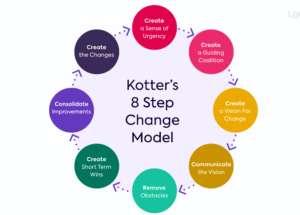
Figure 3: Kotter’s 8 Forces of Change
Source: Laig and Abocejo (2021)
Sense of urgency- Here, need to implement the change is elaborately explained. This is with the management being made aware of their role in the process.
Guiding coalition- A team is initiated with a responsibility of implementing change in the organisation in accordance with earlier identified rationale.
Creating a vision of change- The vision is set which would be to achieve the 4-days working week for example.
Communication- For all the stakeholders, a holistic communication is made for enhancing awareness on the rationale of the process.
Removing obstacles- All the potential barriers of the successful change process are eliminated. This is with the empowerment of the employees in acquisition of relevant knowledge and skills.
Creating short-term wins- The change continuing begin to witness initial gains. These gains are expounded in later phases.
Consolidating improvements- In line with the short-term wins, these are further consolidated to be in large scale for better outcomes.
Creating change– The change is regarded as the organisation norm and as such integrated to the organisation culture. The culture evidence how things are done here which is enhanced successfully.
Application Summary
Considering the Kotter’s 8 Stages model, it can be used in the implementation of the 4 days working with a hybrid arrangement. At the initial phases/process, the best practice would be to create a sense of urgency. This could be noted as the Post COVID-19 pandemic challenges and need for an increased growth. By using statistical data, the creation of urgency would be more profound.
After this, a team made up of experts for IT management, people professionals and experts would be actively engaged to make the decision. The team would be communicated on the target of this change process, supported by the organisation while ensuring any potential hindrance/barrier is mitigated successfully. The 2 days hybrid working strategy would hence be successfully integrated. The improving process of productivity is evidence that quick wins have begun being manifested hence consolidated practices. Eventually, integration of the change which is 2 days working week to the organisation is instrumental and successful.
2.4
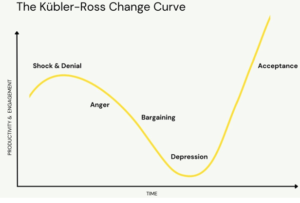
The use of the theory guide change implementation experience manifested by a set of 5 varying manner. In the beginning, Lindblad (2022) had hypothesised the model as having been developed for assisting the people who are going through hard times of grief. Similarly, for people practice professionals under change, the theory is similarly relevance;
Please click the following icon to access this assessment in full
Related to:https://rankedprofessionals.com/downloads/solution-5c001-calmere-house-kirstens-ownership/