(Solution) CIPD New Brief 5CO01 Organisational performance and culture in practice
Solution
Questions
Q1. Evaluate the extent to which the flat non-hierarchical structure was appropriate under Kirsten’s ownership and the extent to which the hierarchical bureaucratic structure is suitable under Chaffinch Group’s ownership. (AC 1.1)
Flat Non-Hierarchical– This organisation structure is less complex structurally as management levels are less. Owing to its simple structure, a seamless engagement is evident amongst the organisation leadership/management and subordinates/followers. In all levels, employees have their input hence participatory decisions made. According to CIPD (2025), this is with collaboration, innovativeness, open-based engagement and commitment enhanced.
Strengths/Advantages and Weaknesses/Disadvantages
For strengths,
Appropriate for small number of workforce– With Kirsten leading, flat structure was most appropriate in Calmere House with 42 full-time staff. For the entire number of staff, Kirsten actively participated in frequent engagements hence a feeling of being of high-value.
Increased commitment– Having the employees feeling appreciated and recognised in decision making, they end up increasing how they are satisfied hence engagement increase. For example, according to CIPD (2025a), involvement of staff in recruiting them prioritise behavioural practices evidencing how qualified they are hence increased commitment.
For the weaknesses,
Inconsistencies and likely compliance challenges– By embracing this structure, it lead to majorly informal relations being in place. By Kirsten receiving the main report, the decisions made is fully relying on her access. This hinder compliance with all decisions to be made.
Lacking scalability– The nature of the organisation is a family business. As such, for Kirsten, it is not possible to significantly increase the relevance of the structure. According to Jamil et al. (2025), this limit success in managing the different issues encountered.
Appropriateness– Considering flat non-hierarchical organisation structure, in Calmere house, it is in alignment with their core mission. This is individualised healthcare provision and empowering staff. Having an enormous engagement in place, the residents are satisfied hence stable and trust-based relations. In line with CIPD (2025b), this facilitates Kirsten a chance for maintain direct engagement with employees with decisions anchored on professionalism and residents demands/expectations.
Hierarchical Bureaucratic– This is a complex organisation structure with immense layers in place. The power is normally flowing in a top-down fashion. According to Jaksa et al. (2021), decision making is not fragmented with policy-based and initiatives guiding active practice. Nevertheless, it is adequately controlled, consistent in implementation and standard-based. It is most appropriate in large-scale entities. The complex nature lower how flexible it is with how decisions are made creating division of top leaders to staff and clients.
Strengths/Advantages and Weaknesses/Disadvantages
For strengths,
Standardised policies and policies implementation– Considering Chaffinch Group, their policies are uniformed and relevant in the different care homes. The outcome is complying and consistently operating core for the large scale organisation (CIPD, 2025b).
High-level accountability– With leadership being centralised, the decision making is accountable to specific individuals. This is with Calmere House organisation being accountable amongst the different management levels.
For the weaknesses,
Lower employees autonomy– Implementation of the organisation structure lead to less autonomy in operations. In particular, Kath Autocratic leadership which alienate employees lead to these issues. According to CIPD (2022), the staff input is eliminated hence dissatisfied, disengaged and retention lowered.
Lack of harmonised culture– With the decisions making majorly from the top, Calmere House impact their cultural practices. The phenomenon is complex owing to the bureaucratic tendencies in place. Further, the residents assume a feeling of being left out owing to ignoring their preference with service-quality diminished.
Appropriateness– Considering Chaffinch Group, it is best for enhancing management of many care homes in demand of controlling and standards set. An elaborate authority structure assists enforcing policy work, performance management and accountable financially in large entity. In line with Fu et al. (2022), this end up facilitating Chaffinch Group in aligning with Calmere House broad mission. The priority is also hedged on consistency in delivering their services and accrued Return on Investment (ROI) in entire structure.
Q2. Analyse how Chaffinch Group could use a rational approach to strategy formulation to ensure that services provided meet customer needs. (AC 1.2)
Area of Improvement in Chaffinch Group– In Calmere House, they have been encountering an operational challenge pitting reduced dissatisfaction of residents. There has been an increased demand for rooms customisation. In past, Residents were interested with leveraging on capability for decorations customisation. With Chaffinch Group leading, refurbishing uniforms is no longer individualised. The negative impact is weakening appealing nature of homes hence residents dissatisfied and departing.
Rational Approach
The rationale of this strategy is Chaffinch Group addressing quality decline by systematically, well-structured and evidence-based decisions made and plans set (CIPD, 2025c). By exploiting SWOT analysis, the issues leading to dissatisfied employees, measurable mission, Vision and alternatives prioritised.
For Chaffinch Group, they could prioritise management of their clients demands. The outcome is the structure managing risks, quality-level made decisions and aligned with areas to be improved based on sustainability.
Analysis of Issue
In line with SWOT analysis, Chaffinch could evaluate strengths including revenues and capacity to refurbish structures. Weaknesses entail de-personalisation with opportunities including differentiation of clients care provision and residents attraction by competitors being major threats.
The outcome of SWOT analysis is identified by CIPD (2025d) as noting core service gaps in failing to prioritise clients preference impacting how satisfied they are and occupancies. Chaffinch end up formulating approaches evidence-based.
Objectives Settings for Clear Goals
For increasing occupancies and residents satisfaction, SMART objectives are relevant. In particular, the SMART objective would be;
In a timeline of 8 months, enhance 95% of all residents offered with customised facilitates to achieve 99% of occupancies increase with good/excellent rating.
The outcome of objective is identified in CIPD (2025c) would be directing, aligning input in varying management scope and progressing hence overall success.
Evaluating Ideas
There are Key Performance Indicators (KPIs) including resources, how feasible and influencing residential satisfied. Also, alignment with entity objectives is a point of evaluation.
In the Décor Packages, standards and individualisation within costs controls is attained. According to CIPD (2025e), a continuous-based feedback opportunities offer sustainable adaptabilities. A well planned evaluation lead to value-based practice for residents parties and organisations hence eliminating reactivity and impracticability.
Pick-up Best Strategies in Decision Making
After successfully evaluating, Chaffinch embrace outcomes of utmost costs-benefit analysis and aligned with organisation mission.
For instance, Décor Package introduced contribute to scaled but personalised approaches. In line with CIPD (2025f), the decision made is normally balancing operations efficiencies amongst the resident-based care service. An address of hoe dissatisfied they are in support of strategies of occupancies increase, financial development and sustainable competition in care.
Strategy Implementation
Success in their embrace vertical and horizontal strategies. In vertical, elaborate sharing of strategy from top management targeting employees lead to consistent relations. In horizontal, CIPD (2025g) identify increased team-work/collaboration in entire care, facilitation and professionals securing buy-ins. Capacity development which target the staff for manging individualised services and inclusion enhanced.
Q3. Analyse one external factor that is currently having a negative impact on the residential care industry and one external factor that is currently having a positive impact on the residential care industry. (AC 1.3)
A Negative Impact Example (Increasing Inflation)
A significant negative factor which affect residential care sector is inflation rates increase hence operation costs surge. In particular, with inflation rising, basic costs for utility, food products and medical care similarly increase all instrumental for the residential care operations.
Also, with inflation costs increasing, purchasing parity is affected pressuring organisation and individuals households. Considering Care Homes, costs accrued to reward employees specifically human resources represent enormous incurred cost. Further, accessing ready capital is a major challenge limiting facilities expansion which has been limiting Décor Selection.
In Stantcheva (2024), Calmere House operates with Kirsten raising issues pertaining to increased utilities management costings interfering with service-quality provision.
Hence, in summary, the inflation costs impact how an organisation is viable and risking quality services provision reduction hence employees dissatisfied and increased resident costs. For a long time, the inflation costs are noted which affect how sustainable and profitable an organisation is.
A Positive Impact Example (Ageing Population)
For ageing population, this positively influence residents satisfaction on their services advanced. This is owing to scope of consistency, sustainable demands for care provision (CIPD, 2025a).
The findings are supported by Government Statistics for elderly identifying by vision 203, approximately 40% of all workforce would be 60 years and more. According to Keating (2022), this broadly influence residential care needs and care for elderly.
The shifting in demographics offer an appropriate change for growth amongst the providers including Chaffinch Group. This is owing to provided opportunities for services expansion for achieving increased needs.
In CIPD (2020), demographics are core for workforce and plan with effective adaptation amongst the change in populations maintaining competitiveness. In Calmere House, the trend evidence opportunity for rebuilding residents foundation through customised service provision as preferred by elderly including individualised rooms and care strategies.
In summary, ageing population could be noted to be long-term leading to maintaining strength for long. Hence, failure to adequately manage this, they would assist care providers to gain financially and at the same time scaled social-based values to support the population requiring immense care.
Q4. Under Kirsten’s ownership of Calmere House, there was little investment in technology. Chaffinch Group want to change this approach and have decided to implement technology to deliver better patient care and employee experience. Assess how technology could be used by Chaffinch Group and how this would impact work at Calmere House. (AC 1.4)
Technologies for Improving Patient Care– An example of a technology which can be embraced in Chaffinch Group hand wearables for detection of vital signs by the residents. These are how they breath, sleeping patterns and cardiovascular wellbeing. The wearables would be donned by the residents are grant on-time alerting them in an event of abnormalities on these trends. The outcome of the technology as identified in Lv and Li (2022) as eliminating falling risks, mitigating any deteriorating health issues. They intervene at an early stages allowing individualised and proactivity in managing care provision.
Impact on Patient Care Work
By successfully introducing the wearables, the scope of patient management would be attained. This is through a reality monitoring an intervening when need arise. In overall, admitted employees to hospital and wellbeing is enhanced. Further, a reassurance for their care providers through the use of technology hence increased Calmere House trust levels.
For demerits, the wearables would be cost intensive to invest on and updating them continuously. According to CIPD (2025c), employees would need to leverage on capacity development with an effective embrace of the wearable’s. This is with a potential of advanced care provision. There similarly prevail a risk of over-relying on technologies and data privacies breached. Cumulatively, identified systems must be well managed with gains outweighing risks with Calmere House Reputation rebuilt.
Technologies for Improving Patient Care– For the sake of improving the staff experiences in Chaffinch Group, people practice professionals is the HR digital platform. This is used for scheduling the employees operations, updating the workplace policy, capacity development and continuous engagement and not relying with current emails sharing from the top-ranked management/admin. The outcome is identified in CIPD (2021) as supporting how they engage all teams, streamlining operations and ensuring employees are adequately guided and inter-connected.
Impact on Employees workplace experience– For the identified technology, the rationale of its use is transformation of staff experiences through a transparent, less confused and morale improved. The employees would clearly be accessing policy, scheduling operations and feedback sourced hence feeling being valued and engaged continuously.
The strategy similarly facilitate improved team-based engagement eliminating Kath autocratic leadership and granting strong employees voice. To licence the digital platform would incur some financial resources, integrating it and capacity development. According to Isa et all. (2021), there would be indirect costs such as managing how they resist the discomfort with the technology. Similarly, people professionals would need to be continuously empowered for initiating well valued culture in Calmere House.
Q5. Using theories and models which examine organisational and human behaviour, explain why problems have arisen following the takeover of Calmere House by Chaffinch Group. (AC 2.1)
Charles Handy Model– Initially established by Charles Handy, it highlight an appropriate organisation culture as being defined with Power, Role, Task and Person.
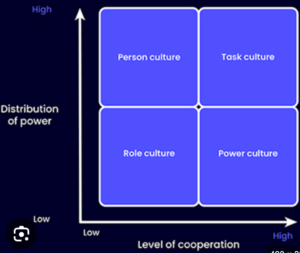
According to Abdala et al. (2021), the people factor in the culture leads to controlling by few people with role culture bureaucracy and formalised. The task culture nevertheless team-based majorly prioritising on how they solve problems and collaborate actively.
The person culture put priority to people autonomy being most important comparative to hierarchical. In CIPD (2025), organisations operates in a specific dominating culture with an opportunity granted for integrating the different aspects. A recommendation is made by the authors of the model that conflicts prevail, disengaged teams and resisting in an event an appropriate alignment of culture and employees goals is lacking.
Application of Charles Handy Model
Please click the following icon to access this project in full
Related to:https://rankedprofessionals.com/downloads/solution-5c001-calmere-house-kirstens-ownership/